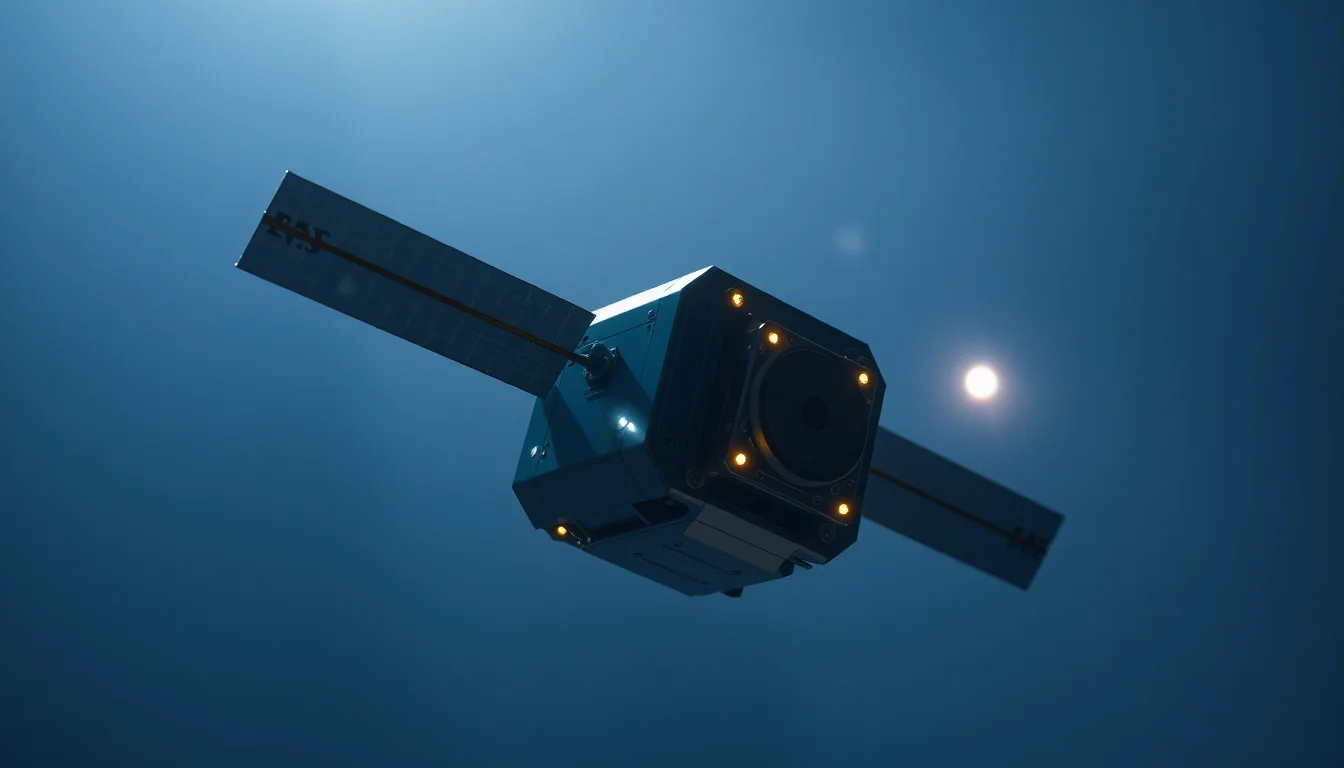
For years, the bottleneck in Earth observation has been less about collecting pixels than interpreting them. Satellites can already gather more imagery than operators can inspect in real time, so the industry’s default workflow has been to downlink data, run it through software on the ground, and let human analysts or batch models decide what matters.
Loft Orbital’s Yam-9 mission just altered that sequence in a meaningful way. In a reported April test, the satellite found what it was looking for on its own, without human analysts on the ground steering the search. According to TechCrunch, that made it the first reported use of a vision-language model in orbit: Google DeepMind’s Gemma 3, running on Nvidia’s Jetson AGX Orin edge hardware, identified areas of interest in response to natural-language queries.
That detail matters. This is not just another onboard inference demo, and it is not merely a classifier running closer to the sensor. A vision-language model sits at a more flexible layer of the stack: it can fuse image understanding with language prompts, which means the satellite is no longer limited to preprogrammed detection rules or fixed labels. In practical terms, that can turn a spacecraft from a passive collector into an active search system.
The hardware choice is just as important as the model. Gemma 3 is described as purpose-built for edge applications, and the Jetson AGX Orin is exactly the kind of constrained compute platform that makes orbiting AI interesting and difficult at the same time. On Earth, the model can be improved with abundant power, cooling, bandwidth, and hands-on debugging. In orbit, every one of those assumptions breaks. Compute is limited. Power is scarce. Thermal margins are tight. And once the satellite is up there, nobody can walk over and patch the machine if the model behaves unexpectedly.
That is why the Yam-9 demo should be read less as a flashy proof point and more as a systems milestone. It shows that a VLM can be made to operate on edge-class space hardware, but it also exposes the real constraint set for future deployments: model size, inference latency, memory footprint, radiation tolerance, fault handling, and the behavior of the surrounding software stack all become part of the product.
The technical upside is straightforward. Onboard target discovery can compress the sensing pipeline. Instead of sending down everything for later inspection, a spacecraft can prioritize what to store, what to downlink, and what to discard. That can reduce bandwidth pressure and shorten the path from capture to decision. In a world where the most valuable asset is often not imagery itself but timely attention to a specific feature on the ground, that is a meaningful shift.
But autonomy also changes where mistakes happen. When a system is only cataloging images on the ground, a false positive is annoying. When a satellite is deciding, in part on its own, what qualifies as an area of interest, a false positive can waste scarce downlink, misdirect operations, or distort downstream analytics. False negatives are worse: if the model misses a critical target, there may be no second chance until the next pass. That means testing has to go beyond benchmark accuracy and into mission-specific validation, edge-case behavior, and failure recovery.
The governance question is not theoretical. Space is an unusually unforgiving environment for opaque decision-making because it combines limited observability with long feedback loops. If a terrestrial AI system makes a bad call, engineers can often trace logs, inspect the inputs, and roll back the model. In orbit, the loop is slower and the consequences are harder to audit. That does not mean autonomous systems should be avoided. It means the burden shifts toward proving what the system can and cannot do, under which conditions it is allowed to act, and what safeguards prevent it from escalating a mistake into a mission problem.
There is also a commercial implication here that is easy to overhype and worth keeping grounded. Onboard AI can reduce ground-ops load and make satellite services more responsive, but it does not automatically rewrite the economics of Earth observation. Adoption will depend on reliability, interoperability with existing mission software, and whether operators trust the system enough to let it influence tasking and triage. A capability can be technically impressive and still remain niche if it is hard to certify, hard to integrate, or too brittle to support service-level commitments.
Still, the direction of travel is clear. The center of gravity is moving upward, from ground stations and analyst desks into the spacecraft itself. As models get smaller, more capable, and easier to run on edge silicon, satellites will increasingly be asked not just to observe, but to interpret. Yam-9 is notable because it suggests that this shift is no longer aspirational.
What happens next will determine whether this was a one-off demonstration or the beginning of a new operational pattern. Watch for broader mission tests, clearer metrics on what “successful” onboard target finding means, and stronger safety frameworks around when an autonomous system is allowed to make a sensing decision. If those pieces mature, this could become a standard architecture for certain classes of space sensing. If they do not, it may remain a useful but constrained experiment in pushing AI closer to the edge.


