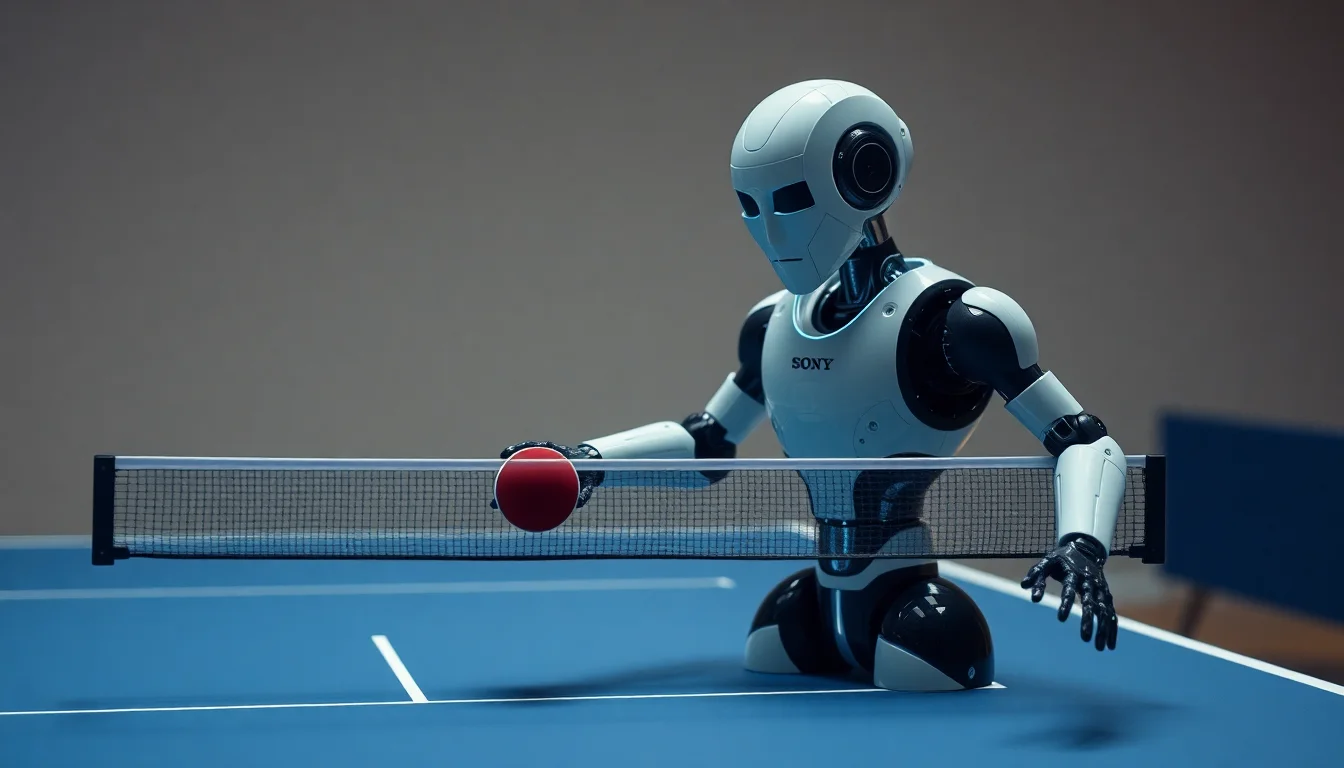
Sony AI’s table-tennis robot, Ace, just crossed a line that matters well beyond the sport itself: it won 3 out of 5 matches against elite players, each with more than a decade of experience and heavy weekly training. That is not a gimmick result. In a high-speed, contact-rich setting where the ball can change behavior on a fraction of a second of spin and paddle angle, Ace demonstrated that a robot can close the loop from perception to action quickly enough to compete with humans who specialize in exactly this kind of fast reflex game.
That is why this looks like an inflection point for robotics. The significance is not that a robot played table tennis. It is that the machine operated in a real environment with noisy inputs, unpredictable returns, and a control problem that punishes hesitation. If a system can track, infer, and respond under those conditions, the same design principles start to look relevant for other time-critical tasks where the world does not wait for a slow planner.
At the same time, the results also define the boundary of the breakthrough. Ace lost both matches against players in Japan’s professional leagues, though it did win a game. That gap matters. It suggests that the system’s perception and reflex loop is credible, but its strategy, adaptability, and long-tail robustness still fall short of what is needed for the most demanding human-level competition — and, by extension, for many production deployments.
What changed and why it matters now
The headline result is simple: Ace beat some of the world’s best players, but not the top professional tier. The deeper change is architectural. Robotics has long struggled when perception and control must operate in a tight feedback loop under uncertainty. Table tennis compresses that problem into a clean test case. The ball arrives fast, the spin is deceptive, and the robot must decide not just where to move, but how to rotate the paddle and shape the return in real time.
That is the part that makes the result interesting for technical readers. Ace is not winning because it has some abstract general intelligence. It is winning because the system can extract enough information from a fast, ambiguous scene to make a useful physical decision before the opportunity disappears. In the paper and related commentary, the emphasis is on the system’s ability to react to pace and spin — exactly the kind of uncertainty that exposes weak control stacks.
The significance, then, is less about the sport than the signal. A robot that can go 3 out of 5 against elite human players in such a narrow time window has crossed into a regime where real-world performance is no longer confined to lab demos. That changes how robotics teams should think about evaluation: not as a single benchmark score, but as evidence that the perception-control loop can survive the physical messiness of deployment.
Architecture that makes the feat possible
Ace’s performance rests on a hybrid sensing stack that combines event-based vision sensors with nine high-speed cameras. That pairing matters because conventional frame-based vision alone can struggle when motion is extremely rapid and the object of interest occupies only a small part of the scene. Event sensors are good at capturing change rather than full frames, which makes them useful for high-temporal-resolution tracking. The cameras add spatial context and redundancy. Together, they give the system a richer view of the ball’s path, spin cues, and paddle interactions.
The design is a reminder that fast robotics is often an integration problem before it is a learning problem. The challenge is not just seeing the ball; it is synchronizing multiple sensor streams, fusing them into a stable estimate, and handing that estimate to a control policy fast enough to matter. In other words, the hard part is the end-to-end pipeline: latency, calibration, timing, and policy robustness.
That pipeline becomes especially important in table tennis because the robot is not merely predicting a trajectory. It has to infer spin and adjust the paddle orientation dynamically. The Conversation’s discussion of Ace rotating its paddle underscores this point: the system is not executing a static return plan, but adapting its paddle motion to the incoming ball. Sony AI’s real-time control work points in the same direction — success comes from designing a system that can keep pace with fast environments, not from relying on a single perceptual trick.
For robotics engineers, the lesson is practical. A good model is not enough if it cannot be synchronized with sensing and actuation at the right cadence. And a fast sensor is not enough if the control policy cannot remain stable under uncertainty. Ace’s architecture works because it treats perception and control as one tightly coupled system.
Where it shines and where it stumbles
The 3-out-of-5 record against elite players is the strongest evidence that Ace’s core loop is more than a demo. Elite players are not trivial opponents; the benchmark matters because it sits at a level of consistent, trained performance rather than casual human play. Winning the majority of those matches suggests that the robot can handle a meaningful amount of variation in pace, placement, and spin.
But the losses in Japan’s professional leagues are just as instructive. These players operate at a different level of consistency, tactical diversity, and pressure. Ace’s partial success there — including a single game win — shows the system can compete in isolated moments, yet not reliably across a full professional match environment. That is exactly where generalization gaps show up: not in clean lab conditions, but in the long tail of weird returns, deceptive placement, and adjustments that human experts make mid-match.
This distinction matters for robotics more broadly. Systems can appear highly capable when tested against a narrow slice of human performance, then break down when the environment becomes less controlled or the opponent more adaptive. In table tennis, that means the robot may have adequate reflexes and tracking, but still lack strategic depth, recovery behavior, or resilience when the exchange diverges from its training envelope.
So the right interpretation is not “the robot almost mastered table tennis.” It is “the robot has shown real-time perceptual competence, but not yet professional-grade robustness.” That is a more useful conclusion for anyone building robots meant to operate outside the lab.
What this means for product roadmaps and deployment
Ace offers a blueprint for fast perception tasks, but not a turnkey recipe for deployment. Teams building real-world robots should pay attention to the pieces that made the system work: event-based vision, multi-camera fusion, and a control stack tuned for tight latency budgets. Those ingredients are especially relevant in domains where the robot must react quickly to moving objects, changing geometry, or dynamic human behavior.
But the result also argues for more disciplined rollout planning. If latency and synchronization are the hidden variables, then benchmark wins on a single task are insufficient. Product teams need phased validation, end-to-end testing, and environment-specific benchmarks that reflect real operating conditions rather than idealized lab scenes. Safety considerations matter too: the faster the control loop, the less room there is for corrective intervention when a policy fails.
That is why deployment readiness should be measured across the full stack, not just by model accuracy. Can the perception system hold up under variable lighting? Does the fusion layer stay aligned when timing drifts? Does the policy behave sensibly when the input distribution shifts? These are the questions that separate impressive demonstrations from systems that can survive contact with production.
Ace’s results also hint at a broader product pattern. For robotics teams, the near-term opportunity may lie in narrow environments where sensing conditions, object motion, and action space are tightly defined. That is where event-based vision and rapid control can create an advantage. But the bar for commercial deployment remains much higher than beating a few strong players in a sport-specific test.
What teams and markets should watch next
The next phase is likely to be incremental rather than dramatic. Expect improvements in perception accuracy, motion estimation, and control latency, along with better calibration across sensors. More important than raw speed, though, will be robustness: how well these systems handle distribution shifts, unusual spins, occlusions, and opponent behavior they did not see during development.
Benchmarks will need to evolve accordingly. If table tennis becomes a reference case for fast-perception robotics, the useful measures will not be just match wins but consistency across opponents, sensor conditions, and deployment constraints. Cross-domain validation will matter as much as single-domain success. A system that can handle a ping-pong rally under one setup is promising; a system that remains stable across varied hardware and environments is deployable.
For the market, the signal is constructive but disciplined. Robotics and AI teams should read Ace as evidence that real-world perception-control stacks are improving in ways that can be productized, especially where speed is a core requirement. But they should also read the professional-league losses as a warning against overextending the result. The hard problems now are not whether robots can react fast in a demo. They are whether those reactions stay reliable when the environment gets messy, the stakes go up, and the system has to perform again and again.
That is what makes Ace notable: not that it played table tennis, but that it exposed both the progress and the remaining engineering burden with unusual clarity.


