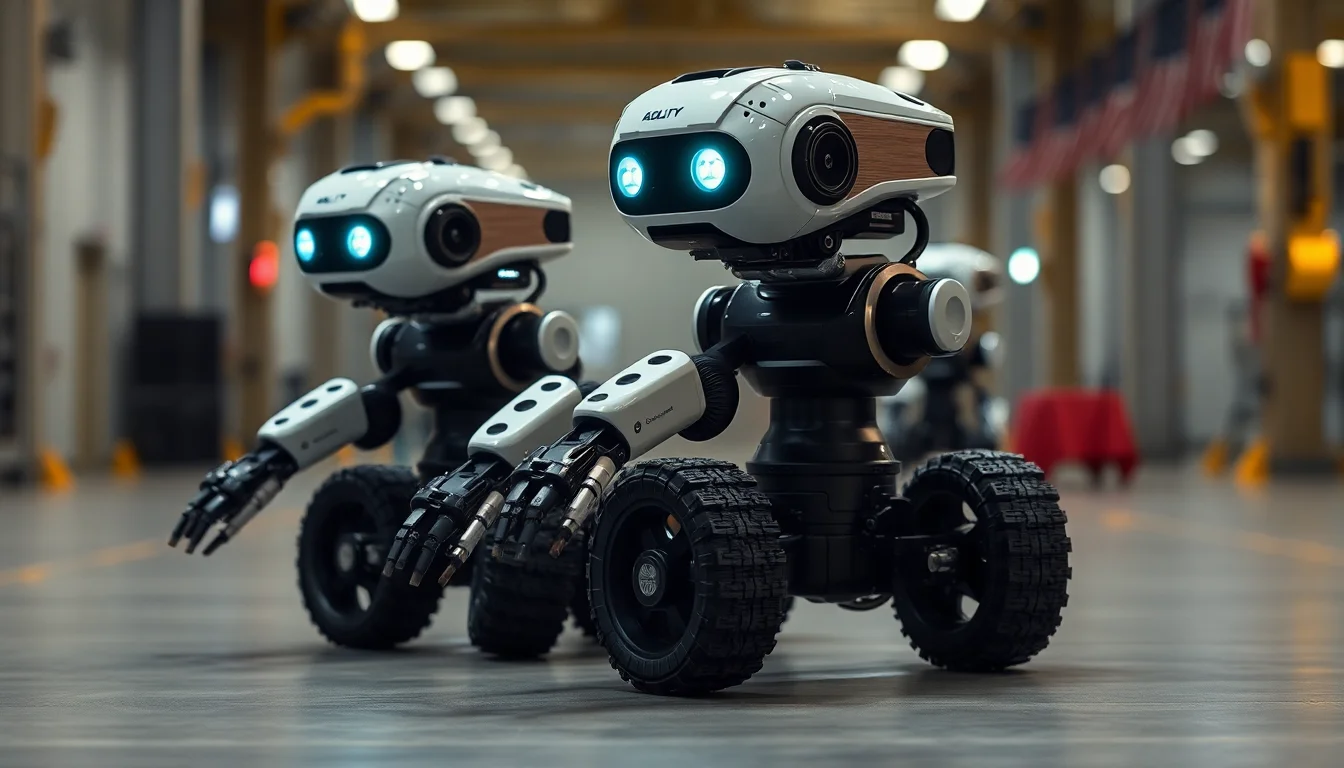
Agility Robotics is taking a direct route to public markets with a Churchill Capital XI SPAC merger that would value the company at roughly $2.5 billion and deliver more than $620 million in gross proceeds. On paper, that is a major financing event. In practice, it is a stress test for a very specific robotics thesis: humanoids are not being sold here as a consumer device waiting to walk into a kitchen, but as industrial machines built for warehouse and factory labor.
That distinction matters because it sets the engineering and commercial bar. Agility’s Digit is designed for heavy lifting and repetitive material handling in logistics environments, where the value proposition is not novelty but reliability: move boxes, tote loads, fit into human-built spaces, and do it safely alongside people and conventional automation. The company’s public-market pitch is therefore less about “general-purpose” robotics than about proving that a humanoid form factor can solve a narrow set of labor problems better than fixed automation or wheeled systems.
The capital raise is significant precisely because the stack beneath that promise is hard to industrialize. A warehouse humanoid is not just a robot arm on legs. It requires a tightly coupled hardware-software system: perception to identify objects and obstacles, sensor fusion to reconcile camera, depth, and proprioceptive data, planning to sequence motions in cluttered spaces, and control loops that can remain stable under changing loads and floor conditions. Those functions increasingly lean on edge inference rather than cloud dependency, because latency, network resilience, and safety constraints do not forgive a remote compute bottleneck on a factory floor.
That makes the software architecture only part of the story. A deployment-grade humanoid must also absorb the realities of manufacturing quality control, calibration drift, maintenance intervals, and field service. If one robot performs well in a controlled pilot but another comes off the line with slightly different tolerances or actuator behavior, the autonomy stack has to be robust enough to handle that variability without constant per-unit tuning. In robotics, scaling the product is often harder than building the demo.
That tension is what makes the SPAC financing so notable. More than $620 million in gross proceeds gives Agility room to push on production lines, customer pilots, and the service infrastructure that industrial buyers expect. But the same capital can also amplify the consequences of weak execution. Humanoid robotics has entered a phase where valuation can race ahead of throughput, yield, and field uptime. Investors may be underwriting a category that eventually becomes important; the near-term question is whether the manufacturing and maintenance systems can mature quickly enough to support that thesis.
Agility is not entering this market in a vacuum. Capital has flooded into humanoid robotics over the past year, with major rounds at Apptronik, Figure AI, and AI2 Robotics underscoring how aggressively investors are pricing optionality in the category. Yet those deals also sharpen the comparison problem. The more money that pours in, the more the market will expect proof that these machines can do more than perform well in staged demos. For warehouse buyers, the relevant metrics are uptime, serviceability, integration with existing workflows, and total cost of ownership versus the labor and automation alternatives already in place.
That is why Agility’s measured messaging stands out. CEO Peggy Johnson is not promising a robot in every home, and she is not framing Digit as a near-term consumer companion. That restraint is strategically important. It keeps the company anchored to a deployment environment where the use case is measurable and the ROI model is at least legible: repeated lifting tasks, predictable routes, structured indoor environments, and supervised human-robot collaboration.
But a narrow focus does not eliminate the risks. The milestones that will matter most after the merger are the ones that translate technical claims into operational evidence: pilot performance in real warehouse conditions, production yield at scale, maintenance response times, safety validation, and integration with warehouse management and logistics systems. If Digit can be deployed repeatedly without bespoke intervention, the company will have something more valuable than a compelling narrative. It will have a scalable product.
If not, the public listing could end up ahead of the industrial reality. In humanoid robotics, money can buy time, talent, and capacity. It cannot buy stable locomotion, dependable manipulation, or a service network that does not yet exist. Agility’s SPAC deal is a big signal that public markets are willing to finance industrial humanoids. Whether they are willing to wait for the engineering to catch up is the question now.


