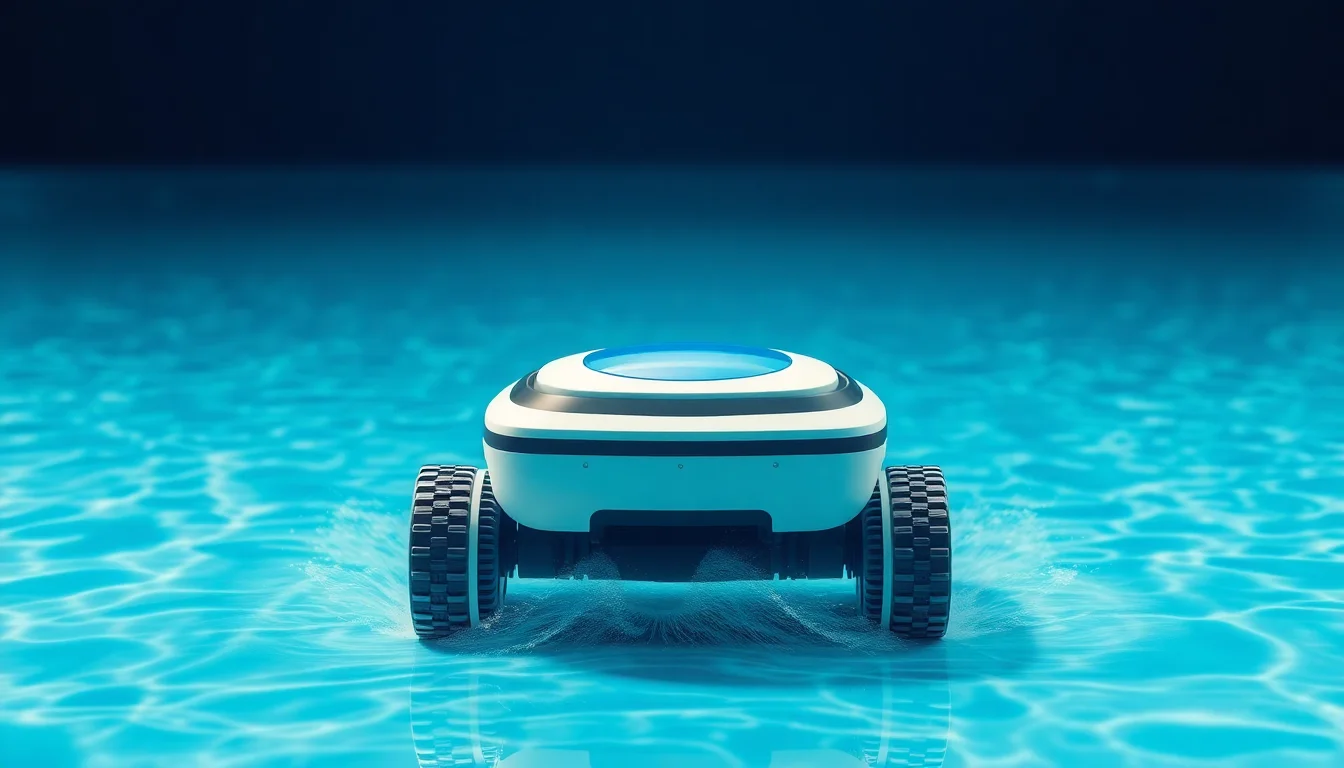
Robotic pool cleaners used to compete on familiar hardware specs: suction, brushes, filter capacity, and runtime. That still matters, but it is no longer the whole story. The real shift is in navigation.
A machine that moves randomly can still collect debris, but it will not reliably understand a pool’s geometry, revisit missed zones efficiently, or adapt when the bottom transitions from a flat basin to a slope, shelf, step, or waterline. AI navigation changes that by turning the cleaner into a compact autonomous system: it senses the environment, builds a working map, plans a route, and adjusts that route in real time as conditions change.
For technical buyers, that shift is important for one reason: coverage quality is becoming measurable in ways legacy designs could not support. Instead of asking only whether a cleaner can pick up leaves, operators can now ask whether it can clean a standard pool with more uniform area coverage, lower revisit rates, and less wasted motion per square meter.
From random motion to geometry-aware cleaning
The older random-walk approach is simple and cheap, which is why it persisted for so long. But random motion has a built-in penalty: it spends energy re-covering already cleaned areas while leaving edge cases under-served. In a rectangular pool, that may be tolerable. In a pool with steps, ledges, curves, benches, and a varied waterline, it becomes a liability.
AI navigation addresses that by combining several functions that used to be separate or absent altogether:
- Sensing: onboard cameras, sonar, infrared, inertial sensors, wheel encoders, or pressure-based inputs help the robot infer where it is and what surface it is crossing.
- Mapping: the robot builds a usable representation of the pool, even if that map is approximate, and uses it to identify regions already cleaned and regions still pending.
- Path planning: instead of bouncing until coverage accumulates, the cleaner follows a structured sequence that can prioritize high-traffic or hard-to-reach zones.
- Real-time control: when traction changes, the floor tilts, or the robot encounters a step or ledge, the navigation stack can re-plan rather than continue blindly.
That matters most at geometric boundaries. Steps and ledges are not just obstacles; they are coverage discontinuities. Waterlines are another recurring problem because debris accumulates where the surface meets the wall, but a random route may touch that band inconsistently. A cleaner with geometry awareness can assign those zones explicit treatment rather than hoping repeated passes eventually get there.
The practical result is not just better cleaning, but more predictable cleaning. Predictability is what turns a consumer appliance into a system that can be specified, benchmarked, and sold on operational performance.
What AI navigation actually changes in the stack
The best way to think about these cleaners is as a hardware-software co-design problem. The navigation layer cannot be bolted on after the fact without tradeoffs.
A more capable robot usually requires:
- Better sensor fusion, so the machine can reconcile noisy signals in a wet, reflective, chemically aggressive environment.
- Onboard compute, which adds power draw and thermal management requirements.
- Firmware robustness, especially for SLAM-like state estimation, odometry correction, and edge-case recovery.
- Better control loops, so motion decisions reflect traction, battery state, and local geometry rather than a fixed pattern.
That architecture creates a real product distinction. Two cleaners with the same brush system and suction motor can produce very different outcomes if one can infer the layout of the pool and the other cannot.
A useful way to frame the performance delta is through deployment metrics, not adjectives. In a hypothetical but realistic side-by-side test on a 40-by-20-foot residential pool with a shallow entry, a deep end, two steps, and a raised bench, a random-pattern cleaner might reach 70% to 80% area coverage after a full cycle, with repeated passes concentrated in the central basin. An AI-navigated unit, by contrast, could target 90% to 95% coverage with fewer redundant traversals, particularly if it treats the waterline, steps, and shelf as named zones rather than incidental surfaces.
That kind of outcome should not be read as guaranteed industry data. It is the kind of result manufacturers would need to document through controlled field testing, ideally across multiple geometries and debris loads. But it shows why navigation is becoming the performance story.
A field-study lens: what better navigation would look like in practice
If a manufacturer wanted to prove the value of AI navigation, a credible trial would need more than a before-and-after video. It would need a protocol.
Imagine a pilot across 30 pools divided into three categories: simple rectangular pools, multi-depth pools with steps and benches, and irregular pools with curves and ledges. The test could measure:
- Coverage uniformity as the percentage of the floor and wall zones cleaned to a target threshold.
- Time-to-clean by zone so operators can see whether the robot consistently reaches steps and waterlines early enough to matter.
- Dwell time per area to detect whether the robot is overworking some regions while neglecting others.
- Energy per square meter to show whether structured routing reduces wasted motion.
- Failure rate per cycle including stuck events, missed-zone events, and aborted runs.
A plausible hypothetical result might look like this: compared with a legacy random cleaner, the AI-navigation unit reduces cleaning time by 10% to 20% in the average pool while improving coverage in complex geometries by 15 points or more. Energy use might fall from roughly 0.08 to 0.10 kWh per cycle to about 0.06 to 0.08 kWh for equivalent area coverage, depending on pool size and debris load. Dwell time near steps, ledges, and waterlines would likely increase, but that is a feature, not a bug, if those zones are the ones most likely to be missed.
Those numbers are illustrative, not a published benchmark. The key point is that AI navigation gives manufacturers a measurable basis for product claims. Without that layer, the only thing left to optimize is brute-force motion.
Product rollout: why the market will split on navigation quality
For manufacturers, the opportunity is obvious, but so is the risk. Better navigation is not free.
Adding sensors, compute, and firmware sophistication can raise bill of materials cost, increase assembly complexity, and create new reliability concerns. In a submerged, chlorinated environment, even small weaknesses in sealing, connector design, or thermal control can become support problems later. A cleaner that performs well in the lab but degrades after repeated exposure to heat, chemicals, and fine sediment will not hold up in the field.
That means rollout strategy matters as much as algorithm design.
Some vendors will likely position AI navigation as a premium feature for larger pools, complex geometries, and high-expectation residential buyers. Others may sell it through service providers or pool management firms that can value reduced labor and better SLA consistency. In both cases, the product pitch shifts away from raw cleaning power and toward operational reliability: fewer missed spots, less manual intervention, and more consistent results across pool types.
This also changes what manufacturers must prove. Traditional specs such as suction rate or runtime remain relevant, but they are not enough if the robot cannot demonstrate structured coverage. The competitive question becomes: can the system explain where it has been, where it has not been, and how it adapts when the environment changes?
That is a higher bar, and it likely favors companies willing to invest in software, not just hardware.
The new risk surface: autonomy in a hostile environment
AI navigation also introduces a different set of deployment risks.
First, there is maintenance complexity. More sensors and a more capable control stack mean more things that can drift, fail, or require calibration. Second, there is durability risk. The environment is wet, chemically aggressive, and often full of fine debris that can interfere with housings, moving parts, and optical surfaces. Third, there is operational transparency. If the robot is making decisions in real time, owners and service providers will want to know why it missed a section or stopped short of a deep-end wall.
There is also a data question. If the machine stores maps or logs cleaning behavior, manufacturers need clear policies around retention, updates, and access. That is not just a privacy issue; it affects trust and supportability.
For technical buyers, the practical takeaway is that AI navigation must be judged as a system-level tradeoff. A cleaner that gains 15 points of coverage in a complex pool may also bring more maintenance overhead, higher upfront cost, and longer service cycles. Whether that is worth it depends on the pool type, the frequency of use, and the economics of missed cleaning.
What to monitor
Readers evaluating these systems should track a small set of deployment metrics rather than relying on feature lists:
- Coverage uniformity: how evenly the robot covers floor, wall, step, and waterline zones.
- Time-to-clean by zone: how quickly the robot reaches high-value areas such as steps and ledges.
- Dwell time per area: whether the robot over-serves one region while neglecting another.
- Energy per square meter: a cleaner route should reduce wasted travel.
- Failure rate per cycle: stuck events, aborted runs, missed-zone events, and recovery failures.
- Post-cycle manual touch-up time: perhaps the most honest metric of all, because it captures the labor the robot still leaves behind.
If AI navigation is working, these numbers should improve together. Better mapping should raise coverage uniformity. Better planning should reduce energy per square meter. Better real-time control should lower failure rates in pools with steps, benches, and nonstandard geometry.
That is why this shift matters. The category is moving from “can it clean?” to “can it understand where it is, decide where to go next, and do that reliably in a wet, messy, irregular environment?” That is a much harder problem, but it is also the one that will define the next generation of robotic pool cleaners.


