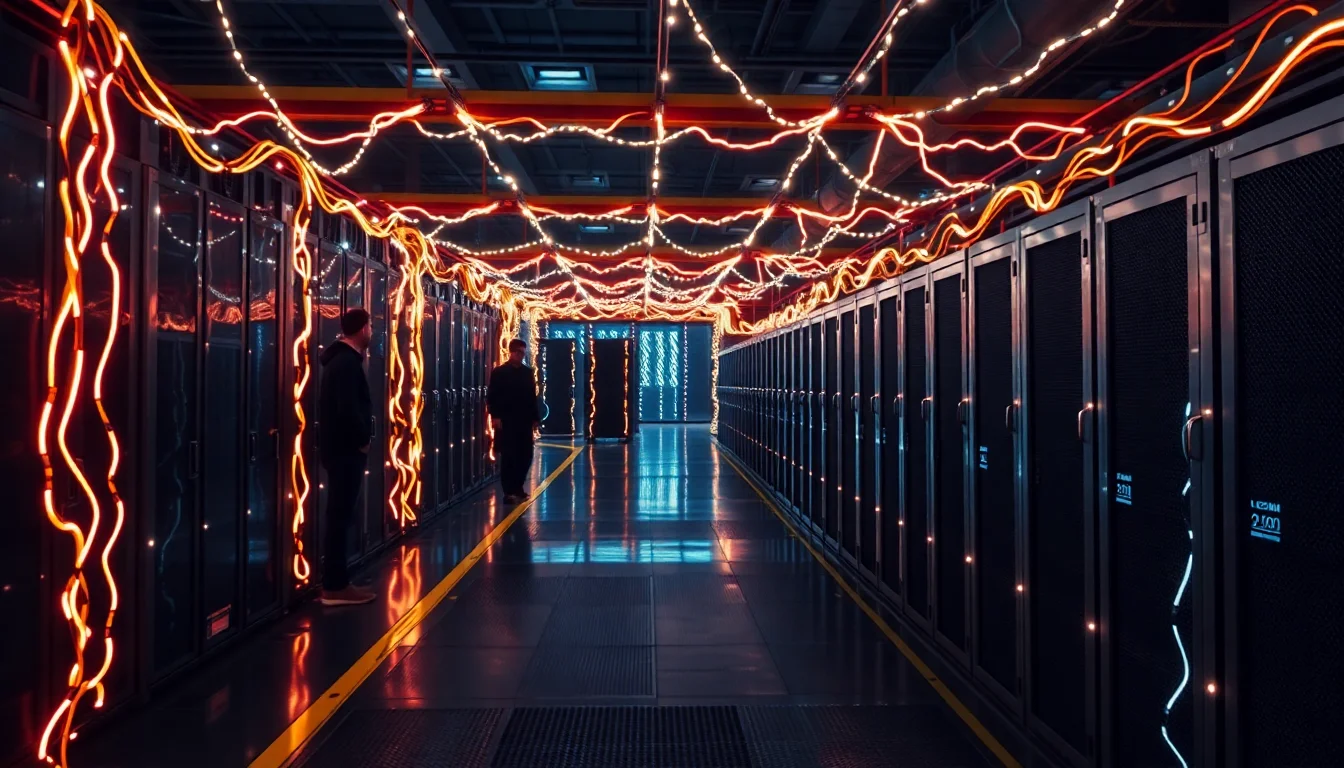
Anthropic’s reported decision to run Claude on SpaceX’s Colossus-1 is the kind of infrastructure move that changes the reference frame. This is not another expansion inside a conventional hyperscale cloud region, where capacity is leased in slices and abstracted behind a multi-tenant control plane. The reported setup puts Anthropic on the entire facility: Colossus-1, with more than 220,000 NVIDIA GPUs and over 300 MW of power, expected to come online within weeks.
That scale matters because it is not just about “more GPUs.” A full-facility deployment changes what the system can optimize. At this density, the problem shifts from procuring compute to orchestrating a giant, tightly coupled machine. Interconnect design, scheduling strategy, power distribution, cooling headroom, and failure isolation all become first-order constraints. For teams building on top of Claude, the practical implication is that the model’s performance envelope can move in ways that are hard to achieve in a conventional shared cloud environment.
The immediate user-facing signal is that Claude Opus API rate limits are rising. According to the reported changes, input and output token ceilings are increasing sharply across tiers, with some limits rising by an order of magnitude or more. Claude Code usage limits are also set to double within a month for Pro, Max, Team, and Enterprise customers, while peak-time throttling for Pro and Max accounts is being removed. In operational terms, that means larger prompts, higher sustained throughput, and fewer artificial bottlenecks for users who have been bumping into rate ceilings.
For developers, the upside is obvious. Higher limits make it easier to run longer context windows, batch more work into a single workflow, and push agentic systems harder without immediately fragmenting them into retry logic and queue gymnastics. But the architectural consequences are more nuanced. When throughput rises this steeply, so does the need to revisit concurrency controls, token budgeting, backpressure, and fallback behavior. If you have built pipelines around conservative assumptions about rate ceilings, the new regime can expose hidden failure modes: runaway cost, bursty load amplification, or brittle retry storms when downstream systems cannot keep up.
The compute stack itself deserves attention. A facility with 220,000 NVIDIA GPUs and 300 MW of power is likely to force a very different topology than the one most production teams are used to reasoning about. At that size, model-parallel and pipeline-parallel strategies stop being abstract design choices and start becoming load-bearing decisions. The economics of data movement, not just raw FLOPs, become central. Latency budgets can improve when the model is kept close to the compute fabric that serves it, but only if the surrounding systems are engineered to avoid coordination overhead and hot spots.
That is why this deal reads as more than a capacity announcement. It hints at a new deployment philosophy in which model quality, serving architecture, and physical infrastructure are negotiated together. Anthropic can use the Colossus-1 footprint to support more aggressive service levels, but the company also inherits the operational characteristics of a giant single-site environment. If the facility is doing the heavy lifting, then topology, failover, maintenance windows, and incident response are no longer background concerns. They are the product.
SpaceX’s role is just as interesting. Colossus-1 is being described here not as a generic colocation site, but as the backbone for a high-intensity AI workload. That puts SpaceX in a position that looks less like a traditional cloud provider and more like a critical infrastructure operator for frontier AI. The leverage implications are hard to miss. A single facility of this size can influence pricing, availability, and how much optionality a model provider has when negotiating around expansion, power, and delivery timelines.
For Anthropic, there is obvious upside in securing this much dedicated capacity. It reduces some of the chronic scarcity that has defined the frontier model market, and it may let the company ship a more responsive product at a scale that would be expensive or slow to replicate across fragmented environments. But concentration cuts both ways. The more Claude depends on one facility, the more a single-site outage, supply interruption, or regulatory complication can ripple through customer workflows.
That is the paradox at the center of this move. Facility-scale compute can make AI feel cheaper and faster to use, because the provider can absorb larger bursts of demand and raise limits across the board. Yet the same concentration increases exposure to energy costs, physical resilience risks, and vendor dependence. The system becomes more capable and more fragile at once.
Read that as a prompt for architecture reviews, not a footnote. If you are running production workloads on top of Claude, this is the moment to revisit your assumptions about SLOs, rate limiting, and failover strategy. If you are watching the market, it is a sign that frontier AI is moving toward infrastructure arrangements that look less like elastic software and more like power-intensive industrial plants.
The next questions are the ones that usually determine whether a scale story becomes a durable operating model: what contingency exists if the facility slips, what energy sourcing backs sustained load, how transparent the SLA structure is, and how much of Claude’s performance profile is now tied to one physical place. The reported Colossus-1 deployment suggests those questions are no longer theoretical.


