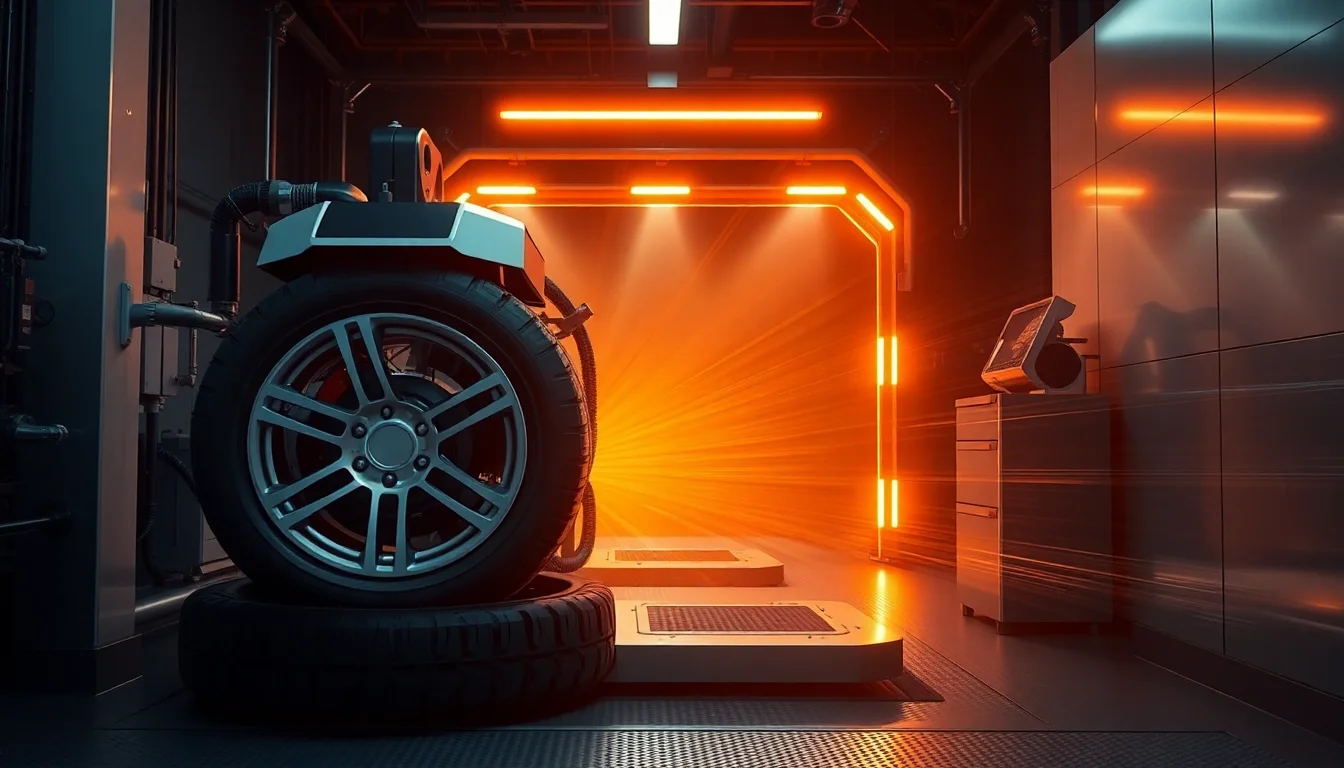
Automated Tire, Inc. has emerged from stealth with SmartBay, a robotic service platform aimed at one of the least digitized parts of automotive operations: the tire bay. The company says the system is designed to automate tire changes, wheel balancing, and vehicle inspections for dealerships and tire centers, using robotics, computer vision, and machine learning to decide how to execute each job in real time rather than following a fixed script.
That distinction matters. In practice, tire service is full of edge cases: mismatched wheel hardware, corroded fasteners, damaged sensors, nonstandard aftermarket rims, variable torque requirements, and vehicles that do not present in clean, repeatable ways. A robot that can only handle the happy path is a lab demo. A robot that can operate across the long tail of vehicle variation is a workflow product.
Automated Tire’s pitch for SmartBay is clearly aimed at that second category. The company describes the system as “understanding, adapting and executing complex physical tasks in real time,” which implies more than automation theater and less than full autonomy in the broad AI sense. The most useful way to read the claim is as a perception-to-action stack: vision identifies the vehicle, the wheel assembly, and the relevant service state; planning software selects the task sequence; actuators execute; sensors verify; and exceptions trigger human intervention.
What is missing from the public announcement is just as important as what is included. There are no disclosed uptime figures, cycle-time benchmarks, defect rates, or audited field results. Without those, any claim about ROI remains provisional. For a dealership or tire center, the economic case will hinge on whether SmartBay can do three things reliably: reduce labor time per bay event, maintain quality under variation, and avoid expensive downtime when the system encounters an unfamiliar vehicle or a degraded component.
A skeptical operator will want to know where the system sits on the shop floor and what it replaces. If SmartBay is installed as a dedicated automation cell, the integration burden is lower but throughput gains may be constrained by ingress, staging, and queue management. If it is expected to slot into an existing bay layout, then the robotics envelope has to tolerate mixed vehicle heights, wheel sizes, lighting conditions, and the daily improvisation that defines service operations. That is before you get to the human workflow: check-in, work-order assignment, parts availability, inspection signoff, and customer communication.
For target customers, Automated Tire is not just selling hardware. It is selling a new operating model for dealerships and tire centers, where the bay becomes a software-instrumented node rather than a technician-only workspace. In concrete terms, that means the platform will likely need to tie into the shop’s scheduling system, inventory database, and service management software. A typical flow would start with a work order in the dealer management system or shop management system, pass through an API layer that exposes vehicle VIN, tire size, service history, and appointment metadata, and then feed SmartBay’s perception and planning stack. After the job, the system would write inspection results, torque confirmation, balancing data, and exception flags back into the service record.
That integration story is where many robotics deployments get harder than the pitch deck suggests. The software surface area includes not just robot control but identity resolution, part compatibility checks, calibration tracking, and logging for warranty or compliance review. If a wheel sensor is detected during inspection, or if the platform flags corrosion, stripped lugs, or an out-of-spec tire, the system needs a clean handoff path to a technician. In other words, the fallback procedure is part of the product, not an afterthought.
The real-time claim also deserves precision. In a production setting, “real time” should mean a bounded latency from perception to action, a defined tolerance for calibration drift, and a safe failure mode when confidence drops below threshold. If the vision model can identify wheel geometry in a few hundred milliseconds but the control loop takes longer to resolve an ambiguous fastener pattern, the machine’s useful autonomy is narrower than the marketing language suggests. The hard part is not showing that the robot can work once; it is sustaining decision quality across the long tail of vehicle configurations, lighting changes, worn hardware, and sensor noise.
That is why safety and compliance are central, not optional. Tire service involves heavy loads, spinning equipment, pinch points, torque-critical fasteners, and the possibility of wheel or jack failure. Any deployment will need physical guarding, interlocks, emergency stop coverage, calibration checks, logged maintenance intervals, and a formal exception workflow. In many shops, the gating issue will be whether the platform can demonstrate that it degrades safely: stopping motion when perception confidence falls, isolating the vehicle, and handing off to a human without creating a new hazard.
There is also the regulatory layer. Even if the system does not face a single universal certification regime, it still has to fit into local workplace safety rules, insurance expectations, and OEM service requirements. That means audit trails matter. A manager will want a record of which service steps were automated, which were manually overridden, what sensors were active, and whether the system was within calibration at the time of service.
From a market standpoint, SmartBay lands in a workflow that has been labor-intensive, margin-sensitive, and difficult to standardize. That gives Automated Tire a potentially attractive wedge. If it can prove consistent execution in a narrow but high-volume service lane, the platform could pressure incumbent labor models and force competitors to think in terms of data-driven automation rather than technician discretion alone. But the first mover advantage in physical AI is fragile; the winner is usually the one that survives variability at acceptable cost, not the one that sounds most futuristic.
Independent analysts would likely frame the opportunity the same way a cautious shop owner does: show me the cycle time, show me the error rate, show me the maintenance burden, show me the payback period, and show me the failure mode. Absent published numbers, the most defensible assumption is that early deployments will be narrow, supervised, and tuned for a specific vehicle mix rather than broadly autonomous.
The edge case is easy to imagine. A dealership receives an SUV with oversized aftermarket wheels, uneven lug wear, and a partially damaged tire pressure sensor. The bay is busy, lighting is imperfect, and the appointment is already behind schedule. In that moment, SmartBay either recognizes the variation, flags the job, and routes it to a technician with a structured exception report, or it becomes another expensive automation asset sitting idle while a human clears the bottleneck. That is the operational test that matters.
Automated Tire’s emergence from stealth is therefore less about a single product launch than a referendum on whether AI can be made useful in a setting that punishes brittleness. SmartBay’s value proposition is strongest where service work is repetitive but not identical, where software can capture patterns without pretending the real world is standardized. If the company can document stable uptime, safe fallback behavior, and clean integration with dealer and tire-center systems, it will have something more meaningful than a robotics demo. It will have evidence that real-time vehicle-specific execution can actually be run as a business.


