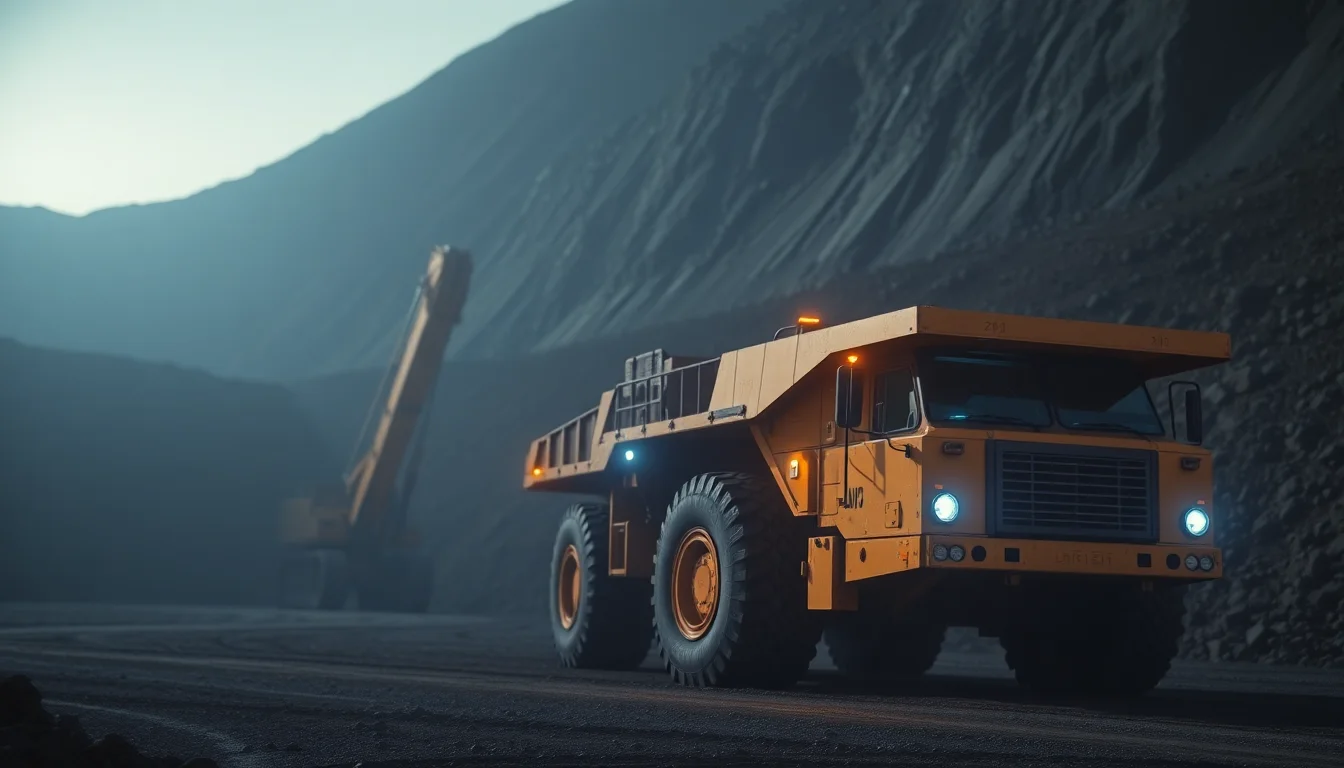
Autonomous mining has crossed a threshold. What used to be a showcase technology — a handful of trucks on a fenced test route, a robotic excavator in a controlled demo — is increasingly the operating baseline in large open-pit sites. The latest wave of equipment from Caterpillar, Komatsu, Hitachi, and Terex is not being sold as experimental machinery; it is being positioned as mature, AI-enabled production hardware designed to run in harsh, continuous-duty environments.
That matters because the competitive question has changed. The issue is no longer whether machine vision, control software, and fleet orchestration can work in a mine. The issue is whether operators can keep autonomous fleets online across shifts, sites, and geographies when availability depends on spare parts, software integrity, and a maintenance model that looks more like a distributed computer system than a conventional heavy-equipment workshop.
The stack behind autonomous mining is now the product
The enabling architecture for autonomous mining is becoming clearer. Intelligent excavators and driverless trucks rely on a layered stack that combines control modules, robotic operating systems, sensor fusion, edge compute, and over-the-air update protocols. These systems translate raw inputs from cameras, radar, lidar, GPS, inertial sensors, and machine-state telemetry into route following, load handling, obstacle detection, and fleet coordination.
That stack changes the failure model. In a conventional machine, a hydraulic fault or drivetrain issue tends to be visible and local. In an autonomous fleet, a degradation in sensor calibration, an edge-compute failure, a version mismatch in firmware, or a corrupted update package can ripple across multiple assets. Uptime is therefore not just a mechanical reliability problem; it is an integration problem.
Standardization becomes central at that point. The more consistent the control interfaces, replacement modules, and diagnostic tooling are across machine families, the easier it is to keep fleets running without turning every service event into a bespoke engineering task. The article’s underlying point is not that autonomy eliminates maintenance. It is that it moves maintenance up the stack, into systems engineering, software release management, and parts governance.
Safety gains are real, but the ROI story is more operational than promotional
The clearest benefit remains safety. Removing operators from cabs in high-risk sections of the mine reduces direct human exposure to dust, vibration, heat, rockfall, and collision risk. Autonomous haulage and robotic excavation also improve consistency: machines do not tire, do not drift in behavior over a shift, and can keep operating in conditions where a human-centric workflow would slow down or stop.
Productivity gains follow from that consistency. Autonomous fleets can tighten cycle timing, reduce idle variation, and support around-the-clock operation with less dependence on shift handoffs. But the economics are not simple enough to treat as a universal ROI formula. The payback case depends on the stability of the parts pipeline, the cadence of preventive maintenance, the quality of the data feeds, and how much site-specific integration is required before a fleet behaves predictably.
That is especially true once a mine moves beyond a pilot and starts scaling across multiple pits or regions. At pilot scale, a vendor can often absorb exceptions and patch around failures manually. At operational scale, those exceptions become cost centers. Lead times for critical spares, the availability of trained service teams, and the reliability of remote diagnostics start to shape realized uptime just as much as the autonomy software itself.
Spare parts are becoming a strategic dependency
The emphasis on mining machinery parts in this new phase is not a footnote; it is a core dependency. Intelligent excavators and driverless trucks are only as resilient as the ecosystem that supports them. That includes actuators, controllers, sensor modules, harnesses, brake systems, power electronics, and the specialized parts needed to maintain autonomous subsystems as well as the base machine.
For operators, parts availability now functions as a scaling constraint. A mine can buy the most advanced autonomous fleet in the market, but if replacement modules have long lead times or if a site lacks standardized inventory for common failure points, the fleet’s theoretical productivity never fully translates into delivered output. The same applies to cross-site operations: moving identical machines across geographies is much easier when the spare-parts architecture, diagnostics, and service contracts are harmonized.
For suppliers, this creates a more durable but less forgiving business. Spare parts, field service, remote support, and software maintenance are no longer ancillary revenue streams. They are part of the operational promise. That increases the value of vendors that can combine machine platforms with a deep support ecosystem, and it penalizes platforms that are technically capable but operationally brittle.
OTA updates and cybersecurity are now part of mine safety
The move to driverless fleets also raises the stakes for over-the-air updates. OTA is not just a convenience feature for pushing new capabilities; it is the mechanism by which autonomy stacks are patched, tuned, and kept compatible across versions of software, sensors, and site control systems. In a mine running multiple autonomous assets, update discipline matters. Poorly staged updates can create fleet fragmentation, where different machines run different software baselines and behave inconsistently.
That creates a direct cybersecurity issue. Autonomous mining fleets are connected systems with remote management pathways, onboard compute, and communications links that must be protected against tampering, unauthorized access, and software integrity failures. The more the operation depends on remote orchestration and data exchange, the more cyber hygiene becomes part of operational continuity.
The practical implication for operators is clear: treat OTA governance, access control, logging, patch verification, and incident response as production requirements, not IT side work. A fleet that cannot safely receive updates at scale will accumulate technical debt quickly. A fleet that can be updated but not secured becomes a moving target.
The vendor landscape is maturing, but differentiation is shifting
Caterpillar, Komatsu, Hitachi, and Terex are all pushing mature AI-enabled mining equipment, and the convergence across the leading brands is notable. The market is no longer defined by one vendor proving autonomy is possible. It is defined by how each vendor packages reliability, integration, and lifecycle support.
Caterpillar and Komatsu bring scale, broad installed bases, and tightly integrated machine platforms. Hitachi has advanced large excavator offerings, while Terex participates with haulage platforms that extend the autonomy conversation beyond one equipment class. Across the group, differentiation is moving away from feature announcements and toward ecosystem depth: how well the machines integrate with mine planning systems, how quickly parts move, how consistently software is maintained, and how open or closed the interfaces are for fleet management and third-party support.
That matters because the next phase of competition may be less about raw autonomy and more about lock-in risk. Mines that adopt a vendor’s control stack, telematics layer, and parts channel may gain efficiency, but they also inherit dependence on that vendor’s update cadence, service quality, and interface philosophy. If standards lag, fragmentation rises. If parts and software are tightly controlled, operational consistency may improve while flexibility declines.
What operators and suppliers should watch next
The signals to track are concrete. First, watch OTA cadence: how often fleets receive updates, how updates are staged, and whether vendors publish enough version discipline to keep mixed fleets stable. Second, examine data governance: who owns the telemetry, where it is stored, how it is used for maintenance prediction, and whether site teams can access it in a usable form.
Third, test cybersecurity posture against operational reality. Can the fleet be patched without extended downtime? Are remote access channels segmented? Are update packages verified before deployment? Those details will separate robust deployments from fragile ones.
Fourth, monitor spare-parts lead times and local service capacity. Autonomous mining is only scalable if the replacement ecosystem scales with it. A fleet that is easy to procure but slow to repair will not hold up under continuous-duty economics.
The broader message is that AI-enabled mining equipment is now mature enough to be mainstream, but maturity creates new dependencies rather than removing them. The winning operators will not be the ones that merely buy autonomous trucks. They will be the ones that build the parts, software, and governance systems needed to keep those trucks productive across time, distance, and disruption.


