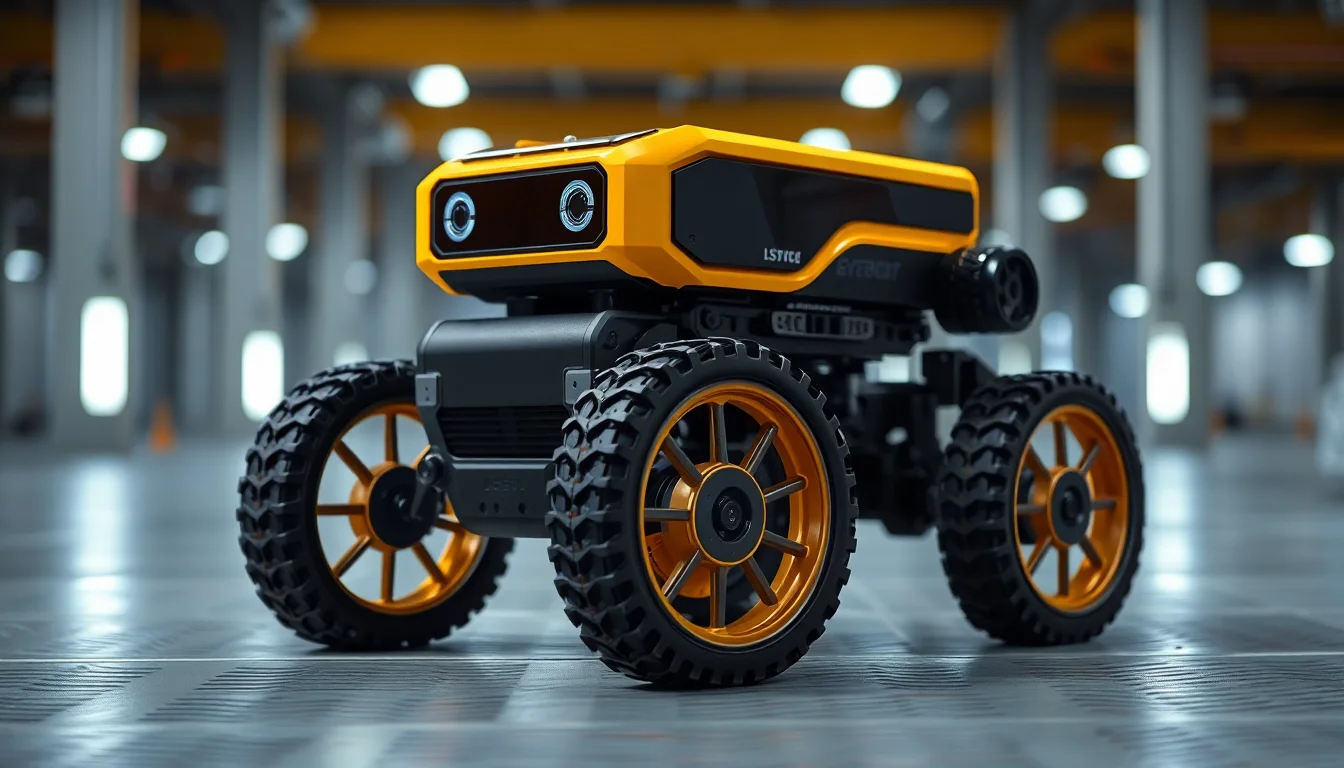
Deep Robotics’ Lynx M20S is not just a stronger version of its predecessor. The launch points to a broader change in what wheeled-legged robots are being asked to do in industrial settings: carry more, survive harsher environments, and make balancing decisions on the fly rather than relying on fixed motion patterns.
The headline numbers are material. Deep Robotics says the M20S lifts payload capacity to 35 kg on flat terrain, a 233% increase over the previous generation, while also improving protection and speed. In practical terms, that moves the platform closer to a deployable field robot for industrial inspection and emergency response workflows, rather than a niche mobility demonstrator.
Why the architecture matters
The most consequential element of the M20S is not the payload figure on its own, but the control stack behind it. Deep Robotics describes a self-developed AI motion control algorithm that can adjust posture in real time and dynamically match gait to terrain. That is an important distinction for a class of robots that has to bridge two difficult modes of locomotion: rolling efficiently when the ground permits, and stepping or rebalancing when the surface turns irregular.
In an industrial context, that kind of terrain-aware control is what separates a robot that can occasionally traverse a rough site from one that can be integrated into a repeatable workflow. Power plants, substations, rail corridors, and disaster zones rarely offer clean, predictable surfaces. A motion-control loop that continuously updates posture and gait based on terrain feedback can reduce the manual intervention needed to keep the robot upright and operational, especially in the kinds of mixed environments Deep Robotics is targeting: rugged mountain roads, muddy wetlands, debris fields, and steep staircases.
That said, real-time adaptation is only one layer of the system. For operators, the question is whether the algorithm remains stable under sensor noise, intermittent connectivity, changing payloads, and degraded conditions that are common in the field. The promise is not just mobility, but mobility that can be trusted repeatedly enough to support inspection routes, patrol schedules, and emergency response procedures.
What the performance gains unlock
The jump to a 35 kg flat-terrain payload is the clearest operational upgrade. In practice, payload determines what a robot can actually do once it arrives on site. Higher capacity can mean additional inspection instrumentation, communications gear, on-board computing, thermal sensing packages, or tools required for response tasks. It also gives teams more flexibility when they need to balance autonomy with teleoperation hardware and redundant safety systems.
The 233% uplift over the prior generation matters because payload improvements at this scale often change the deployment category entirely. A lighter platform can be limited to observation and data capture. A heavier one can begin to carry mission-specific modules without forcing operators to trade away endurance or mobility in the process. The M20S appears aimed at that middle ground: enough load-bearing capability to support useful payloads, while still preserving the agility associated with wheeled-legged locomotion.
Protection improvements are equally important, though harder to quantify from the launch material alone. For robots entering hazardous environments, ruggedization affects uptime, not just survivability. Better protection can reduce the likelihood that dust, water, shock, or debris will take a platform out of service after a single mission. In industrial operations, that can matter as much as top speed. A robot that arrives quickly but requires frequent recovery or repair will usually underperform a slower system with better availability.
Where the M20S fits in real operations
Deep Robotics is positioning the M20S for industrial inspection and emergency response, with specific scenarios including power inspection, security patrols, and emergency firefighting. Those are sensible targets for a platform that blends wheel efficiency with legged adaptability.
For power inspection, the value proposition is access. Robots that can traverse stairs, uneven access roads, and debris can reduce the need for human crews to enter dangerous zones during initial assessments. In security patrols, terrain adaptability can extend coverage to locations that are expensive or unsafe to monitor continuously with fixed infrastructure or wheeled robots alone. In emergency firefighting, the robot’s role is likely to be reconnaissance and situational awareness rather than direct suppression, but that still matters: terrain-capable systems can help teams map hazards before sending people in.
The deployment implication is that the M20S is not a generic mobile platform. It is a platform that has to be matched to a specific operational doctrine. If a site already uses inspection drones, fixed cameras, and wheeled ground robots, the M20S only adds value if it can handle terrain and payload combinations those systems cannot. Otherwise, the incremental benefit may not justify the added complexity.
Ruggedness helps, but lifecycle costs still decide the business case
Industrial robotics buyers rarely evaluate a system on performance alone. They evaluate it on availability, serviceability, and the total cost of keeping it mission-ready. A tougher chassis and better protection should help the M20S last longer in hostile environments, but ruggedization also tends to raise replacement-part costs and complicate maintenance.
The addition of AI-driven gait control introduces another operational layer. If the mobility stack depends on software that adapts behavior in real time, teams will need clear processes for calibration, logging, fault diagnosis, and software updates. That is especially true if the robot is expected to move between sites with different terrain profiles or carry different payloads. A control policy that works in one setting may need validation in another.
For fleet operators, the main question is whether the M20S can slot into existing robotics programs without creating a parallel support model. That means thinking through spare-part inventory, field repair procedures, battery logistics, and the training burden on technicians and operators. A platform that can handle harsher terrain may also demand more disciplined preventive maintenance if organizations want to preserve the reliability gains that justify the purchase.
What operators should evaluate before deployment
Teams considering the M20S should treat the launch as a platform expansion, not a drop-in replacement for existing robots. Several implementation questions stand out:
- Telemetry and observability: Can the robot export enough state data to support remote monitoring, post-mission analysis, and incident review?
- Safety integration: How does it fit with site safety procedures, geofencing, remote shutdown, and human-over-robot escalation rules?
- Data pipelines: Are inspection outputs compatible with existing maintenance, asset management, or incident-response systems?
- Fleet interoperability: Can it be scheduled, dispatched, and maintained alongside current ground robots without separate tooling?
- Training and support: Do operators understand both the mobility behavior and the limits of real-time terrain adaptation?
- ROI model: Does the platform reduce labor exposure, increase inspection frequency, or improve response time enough to offset maintenance and integration costs?
Those questions matter because a robot with better mobility can still fail commercially if it is difficult to certify, too costly to service, or awkward to integrate into existing workflows. The M20S’s technical direction suggests Deep Robotics understands that the next stage for wheeled-legged systems is not novelty but operational fit.
The launch does not prove that industrial fleets are ready to standardize on this class of robot. But it does show that the category is maturing. With a 35 kg payload, higher protection, and terrain-aware AI control, the Lynx M20S is being framed as a machine for real industrial work rather than a lab showcase. Whether that translates into durable deployment will depend less on the spec sheet than on how well the robot survives the routines, constraints, and maintenance realities of the sites it is meant to serve.


