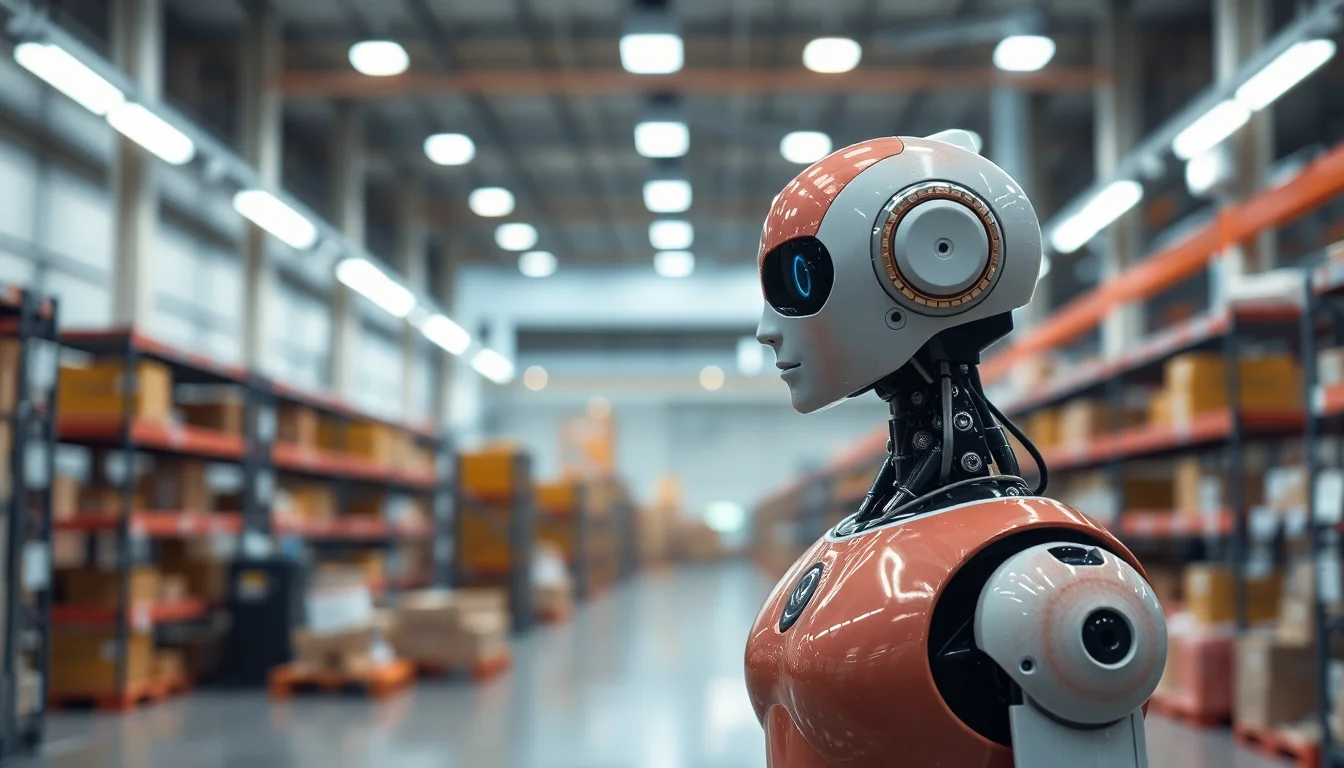
Doozy Robotics is presenting its latest move as a growth story, but the more interesting reading is architectural: the company’s coordinated expansion across the United States, GCC and Asia is also an attempt to prove that its software-led industrial robotics stack can survive contact with very different factory environments.
That matters because Doozy is not positioning itself as a point-solution vendor. The Singapore-based Physical AI company says it is building a vertically integrated system that combines an Industrial Super Humanoid, autonomous mobile robots, and autonomous forklifts under a single orchestration layer called Eywa-OS. In other words, the company is not just shipping machines; it is trying to define the control plane that assigns work across them.
Global expansion as an architectural milestone
The expansion announcement, made ahead of a planned Series A, is notable because it turns a sales plan into a systems test. Rolling out across the US, GCC and Asia forces the platform to operate across different labor regimes, site topologies, safety expectations, and integration standards. For a robotics company, those differences are rarely cosmetic.
If Eywa-OS is meant to behave like a factory OS, then multi-region deployment is where that claim either hardens into an operational advantage or starts to show seams. Coordinating humanoids, mobile robots and forklifts inside a single plant is already a nontrivial integration problem. Coordinating that stack across geographies, with different customers and regulatory environments, raises the bar again.
The company says the Industrial Super Humanoid is slated for Q3 2026 deployment, with first deployments beginning soon after. That timeline is significant less for the date itself than for what it implies: Doozy is asking investors and customers to judge the architecture before the hardware has had time to accumulate the kind of field data that usually separates demo-grade automation from production-grade systems.
Eywa-OS and the Industrial Super Humanoid: architecture in practice
Eywa-OS is the centerpiece of the story. According to Doozy’s description, the orchestration layer governs the operation end to end: it interprets production goals, dynamically allocates humanoids and robots across the floor, and adapts to disruptions in real time.
That framing places the software in the role that traditional manufacturing sites often reserve for a combination of human supervisors, MES tools, warehouse systems, and fleet managers. Doozy is trying to collapse those layers into a unified control plane. The bet is that a single orchestration layer can move work between a humanoid, a robot, and a forklift more efficiently than a fragmented stack of specialized systems.
Technically, that is a demanding proposition. It assumes the platform can maintain state across heterogeneous assets, understand task constraints at the plant level, and issue commands quickly enough to remain useful when conditions change. It also suggests a path toward measurable factory-level value: less idle equipment, better task routing, and tighter adaptation to disruptions. But those benefits depend on reliability, latency, and the quality of the underlying perception and planning systems. Without deployment data, they remain architectural promises, not validated outcomes.
Regional rollout: go-to-market, risk, and integration
The choice of the US, GCC and Asia as launch regions reads like a deliberate attempt to test portability. If the stack can be standardized across those markets, Doozy can argue that Eywa-OS is not just tailored to one pilot site or one industrial workflow, but to a broader class of factory operations.
That will require more than a polished product demo. Safety certification, data governance, site integration, and interoperability with existing factory systems are all likely to shape adoption. Industrial buyers rarely greenlight autonomy on software branding alone; they want evidence that a new system can sit alongside existing conveyors, warehouse software, safety barriers, enterprise planning tools and maintenance routines without creating new operational fragility.
The presence of Cocoon Capital among Doozy’s backers gives the company a degree of venture credibility as it moves toward a planned Series A, but it does not remove the burden of proving that the stack is deployable beyond controlled conditions. In fact, the fundraising timeline may intensify the need to show repeatable implementation patterns across regions rather than one-off engineering successes.
Risks, feasibility, and unintended consequences
The main technical risk is concentration. A platform that orchestrates humanoids, machines and forklifts through a single layer can be elegant in theory, but it also creates a potential single point of failure if Eywa-OS is not sufficiently resilient.
That risk cuts across several dimensions. Cybersecurity becomes more important when a control layer spans multiple classes of equipment. Maintenance becomes more complicated when the orchestration model must remain reliable across fleet updates, site-specific customizations, and regional operating conditions. Data governance also becomes a real issue when system telemetry and task data move across geographies with different rules and customer expectations.
There is also an operational risk that comes with ambition: integration overhead can swamp early deployments if the platform requires too much tailoring before it is useful. Industrial customers tend to reward systems that reduce friction quickly. If Doozy’s stack needs significant site-by-site adaptation, the promised scalability could become harder to realize.
The Industrial Super Humanoid’s Q3 2026 timeline underscores that these questions are not abstract. The company is asking the market to believe that the orchestration model will remain coherent as the footprint expands and the hardware reaches initial deployment. That is a reasonable ambition, but not yet a demonstrated one.
Market positioning: platform play vs hardware incumbents
Doozy’s strategy places it in a different category from the standard robot-maker playbook. A vendor selling a single machine can win narrowly on unit performance. A platform company has to prove that its stack can coordinate across asset classes, integrate into existing operations, and preserve that advantage across markets.
If Doozy succeeds, it could help shift industrial automation away from isolated machines toward an end-to-end orchestration model in which the control layer matters as much as the hardware. That would be a meaningful competitive move, especially if the company can show that Eywa-OS produces repeatable gains without requiring extensive custom engineering each time.
But the constraints are equally real. Industrial ecosystems are sticky, standards are uneven, and capital costs remain high. A vertically integrated robotics stack may be strategically coherent, yet coherence alone does not guarantee adoption. The company will need to demonstrate that its architecture is not only technically elegant, but operationally durable in the messy realities of factory life.
Cocoon Capital’s backing suggests there is investor appetite for a platform-led industrial AI story. The next question is whether Doozy can convert that confidence into a credible deployment record before the Series A process forces a sharper reckoning with execution.
For now, the expansion across the US, GCC and Asia is best understood as a test of whether a humanoid-centered orchestration platform can scale without losing the very reliability that factories demand.


