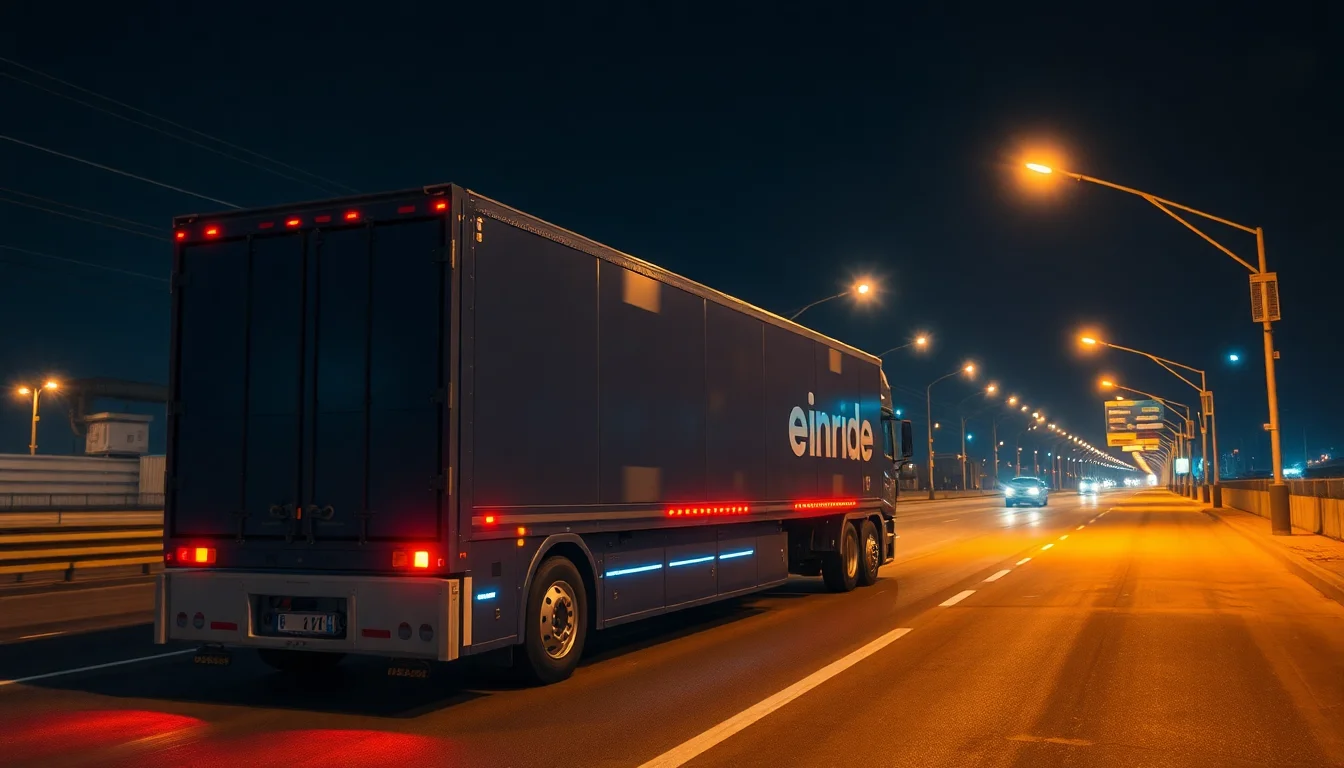
Einride’s Nasdaq debut is more than a financing event. By beginning trading on the Nasdaq Global Market and Nasdaq Capital Market under ENRD and ENRDW, the autonomous freight company has shifted its AI-first logistics platform into a setting where engineering decisions are measured not only by fleet performance, but also by disclosure quality, governance discipline, and operational repeatability.
That matters because Einride has spent the last decade building something closer to a software-and-operations stack than a conventional trucking business. The company says it now serves 30 global customers across FMCG, food, and industrial sectors, and that its platform includes comprehensive operational data integrations and a pipeline exceeding $800 million in opportunities through its Joint Business Plans. In private markets, that kind of integrated system can iterate quickly around a tight customer set. In public markets, it has to be legible: APIs need clearer boundaries, telemetry has to be auditable, and data handling has to hold up under investor and regulatory scrutiny.
What changed
The immediate change is straightforward: Einride is now listed on Nasdaq, with leadership marking the debut by ringing the Opening Bell at MarketSite in Times Square. But the technical significance is more interesting than the ceremony. A public listing turns the company’s AI and robotics platform into a metrics-driven product story, where the market will expect evidence that the underlying tooling is robust enough to scale across customers, geographies, and operating conditions.
For a company building autonomous freight infrastructure, that means the core engineering questions get sharper. How are sensor and fleet data normalized across deployments? How are model updates validated before rollout? How are exceptions, handoffs, and human interventions logged? Public-market status does not change the physics of autonomy, but it does raise the cost of ambiguity in the software layer that orchestrates it.
Why it matters now
The capital angle is obvious, but the more important implication is governance. Investor scrutiny typically forces companies to formalize what had previously been implicit in product and operations. For Einride, that could mean more explicit API contracts, stronger access controls, versioned interfaces, and more consistent reporting around uptime, utilization, and deployment readiness.
That shift is especially relevant for autonomous logistics, where the production environment is not a lab bench but a live freight network with customers, routes, and compliance obligations. The more Einride expands, the more its platform will need to behave like enterprise infrastructure: observable, testable, and secure by default. In that sense, the Nasdaq listing is also a tooling milestone. It pushes the company toward the kinds of data governance and interface stability that enterprise customers and auditors will increasingly expect.
Platform architecture under scale
The evidence of scale is already there in the customer base. Thirty global customers is not a proof point for full autonomy, but it does suggest a platform that has moved beyond single-deployment experimentation. At that stage, the architectural challenge is less about building one impressive autonomous truck and more about making each deployment fit into a repeatable operating model.
That is where comprehensive operational data integrations become central. Freight autonomy depends on continuous feedback loops: vehicle state, route context, environmental conditions, exception handling, maintenance records, and customer-specific constraints all need to flow into the same system. If those data streams are inconsistent, model performance and operational decisions become hard to compare across sites. If they are standardized, the company can improve not just one deployment, but the tooling behind every rollout.
The reported pipeline exceeding $800 million in opportunities through Joint Business Plans also hints at the next technical test. As deployments move from bespoke pilots to structured enterprise programs, Einride will need tooling that supports segmentation, repeatable rollout patterns, and cleaner instrumentation for customer-specific requirements. The platform has to scale without becoming a one-off integration project for every shipper.
Open ecosystem and developer tooling
Public visibility changes expectations for the ecosystem around the product, too. Even if Einride does not position itself as an open platform in the conventional cloud-computing sense, enterprise buyers, logistics partners, and systems integrators will increasingly judge it through the lens of developer experience.
That means questions about SDKs, API documentation, event schemas, and observability tools move from implementation details to commercial requirements. In autonomous freight, ecosystem maturity is not just about whether partners can connect to the system; it is about whether those integrations are stable enough to support auditable operations over time. A partner program that works in a private pilot may prove fragile once it has to support dozens of customers and a more formal public-company control environment.
This is also where governance and tooling converge. Better-defined interfaces make it easier to trace data lineage, isolate failures, and prove that a deployment behaved as expected. In other words, the same engineering work that improves developer usability can also improve compliance posture. That should matter to a newly listed company whose claims about scale will be scrutinized as much for repeatability as for ambition.
Market positioning and risk
Einride’s customer mix and market framing put it in a demanding part of the autonomy landscape. Serving FMCG, food, and industrial customers means the company is operating in sectors where uptime, traceability, and safety carry operational consequences, not just software consequences. The company also cites a $4.6 trillion total addressable market, which signals the size of the opportunity but also the intensity of the competition.
In that environment, the differentiator is unlikely to be novelty. It will be reliability at scale: the ability to run autonomous and electric freight systems with clear safety governance, disciplined data handling, and deployment models that enterprise customers can trust. Public markets tend to reward companies that can translate technical complexity into measurable controls. They are less forgiving of systems that remain difficult to inspect.
So the IPO is not just a vote of confidence. It is a test of whether the company’s autonomy stack can be managed like a public infrastructure platform while still improving like a modern AI system.
What comes next
The next phase will be about proving that capital can be converted into tooling maturity without sacrificing the speed that made the platform viable. If the listing gives Einride room to accelerate R&D, the return on that investment will depend on whether the company can standardize interfaces, harden telemetry, and make deployment workflows more transparent across customers.
That is the central tension now. Autonomous freight depends on rapid iteration, but public-market readiness depends on restraint, documentation, and control. Einride’s challenge is to make those compatible: to build an AI and robotics platform that can scale across enterprise logistics while remaining observable enough for operators, partners, and regulators to trust.
The Nasdaq debut does not answer that question. It makes it unavoidable.


