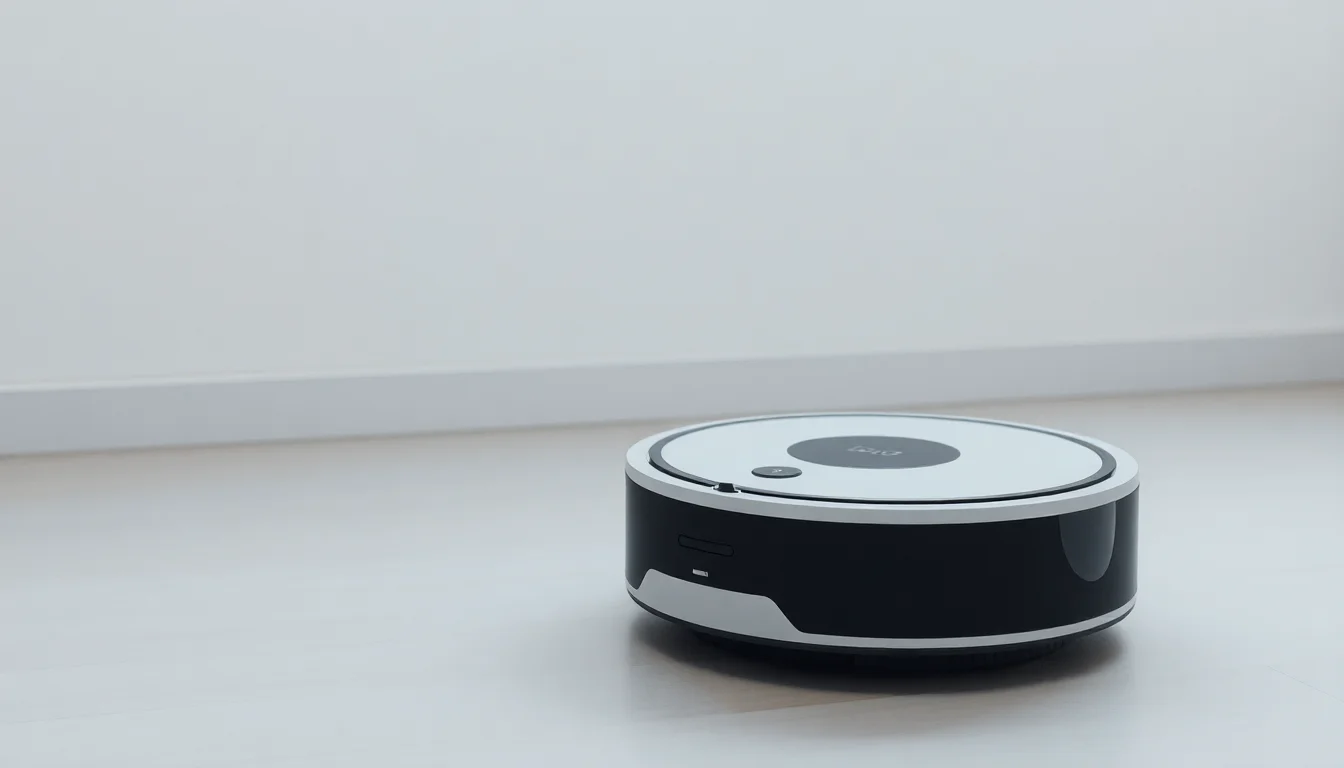
Prime Day has pushed Eufy’s Omni C28 down to $449.99, a new low and roughly $350 off MSRP. That matters for more than the obvious reason that it makes the robot easier to buy. At this price, the C28 becomes a useful case study in what “affordable AI-enabled home robotics” actually means when the machine has to navigate, map, vacuum, and mop in real homes rather than in a spec sheet.
The C28’s appeal is not just that it is cheaper than before; it is that the discount exposes the engineering tradeoffs underneath its autonomy stack. A robot vacuum-mop hybrid has to do several things simultaneously: localize itself, infer the geometry of a room, avoid getting trapped, manage brush and mop behavior, and do all of that on a consumer-friendly power, sensor, and cost budget. In other words, this is a deployment problem as much as a product problem.
What the Prime Day drop really changes
The Verge’s testing suggests the Omni C28 is not being sold here as a stripped-down budget bot. It is positioned as a hybrid that can clean well, keep its dual roller brushes relatively tangle-free, and handle navigation better than many larger, pricier competitors. It also earned notice for moving through tight spaces, climbing over the legs of a lounger, and doing a solid job along edges and corners. Those are not trivial behaviors for a roller-mop design, because they imply the robot is doing enough onboard perception and path planning to preserve performance in messy, human-shaped environments.
The pricing change matters because it compresses the value stack. At nearly $800 MSRP, the C28 could be framed as a feature-rich midrange robot with some compromises. At $449.99, it becomes part of the broader normalization of AI robotics features that used to sit much higher up the price ladder. That puts pressure on the underlying system design: if navigation and mop handling are the differentiators, the company has to deliver them with less margin for expensive sensors, more conservative compute, and tighter power management.
On-device AI, SLAM, and the cost of autonomy
The technical story here is less about a single model than about the autonomy pipeline. A robot vacuum like the Omni C28 depends on SLAM-style navigation to build and update a map while estimating its own position in the room. In a consumer robot, that means sensor fusion, path planning, obstacle handling, and local decision-making all have to work in near real time. If the robot is also running mop logic, brush control, and docking behavior, the system has to prioritize tasks without burning through battery or wandering into edge cases.
That is where the price becomes interesting. A sub-$500 robot cannot simply throw expensive sensing hardware at the problem and call it solved. It has to achieve acceptable autonomy with a narrower sensor array, more disciplined compute, and firmware that can make robust choices under constraint. If the C28 is navigating tight spaces well, that implies the stack is doing enough on-device inference and state estimation to remain useful without leaning heavily on cloud dependence or elaborate external infrastructure.
The mop integration raises the difficulty further. Vacuuming and mopping are not independent behaviors. The robot has to understand when to transition between dry debris pickup and wet cleaning, and it has to do so while maintaining traction, avoiding obstruction, and keeping the cleaning modules from interfering with one another. The fact that the C28 is described as a hybrid that performs well suggests the device is not just bolting a mop onto a vacuum chassis; it is coordinating those subsystems as part of a single autonomy routine.
Real homes are the real benchmark
The Verge’s note that users should clear their floors before sending the robot out to clean is the part of the story that matters most for deployment. That is not a minor housekeeping tip; it is a reminder that home robotics still depends heavily on environment preparation. In practice, clutter, cords, stray objects, and narrow transitions are the inputs that turn a promising autonomy stack into a support burden.
That is why maintenance remains central to the product’s real-world value. A robot can be strong at edge cleaning and still lose favor if its brushes tangle frequently, the dock requires too much intervention, or mop-related upkeep becomes annoying enough to offset the convenience. Consumer satisfaction in this category is usually determined less by the headline feature list than by how often the owner has to intervene.
The C28 appears to be doing a few of the hard things well: maneuvering through tight spaces, avoiding obvious brush snarls, and cleaning near edges. But those strengths only matter if the robot can sustain them across a real household’s irregular floorplan and recurring debris. In robotics, reliability is not a bonus feature. It is the product.
Why the pricing signal matters for roadmap decisions
A Prime Day price move like this is also a signal to the market. When a robot vacuum-mop hybrid with credible autonomous behavior lands at $449.99, the competitive baseline shifts. Rivals cannot assume that on-device AI navigation, mop integration, and competent cleaning are reserved for premium tiers. If consumers can buy those capabilities at this price, then firmware efficiency, mapping quality, and maintenance ergonomics become harder to separate from brand positioning.
That has roadmap implications. To defend or extend this kind of pricing, vendors will need to keep improving autonomy without adding cost in the wrong places. That usually means more efficient edge inference, better map persistence, cleaner recovery logic, and software that reduces user babysitting. It also means using data and firmware updates to improve reliability after launch, because that is one of the few scalable ways to strengthen an installed base without reworking the hardware bill of materials.
So the Omni C28’s Prime Day discount is not just a good deal on a robot vacuum. It is a market test for how far mass-market AI robotics has moved from novelty toward infrastructure. The question is no longer whether a robot can vacuum and mop. It is whether it can do so with enough autonomy, consistency, and low-friction maintenance to justify shipping at a price that forces engineering discipline rather than luxury assumptions.


