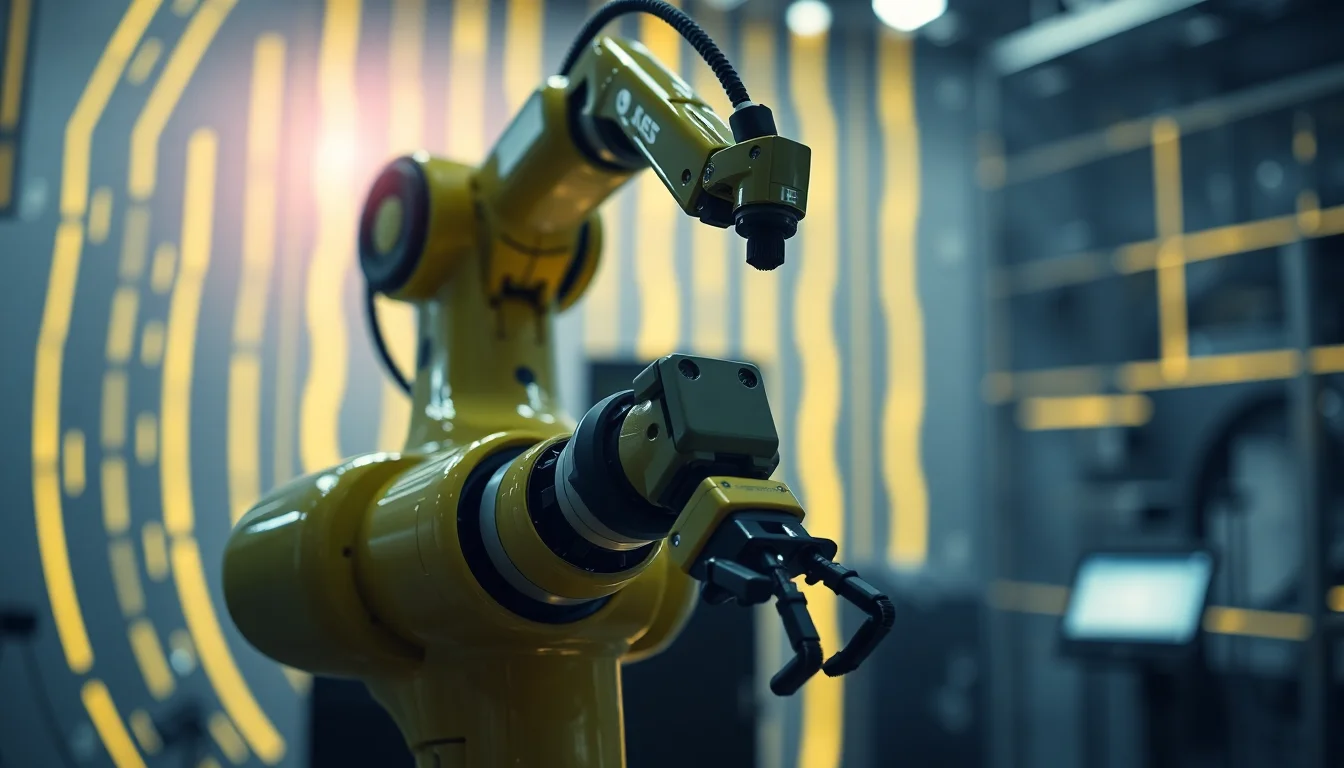
Fanuc’s latest move with Nvidia is notable not because it adds another simulation connector, but because it pushes the simulation stack closer to something operators can use as part of production workflow. The company says the integration between Nvidia Isaac Sim and Fanuc RoboGuide has been strengthened to support highly accurate digital twins, real-time operation in a virtual factory, and robot behavior that matches the physical system through identical trajectories and cycle times.
That matters because the line between “simulation” and “commissioning” has been getting thinner in robotics for years, but it has rarely been this explicit. At the International Robot Exhibition in Tokyo last December, Fanuc showed motion simulations created in RoboGuide being imported into Isaac Sim, with the same control algorithms used by the actual robot. The new announcement goes further: the two systems are now described as more tightly integrated, with continuous direct communication intended to make virtual commissioning more practical and more efficient.
Two integration modes, one goal
Fanuc’s framing matters as much as the technical detail. The company is now describing two integration modes.
In the first, Nvidia Isaac Sim sits at the front end while RoboGuide runs in the background, using Fanuc’s simulation environment to preserve fidelity without exposing users to the full complexity of the underlying robot model at every step. In the second, RoboGuide and Isaac Sim are tightly integrated, with continuous communication between the systems. That tighter mode is the more consequential one for production teams, because it is the version that aims to keep the simulated robot aligned with the physical robot as conditions, programs, or cell layouts change.
For technical users, the important point is not just that the tools exchange data, but that they are trying to preserve control parity. Fanuc says the same control algorithms can run in both environments, allowing RoboGuide-generated motion simulations to be reproduced in Isaac Sim with precise trajectories and cycle times. That kind of parity is what makes virtual commissioning credible: if the simulation diverges from the real robot at the level of motion timing or execution logic, the value collapses quickly.
Fidelity is the product, not the feature
In robotics, simulation fidelity is often discussed as a visual problem. In practice, it is a control problem.
If a digital twin is meant to do more than produce a pretty render of a cell, it has to reflect how the robot actually moves, stops, and responds to commands. Fanuc’s description suggests the integration is designed to preserve that behavior by importing robot motion simulations from RoboGuide into Isaac Sim and reproducing them in a virtual factory. The emphasis on identical trajectories and cycle times is doing a lot of work here: it implies that the twin is being treated as a testable surrogate for the production robot, not merely an offline sandbox.
That is especially relevant for AI-powered robotics, where operators are increasingly trying to validate perception, planning, and control logic before deploying to a live cell. A higher-fidelity loop reduces the amount of trial-and-error on hardware, but only if the data flow between simulation layers remains trustworthy. Continuous communication between Isaac Sim and RoboGuide is therefore more than an architectural detail. It is the mechanism by which changes in the simulated environment can propagate back into the robot model without forcing users to rebuild the pipeline from scratch.
What the two-mode rollout means in practice
The two integration modes point to a realistic rollout path, not an instant platform flip.
For teams that want quick access to Isaac Sim’s broader robotics and AI ecosystem, the front-end mode offers a lower-friction entry point. Isaac Sim becomes the visible workflow layer, while RoboGuide supplies the robot-specific accuracy underneath. That is likely to appeal to organizations trying to standardize on Nvidia’s simulation tools without giving up Fanuc-specific behavior models.
The tighter mode is more demanding, but also more useful for commissioning. If the systems are continuously communicating, operators can test robot motions, timing, and cell interactions in a loop that better reflects the production environment. That should shorten some validation cycles, though not eliminate them. The caveat is important: tighter integration can improve consistency, but it also increases dependency on the quality of the underlying models, the calibration discipline of the user, and the robustness of the interfaces that bind the two systems.
In other words, the promise is not “simulate once, deploy anywhere.” It is “reduce the gap between virtual and physical behavior enough that commissioning becomes less speculative.” For manufacturers with stable processes and well-defined cells, that can be valuable. For highly variable deployments, the same setup may still require substantial adaptation.
A stronger gravity well around Nvidia and Fanuc tooling
The partnership also has positioning implications. By combining Isaac Sim with RoboGuide, Fanuc and Nvidia are making a case for a de facto digital-twin workflow in robotics: use a reference simulation layer from Nvidia, preserve robot-specific fidelity through Fanuc’s software, and treat the virtual factory as an operational environment rather than an isolated design tool.
That is strategically meaningful because it gives both vendors a more defensible story for customers who want fewer integration seams. It also raises the stakes for competitors. Rivals may respond by tightening their own simulation-to-commissioning stacks, improving interoperability, or emphasizing open standards and hardware neutrality. Downstream vendors that build around robot programming, line balancing, or cell validation will have to decide whether to align with this stack or preserve more platform independence.
The IRE demonstration context is also telling. Showing parity between simulated and real robot behavior is the kind of proof point industrial buyers care about because it speaks directly to deployment risk. But demonstrations are not deployments. The real test is whether the workflow holds up under the messiness of actual factory changes: payload variation, fixture drift, network latency, model updates, and the inevitable mismatches between idealized cell design and shop-floor reality.
The governance questions now become unavoidable
As digital twins move closer to production use, the technical questions become governance questions.
Operators will need to validate parity, not assume it. That means defining how trajectories, cycle times, and control behavior are checked against the real robot, and how often that validation is repeated. It also means tracking data provenance: which robot model generated the simulation, which software version produced it, what calibration state was used, and whether any changes were introduced in Isaac Sim or RoboGuide after the last validated run.
Cybersecurity becomes more relevant too. A tightly integrated virtual commissioning workflow creates more interfaces, more shared state, and more opportunities for configuration drift or unauthorized changes. If the digital twin is influencing how a physical robot will behave, then update control, access control, and auditability stop being back-office concerns.
The broader point is that Fanuc and Nvidia are not just offering better visualization. They are pushing toward a tighter operational loop where the digital twin can help shape the behavior of the physical robot with less translation loss in between. That is a meaningful advance for AI robotics, but it only pays off if operators are willing to treat fidelity, calibration, and governance as first-class engineering requirements.


