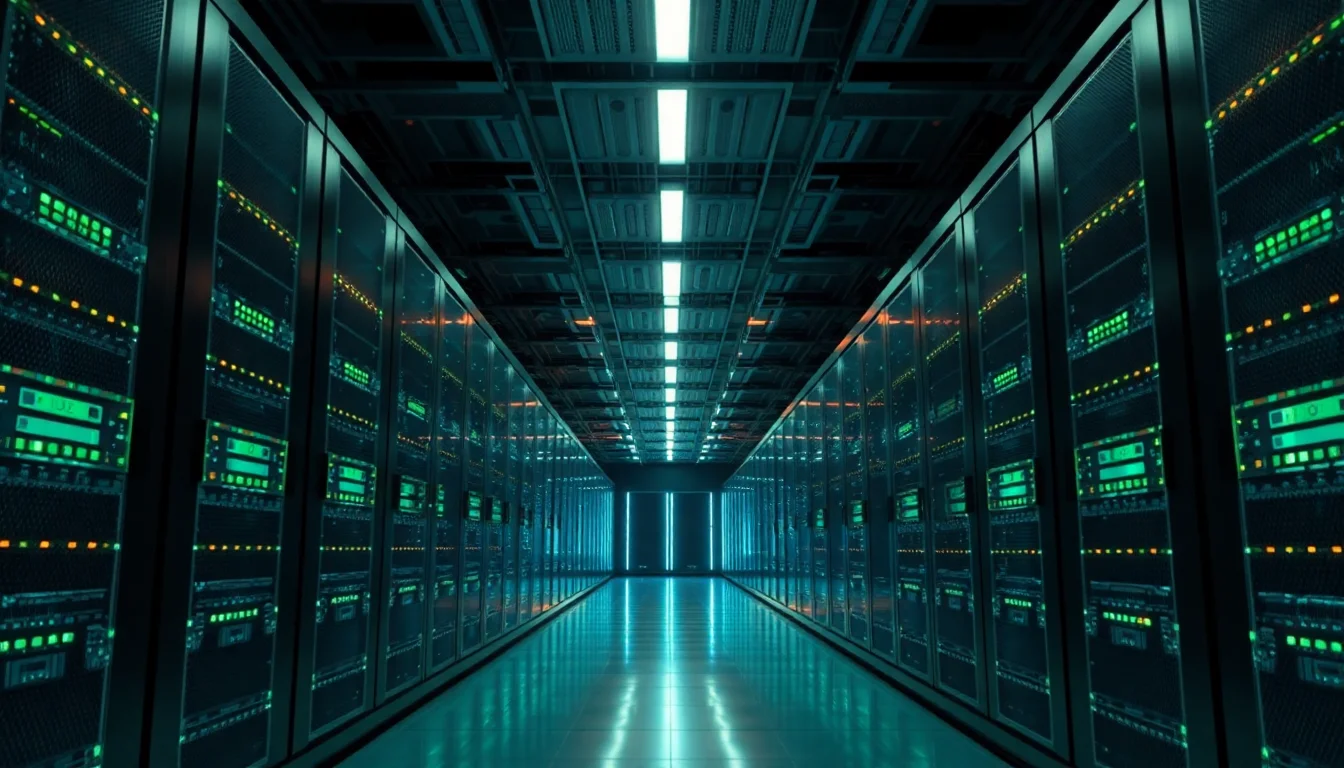
Firmus’s jump to a $5.5 billion valuation after raising $1.35 billion in the last six months is notable not because another AI company got big, but because the market is increasingly paying up for the layer that turns demand for compute into something physically usable. In the latest phase of AI competition, the scarce asset is not just GPUs. It is the ability to secure power, land, permits, cooling, and interconnection fast enough to deploy those GPUs before the rest of the stack moves on.
That is why a datacenter developer now looks, to investors, a lot like an AI platform company. The point is not that concrete and switchgear have suddenly become glamorous. It is that the owners of ready sites, utility access, and construction execution are becoming the gatekeepers for who can actually consume Nvidia-class hardware at scale. If a lab can ship a model in weeks but a datacenter cannot energize a hall for months, the model release matters less than the site readiness behind it.
Firmus is especially interesting because it is focused on Asia, where demand growth, supply-chain proximity, and national ambitions around AI infrastructure intersect with a more complicated operational environment. Asia is not just a market label here; it shapes the business. Developers have to coordinate with utilities that may be under pressure, navigate permitting and zoning regimes that vary by jurisdiction, and design for latency-sensitive deployment patterns that can differ from U.S. hyperscale assumptions. A builder that can secure capacity in that context is not merely installing servers. It is solving a regional infrastructure problem that many competitors cannot clear quickly.
The technical moat is therefore broader than access to silicon. In AI datacenters, power density has become the first-order constraint: modern GPU racks can consume far more electricity per square foot than traditional enterprise loads, which means a site has to be designed around high-density electrical delivery, transformer capacity, and cooling architecture from the start. Liquid cooling, or at least cooling systems built for far denser thermal loads, is no longer an optimization; it is often table stakes. Then comes interconnect and deployment speed. A facility can have a signed land deal and still fail the market test if it cannot bring capacity online at the pace required by model training and inference demand.
That is where Nvidia’s backing matters as a strategic signal rather than a simple credibility flourish. Nvidia is not just a well-known name on the cap table. Its support can improve procurement confidence with suppliers, make the company more legible to prospective customers building around Nvidia’s roadmap, and help reduce the perceived risk for other financiers deciding whether a datacenter pipeline is real or theoretical. In a market where customers want assurances that the infrastructure they commit to will be aligned with the hardware they plan to deploy, Nvidia’s involvement can function as a demand signal as much as a fundraising one.
It also reveals how tightly infrastructure planning is now coupled to one vendor’s ecosystem. That is not a weakness in itself, but it is a structural feature of the current AI buildout. If the dominant accelerators, networking gear, and reference architectures are all moving in step, then datacenter developers that can align their mechanical and electrical designs to that cadence have an advantage. Firms like Firmus are effectively betting that the next wave of compute demand will not be satisfied by generic colocation space; it will require purpose-built capacity that can absorb very high-density GPU deployments without costly retrofits.
Still, the valuation should be read as a claim on future execution, not a verdict on success. Infrastructure businesses can look scarce on paper and unforgiving in practice. Utilization has to be high enough to justify the capital base. Financing costs have to stay manageable while projects are under construction. Tenant demand has to arrive on schedule. And the pace of chip generation shifts can turn a carefully planned deployment into a stranded asset if the facility’s power and cooling envelope is misaligned with the next hardware cycle.
That is the tension inside Firmus’s pricing. A $5.5 billion valuation assumes the company can convert access into recurring capacity at speed, and in Asia that means doing more than building shells for servers. It must line up utilities, engineering, permitting, and customer commitments in a region where the operational friction is real and timelines can slip. If it can do that, the payoff is substantial: a foothold in the scarce part of the AI stack, where power and location matter as much as model quality.
If it cannot, the valuation will look early. Infrastructure scarcity can support aggressive multiples, but only when the builder can translate scarcity into deployed megawatts and contracted demand. That is why Firmus is more than a funding headline. It is a sign that capital is flowing toward whoever can industrialize compute supply fastest, not just whoever can advertise the loudest model breakthrough. For competitors, the message is clear: the next AI race is being won on the grid, in the permit office, and inside the datacenter design review, long before a model ever reaches the benchmark chart.


