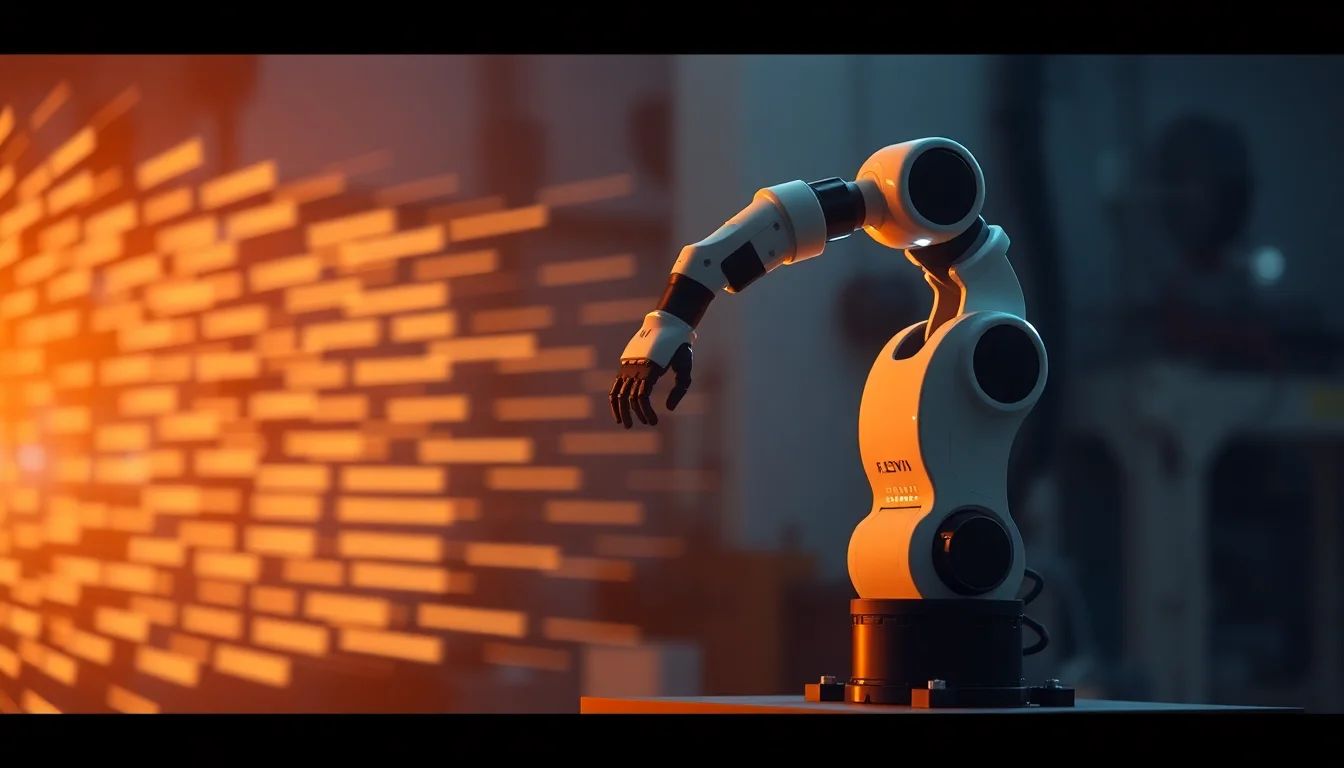
Flexiv’s Enlight and Mico push factory robots toward tactile, embodied automation
Flexiv’s latest launch reads less like a simple product refresh and more like a redefinition of what an industrial robot is expected to perceive. The company has introduced Enlight, a seven-axis adaptive robotic arm, and Mico, a modular dual-arm platform, both aimed at production settings where conventional fixed-trajectory automation tends to break down: constrained workspaces, variable parts, inconsistent surfaces, and tasks that depend on contact rather than pure positioning.
The distinctive technical move is inside Enlight itself. Flexiv says the arm uses force-torque sensors in every joint, a design that enables what it calls whole-body touch. In practical terms, that shifts the robot from a mostly position-governed machine toward one that can sense load, contact, and interaction across the entire kinematic chain. The company says the platform can detect single-touch contact, track multiple contact points, and recognize tactile patterns. For factories, that is not a cosmetic feature; it changes the available control strategies.
Traditional industrial robots are built around repeatability. They excel when a part arrives in the same pose, the fixture is stable, and the motion path can be preplanned with high confidence. When the part shifts or the insertion force varies, engineers often add external compliance hardware, conservative tolerances, or manual intervention. Enlight’s architecture suggests a different assumption: that useful automation increasingly requires the robot to feel its way through the task.
Why joint-level force sensing matters
Embedding force-torque sensing in each joint does more than improve end-effector feedback. It changes the control loop itself. Instead of relying primarily on position commands and a single wrist sensor, a controller can infer how forces propagate through the arm, detect contact earlier, and modulate motion across the full structure. That matters for manipulation jobs such as assembly, finishing, part alignment, and other operations where failure is often caused by small misregistrations that a rigid robot would only notice after applying too much force.
It also opens a richer sensing stack for software. A force-aware robot can provide signals that are useful for:
- Fault detection, by spotting abnormal torque signatures that indicate binding, slippage, or misfeeds.
- Skill execution, by letting motion policies adjust dynamically as contact conditions change.
- Human-robot collaboration, where softer interactions and safer handoffs depend on fine-grained force awareness.
- Tactile pattern recognition, where repeated contact signatures can become part of a learned workflow rather than a one-off exception.
That last point is where Flexiv’s embodied AI framing becomes more than branding. If the robot can learn from tactile traces as well as vision, then the perception pipeline is no longer a camera-first stack with force data attached as a peripheral signal. It becomes a multi-modal system in which contact is part of the state estimate. For software teams, that means broader implications for data schemas, model training, replay tools, and telemetry retention.
Mico extends the same idea into a different form factor. Flexiv positions the platform as a modular dual-arm system built for adaptable tasks, which is the more obvious fit for workflows that need coordinated manipulation, station flexibility, or a smaller footprint than two separate single-arm cells. In production environments where space is constrained and task diversity is high, modularity matters as much as raw payload or cycle time.
A different control stack for messier factories
The technical significance of Enlight and Mico is not just that they can sense contact; it is that contact becomes a first-class variable in the automation stack. That affects control, perception, and safety simultaneously.
On the control side, force-aware robots require more than the classical open-loop trajectory plus emergency stop model that governs many fixed automation cells. Engineers need to define how the controller behaves when contact appears unexpectedly, when multiple contact points emerge, or when the robot transitions between free-space motion and constrained motion. If tactile signals are available at every joint, then compliance can be distributed rather than centralized at the wrist. That can make the system more adaptable, but it also complicates tuning, calibration, and validation.
On the perception side, force and vision must be fused carefully. Vision can localize the part, but tactile feedback often confirms whether the grasp is correct, whether a connector is fully seated, or whether a surface interaction is proceeding as intended. In variable environments, the two modalities can disagree. That means deployment teams need explicit logic for arbitration, confidence thresholds, and recovery behavior. In other words, this is not just an AI model problem; it is a systems-engineering problem.
Safety becomes more nuanced as well. A robot that senses touch across the whole body can be better at detecting unintended contact, but it also introduces new failure modes: false positives that halt production, calibration drift that changes force interpretation, and overconfident autonomy in edge cases that exceed the trained contact patterns. Any real deployment will need a clear mapping between sensing behavior, protective stops, supervisory controls, and whatever safety certifications or site-specific validation process the integrator requires. The important point is that more sensing does not remove the need for safety architecture; it raises the bar for how that architecture is documented and tested.
What this means for enterprise tooling and deployment
For enterprise AI and robotics teams, the launch is as much about data plumbing as hardware. A tactile robot generates new categories of operational data: joint torque traces, contact events, contact-duration signatures, recovery sequences, and task outcomes under varying conditions. Those signals need to move through the same enterprise stack as vision data and PLC telemetry if the organization wants them to improve performance over time.
That has consequences for tooling. Teams evaluating robots like Enlight and Mico will need to think about:
- Data capture and retention, including how tactile traces are logged, labeled, and versioned.
- Integration with existing vision systems, since contact-aware manipulation usually depends on camera or depth inputs for coarse localization.
- Compatibility with automation software and SaaS layers, such as orchestration, monitoring, maintenance, and digital-twin workflows.
- Model update governance, especially if embodied AI techniques are used to adapt behavior across sites or shifts.
- Operational observability, so engineers can debug whether a task failed because of perception error, force-control tuning, fixture drift, or material variation.
This is where vendors that can support both hardware and integration tend to gain an advantage. A robot with more sensing is only valuable if it can be deployed into the customer’s stack without turning every cell into a bespoke research project. Flexiv appears to be positioning Enlight and Mico for precisely those harder-use cases where standard industrial arms need too much external help to stay productive.
That positioning matters in markets defined by variability rather than pure volume. For highly variable tasks, constrained spaces, and workflows that involve unstructured contact, a tactile platform can reduce the amount of mechanical fixturing and custom exception handling required. But the trade-off is that system complexity shifts upward into software, test procedures, and integration work.
How to evaluate a pilot without overcommitting
Teams considering a trial should treat these robots as a control-and-data project, not just a hardware purchase. The right pilot criteria look different from a conventional arm evaluation.
First, validate the task envelope. Does the process actually benefit from joint-level force sensing, or could a standard robot with better fixturing do the same job more simply? Tasks with insertion, alignment, delicate contact, or frequent variation are the strongest candidates.
Second, test the perception and control stack under real faults. A pilot should include misaligned parts, surface variation, lighting changes, and cycle interruptions. The question is not whether the robot works in a clean demo; it is whether vision, force sensing, and recovery logic still work when the line is noisy.
Third, involve safety and quality teams early. If whole-body touch is part of the value proposition, then the organization needs to specify how contact is classified, when the robot pauses, what thresholds are acceptable, and how the system is validated before broader rollout. That includes documentation for operators, maintenance staff, and integrators.
Fourth, define the data workflow up front. Decide what tactile and motion data will be stored, where it will live, and who will own retraining or tuning. If embodied AI is part of the roadmap, the pilot should generate reusable data assets rather than one-off logs.
Finally, sequence the rollout. A phased approach is likely to be more effective than immediate scale-up: start with a bounded task, prove the sensing and control assumptions, then expand into adjacent operations once the exception rate, recovery behavior, and integration burden are understood.
Flexiv’s Enlight and Mico do not eliminate the engineering difficulty of factory automation. They make that difficulty more visible—and, in some cases, more programmable. By putting force-torque sensing into every joint and leaning into whole-body touch, the company is betting that industrial robots are moving toward a world where contact is not an afterthought but the basis of the control system. For teams building the next generation of automated cells, that is the shift worth watching.


