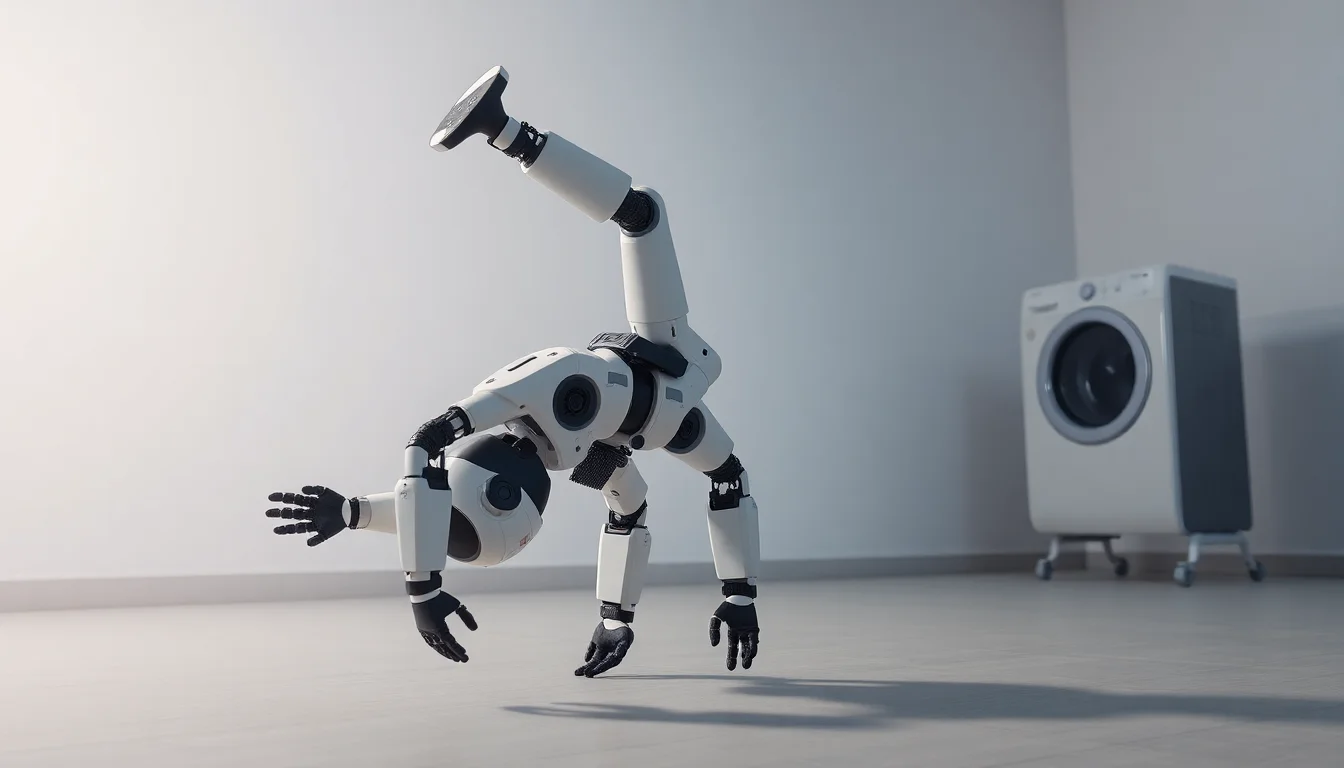
The pivot that changes nothing — or everything
On June 17, 2026, Robotics & Automation News framed a useful tension in embodied AI: the field keeps producing spectacular hardware demos — humanoids doing backflips, obstacle courses, staged dances — while the harder problem remains stubbornly practical. Can a robot actually cope with the cluttered, ambiguous, failure-prone spaces where people live and work?
X Square Robot’s answer is a deliberate shift in emphasis. The company says the hardware stack is no longer the core bottleneck. The missing piece is the “brain.” In that framing, embodied AI stops being a race to build the most impressive body and becomes a software-and-data problem: perception, reasoning about physical events, and learning from far less robot-native data than the industry has assumed.
That is the logic behind X Square Robot’s recent open-sourcing of three components: Wall-OSS-0.5, a Vision-Language-Action model; WALL-WM, a World Action Model; and XRZero-G0, a robot-free data collection and training framework. Taken together, the trio is meant to push embodied AI toward real-world generalization instead of one-off stage demos.
The bet is not that open source automatically solves embodied AI. It is that opening the stack may accelerate the part of the field that still looks underbuilt: the intelligence layer.
What the triad is trying to do
The three releases are not redundant. They map onto different failure modes in robotics.
Wall-OSS-0.5 is the action-facing model in the stack. As a Vision-Language-Action system, it is meant to connect what the robot sees, what it is told, and what it does. That matters because embodied tasks are rarely just classification problems. A robot in a kitchen or warehouse has to interpret context, track objects, and choose actions under uncertainty.
WALL-WM, by contrast, targets world modeling. The core idea is that robots need a representation of how physical events unfold — not just what objects are present, but how they move, interact, and change state. In messy environments, that layer is crucial. A system that can name things but cannot reason about friction, occlusion, or sequence will still break when conditions drift from the training set.
XRZero-G0 is the more economically interesting piece. X Square Robot describes it as a robot-free data collection and training framework designed to dramatically reduce data costs. That matters because embodied AI has a notoriously expensive data pipeline. Collecting real robot interaction data is slow, hardware-intensive, and difficult to scale across environments. If a meaningful portion of training can be done without continuously instrumenting physical robots, the cost structure changes.
That is the practical promise of robot-free data collection: use alternative sources — simulations, synthetic scenarios, offline trajectories, or non-robot interaction signals — to train the policy and world model before, or instead of, gathering large volumes of physical robot experience. The key question is not whether that is possible in principle. It is whether the resulting models transfer robustly enough into the uncontrolled conditions that define the market.
If they do not, the stack becomes a more efficient way to produce lab-grade competence. If they do, XRZero-G0 could lower one of embodied AI’s biggest barriers to iteration: the cost and speed of getting new data.
Why the timing matters
The timing of this move is as important as the release itself. Hardware-led demos have already done their job: they proved that locomotion, grasping, and balance have advanced enough to make robots look convincing on stage. But staged capability is not the same as operational reliability. The challenge now is not whether a humanoid can perform a choreographed task; it is whether it can do so repeatedly, safely, and with enough adaptability to survive distribution shift.
That is where a brain-first strategy becomes more than a branding choice. If the industry has over-indexed on hardware spectacle, then software-centric efforts can claim a different kind of urgency: fewer expensive robots, more reusable intelligence, and faster learning loops.
X Square Robot’s framing also subtly challenges a common assumption in embodied AI investment. Hardware is capital-intensive and slow to iterate. Software can scale faster, but only if it has enough data and a sufficiently generalizable model architecture. By open-sourcing the stack, X Square Robot appears to be betting that ecosystem adoption can substitute for some of the closed-loop advantage hardware incumbents usually enjoy.
That is an aggressive bet. Open source can speed diffusion, but it can also expose rough edges quickly. If Wall-OSS-0.5, WALL-WM, and XRZero-G0 are genuinely useful, the community will pressure-test them in ways a single company cannot. If they are not, the market will see the limits just as fast.
What it could change in the market
The most immediate implication is on deployment timelines. If the stack reduces the amount of robot-specific data needed to get a policy off the ground, teams may be able to prototype across more task domains before committing to expensive hardware runs. That does not eliminate the need for robots. It could, however, shift when the expensive parts of the development cycle begin.
For startups, that is appealing. A smaller company trying to build embodied AI systems cannot afford unlimited data collection or a fleet of bespoke robots just to discover that its policy does not generalize. A reusable open-source brain stack could let such teams concentrate on integration, task design, and niche deployment environments.
For hardware-first incumbents, the response may be equally important. If intelligence becomes the primary differentiator, then the competitive advantage moves away from body design alone. Robot makers may need to accelerate their own software and model strategy, partner more aggressively with AI developers, or contribute to open ecosystems to remain relevant.
But open source also introduces frictions that matter in robotics more than in pure software. Documentation quality, benchmark transparency, reproducibility, and governance all become adoption bottlenecks. A model family can be available and still be hard to integrate. A data framework can promise efficiency and still fail to produce enough transferable behavior across domains. And in embodied systems, safety and liability are not side issues. They are deployment gates.
There is also a strategic ambiguity in the open-source move itself. It may broaden adoption, but it may also compress differentiation. If the intelligence layer becomes widely accessible, competition could shift toward who can best integrate the stack into reliable products, who can gather superior task data, and who can validate performance in real environments.
That would not make the hardware less important. It would just make hardware one layer in a more software-defined stack.
What to watch next
The next few months will tell us whether X Square Robot’s strategy is a genuine inflection point or a well-timed thesis statement.
The clearest signals to watch are straightforward:
- Community uptake: Are developers actually building on Wall-OSS-0.5, WALL-WM, and XRZero-G0, or merely downloading them?
- Benchmark behavior: Do the models hold up on cross-domain tasks, especially in messy environments that reward generalization rather than scripted execution?
- Data efficiency: Does XRZero-G0 materially reduce the amount of robot-native training data required to reach usable performance?
- Integration timelines: Do partners or integrators move from announcement to deployment pilots quickly enough to suggest the stack is practical, not just directional?
- Failure disclosure: Are limitations being documented clearly, or will the field be forced to infer the boundaries through trial and error?
If those indicators move in the right direction, X Square Robot could help reset embodied AI around a more durable premise: that the next breakthrough is less about making robots look human and more about making them reason, learn, and act reliably in the real world.
If they do not, the industry may keep doing what it has done best so far — impressive demos, gradual progress, and a long wait for intelligence to catch up with hardware.


