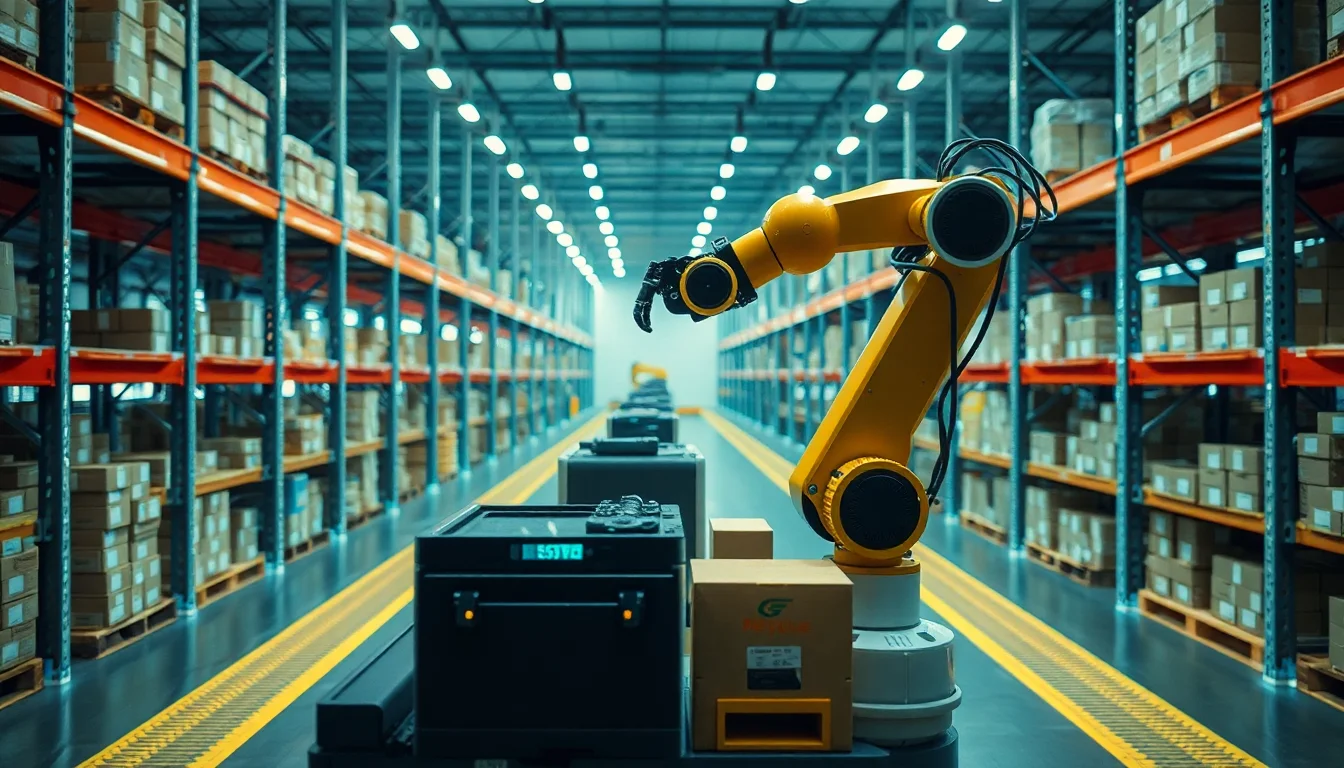
Geekplus’s fifth RBR50 Innovation Award is more than a trophy case update. It is a useful signal that warehouse robotics is moving into a new phase: not just automating movement, but automating variation. The company won the 2026 award for its Robot Arm Picking Station, an AI-powered picking station that uses zero-shot learning and the Geek+ Brain foundation model to handle unfamiliar SKUs without the same retraining burden that has slowed past warehouse deployments.
That matters because the warehouse picking bottleneck has never been about whether a robot can move a tote or navigate an aisle. Mobile robots solved much of that years ago. The hard problem has been the handoff at the shelf or bin: identify the item, estimate pose, grasp it reliably, and place it into the right container despite changing catalogs, packaging, and lighting. In other words, the failure mode has always been variability. SKU churn and product diversity force many systems back into the expensive loop of data collection, labeling, and model updates.
Geekplus is pitching a different operating model. Zero-shot learning, in this context, means the system can make a first pass at handling items it has not been explicitly trained on as individual SKUs. Instead of memorizing one model per product or retraining for every catalog change, the Geek+ Brain foundation model is supposed to provide a more general perception-and-manipulation layer. The practical promise is not magic universal picking. It is a reduction in the amount of bespoke work needed to bring new items online.
That distinction is important. A foundation-model approach does not eliminate the need for deployment engineering; it changes where the effort goes. Rather than building a separate model for each SKU family, operators can focus on validating how well the system generalizes across item shapes, surfaces, packaging types, and warehouse conditions. The real question is no longer whether a model can learn one catalog. It is whether it can stay useful when the catalog changes faster than the retraining cycle.
The strongest evidence in Geekplus’s announcement is the deployment context. The company says the zero-shot system is in use at a Schneider Electric facility in Shanghai. That matters because a live industrial site is a very different test from a controlled demo. Production warehouses introduce uneven lighting, edge cases in packaging, throughput pressure, operator handoffs, and the ordinary messiness of day-to-day fulfillment. A system that survives there has at least cleared a higher bar than a lab prototype.
Still, one deployment does not settle the scaling question. The fact that Geekplus is highlighting a Schneider Electric site suggests confidence in the system’s operational profile, but it also raises the standard for what comes next. If zero-shot generalization is the new product story, then the critical metrics shift from model accuracy in isolation to system behavior under load: pick success on unfamiliar SKUs, latency at inference time, recovery from failed grasps, and maintenance overhead across shifts and sites.
That tradeoff could reshape how warehouse AI products are rolled out. SKU-specific retraining is slow, expensive, and operationally fragile, but it gives vendors a narrow, controlled performance envelope. Foundation-model-driven generalization promises faster expansion across categories and lower data dependency, but it introduces new validation work. Teams have to know not just whether the model works on the first deployment, but whether it continues to work when the product mix changes, the ambient conditions drift, or the site architecture differs.
This is where the market implications start to widen. Geekplus is now a five-time RBR50 honoree, which puts it in a small group of repeat names alongside companies such as ABB, Amazon, Boston Dynamics, and Nvidia. That kind of recognition does not guarantee category leadership, but it does help define the benchmark. If a major warehouse robotics vendor is publicly associating itself with zero-shot learning and a foundation model for picking, competitors will need to respond with their own stories around generalization, not just mechanical throughput.
For customers, the strategic appeal is obvious: if new SKUs can be handled with less retraining, automation can expand faster into high-mix environments that were previously too cumbersome to justify. But the operational bar is equally obvious. Unfamiliar SKU handling remains the most stubborn challenge in warehouse automation, and a system that performs well in one facility may still need extensive validation before it can be treated as a repeatable product rather than a one-off success.
That is the central tension in Geekplus’s award win. The RBR50 recognition validates the direction of travel: AI-based picking is no longer just about narrow task automation; it is about generalization at the point where automation historically breaks down. But the deployment economics will ultimately depend on whether the Robot Arm Picking Station can preserve accuracy and acceptable latency as it moves from a showcase site to broader rollout. In warehouse robotics, that is the real test of intelligence: not whether the model can recognize a known item, but whether it can remain dependable when the item is new.


