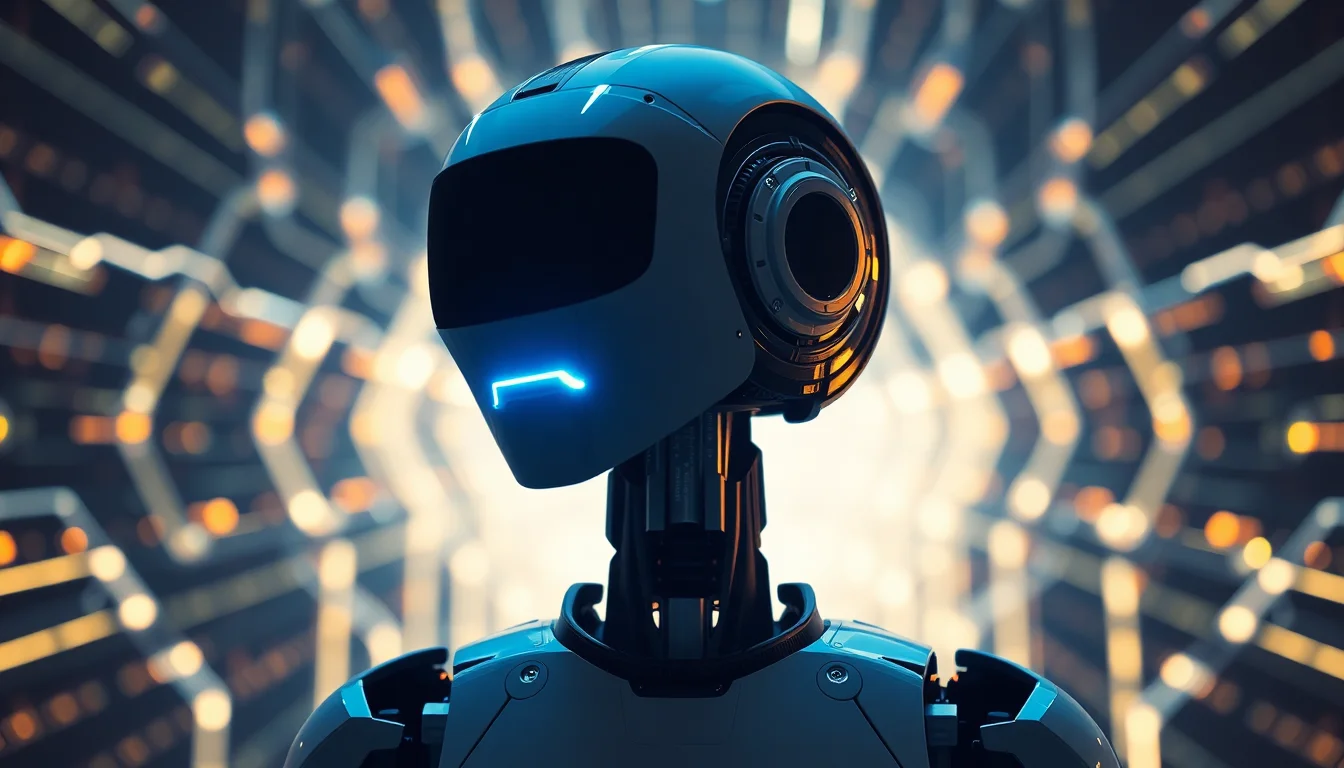
Genesis AI’s launch of Eno marks a familiar robotics ambition packaged in a more consequential way: not a single-purpose machine tuned for one workflow, but a general-purpose robot framed as a physical agent. The company says Eno is powered by GENE, its foundation model for robotics, and that the system is designed to reason across steps, adapt to conditions, and own outcomes rather than follow a narrow script. If that positioning holds up in deployment, it would compress the old robotics timeline from months of task-specific integration toward something closer to a model-led configuration cycle.
That is the claim. The harder question is whether the system can survive contact with real environments, where messy surfaces, variable lighting, human interference, and exception handling are the norm, not edge cases. Genesis AI is clearly trying to reframe the category: not a robot arm here, a mobile assistant there, but one stack that can stretch across industrial and consumer settings. That is a meaningful strategic bet because it shifts value from the hardware shell to the orchestration layer—the model, the controls, the interface, and the deployment tooling.
GENE is the product’s center of gravity
Genesis AI describes GENE as the brain behind Eno, and that matters more than the robot’s form factor. In its telling, the model does not just map perception to motion; it functions as a true physical agent capable of long-horizon reasoning and task execution. In practical terms, “long-horizon” should be read cautiously. In robotics, that usually means a system can preserve a goal across multiple substeps, recover from interruptions, and continue operating after partial failures without requiring a human to reissue every instruction.
That is a materially different proposition from the brittle automation many field deployments still rely on. The common baseline in enterprise robotics is still task-bounded control: pick, place, transport, inspect, repeat. Each extension to a new object class, floorplan, or work cell often means more tuning, more exception logic, and more operator oversight. A foundation-model-powered agent promises to reduce that integration burden by sharing perception, planning, and action policy in one system.
Genesis AI has not published the kinds of independent benchmarks that would make this claim easy to verify—no task success rates, no failure-mode taxonomy, no time-to-recover figures, no head-to-head comparison against a warehouse mobile manipulator or a teleoperated baseline. That absence does not disqualify the launch, but it does define the reading: Eno should be treated as an architecture statement until third-party pilots show how much of the claimed generality survives repeated deployment.
Minimalist hardware is a strategic choice, not a lack of ambition
Eno’s physical design is deliberately restrained. The company highlights wheeled mobility and adjustable height, along with a minimalist form that it says breaks from traditional humanoid expectations. That restraint is worth taking seriously. In robotics, fewer moving parts often means fewer failure points, simpler maintenance, and easier integration into spaces that were not designed for legged platforms.
Wheeled mobility also signals where Genesis AI thinks the immediate deployment opportunity lies. Wheels are not as glamorous as bipedal locomotion, but they are easier to operate indoors, easier to power, and more predictable on flat surfaces. Adjustable height adds practical reach without forcing the system into a more mechanically complex humanoid gait. Taken together, these design choices suggest a robot optimized for utility and uptime rather than cinematic generality.
That distinction matters for readers evaluating deployment readiness. A minimalist platform can be a capability enabler if the software layer is strong enough to compensate for hardware simplicity. It can also be a constraint if the robot is asked to operate in environments that require stairs, uneven terrain, or dexterous manipulation beyond what the chassis and end effector can support. Genesis AI is effectively betting that most commercially valuable tasks do not need maximal anthropomorphism; they need reliable mobility, sensible reach, and a model that can reason across sequences.
The cognitive interface is about auditability as much as trust
One of the more interesting parts of the launch is the optional screen version with a cognitive interface that can show what the robot is thinking and doing in real time. That is more than a UI flourish. In a safety-critical system, observability is part of control. If operators can see the robot’s current goal, planned action, and uncertainty state, they can intervene earlier and diagnose errors faster.
For enterprise buyers, that matters because autonomous systems fail in ways that are often hard to inspect after the fact. A robot that misclassifies an object, enters the wrong work path, or drifts into an unexpected state can be difficult to troubleshoot if its internal reasoning is opaque. A visible reasoning surface does not guarantee safety, but it can shorten mean time to understand, which is often the difference between a manageable incident and a system that gets sidelined.
Still, transparency is not the same as governance. A screen that reveals intent is useful only if it is paired with escalation policies, operator override pathways, logging, and post-incident review. For deployments in factories, hospitals, retail spaces, or homes, the relevant question is not whether the robot can narrate its actions, but whether that narration is auditable and actionable when things go wrong.
Full-stack positioning hints at a broader deployment strategy
Genesis AI calls itself a global full-stack robotics company, and Eno is being positioned to operate across industrial and consumer environments. That is a broad target, but it is also a revealing one. Full-stack in robotics usually implies control over the model, the hardware, the system software, and the deployment layer. In theory, that can shorten integration timelines because buyers are not stitching together a perception vendor, a motion stack, a remote ops layer, and a safety system from different suppliers.
Competitively, that puts Genesis AI in a different conversation from vendors focused on narrow industrial automation or single-environment service robots. The comparison set is less about one-off robot demos and more about platform claims: can a unified stack adapt across sites without extensive rewrites, and can it do so with operational reliability that would satisfy procurement teams?
That is where external validation will matter. Industrial buyers tend to care about time-to-operate after deployment, not just time-to-demo. If Eno can be installed and brought to useful work with materially less customization than competing stacks, that would support the thesis that foundation models can reduce robotics integration overhead. If the system still requires long commissioning periods, frequent resets, or heavy human supervision, the value proposition narrows quickly.
For now, Genesis AI’s rollout signals a shift in expectation more than a proof point. Robotics is moving from “can this machine do the task?” to “can the stack generalize fast enough to justify deployment?” That is a meaningful change in buyer psychology even before the answer is fully settled in production.
What success would actually look like
The most useful way to judge Eno is by failure tolerance and operational continuity, not by a launch video or a broad category label. A successful deployment would show that the robot can sustain a task across interruptions, adapt to a new object or layout with minimal retraining, and hand off cleanly to a human when uncertainty rises. It would also show that operators can inspect its reasoning, that logs are complete enough for audit, and that integration time is shrinking rather than moving the complexity elsewhere.
Failure, by contrast, would look more familiar: repeated human overrides, brittle behavior outside demo conditions, opaque model outputs, and a deployment process that still depends on a long tail of site-specific tuning. In that scenario, the “general-purpose” label becomes mostly a marketing abstraction over a system that remains task-constrained in practice.
Governance will decide whether the model becomes a product
Genesis AI is right to foreground transparency, but long-horizon robotics raises governance questions that a screen alone cannot solve. If Eno is expected to plan across multiple steps and own outcomes, then someone has to define where autonomy starts and stops. That includes safety envelopes, escalation thresholds, blocked actions, approved work zones, and incident logging standards.
It also includes compliance. Industrial deployments may require machine safety validation, access control, and documented operating procedures. Consumer-facing use raises a different set of concerns: privacy, bystander awareness, and clear lines around data collection and retention. In both settings, the more capable the agent, the more important it becomes to prove that the system can be constrained when it should be constrained.
That is the central tension in Genesis AI’s launch. Eno’s architecture points toward a robotics future in which cognition, control, and observability are unified in one system. But the market will not reward elegance alone. It will reward robots that can be deployed, supervised, audited, and maintained without turning every customer into a research site.
On that score, Genesis AI has made a strong technical and strategic statement. The next test is much narrower and much harder: whether Eno can deliver reliable outcomes in real environments often enough, and with enough transparency, to justify the claim that general-purpose robotics is finally becoming operational rather than aspirational.


