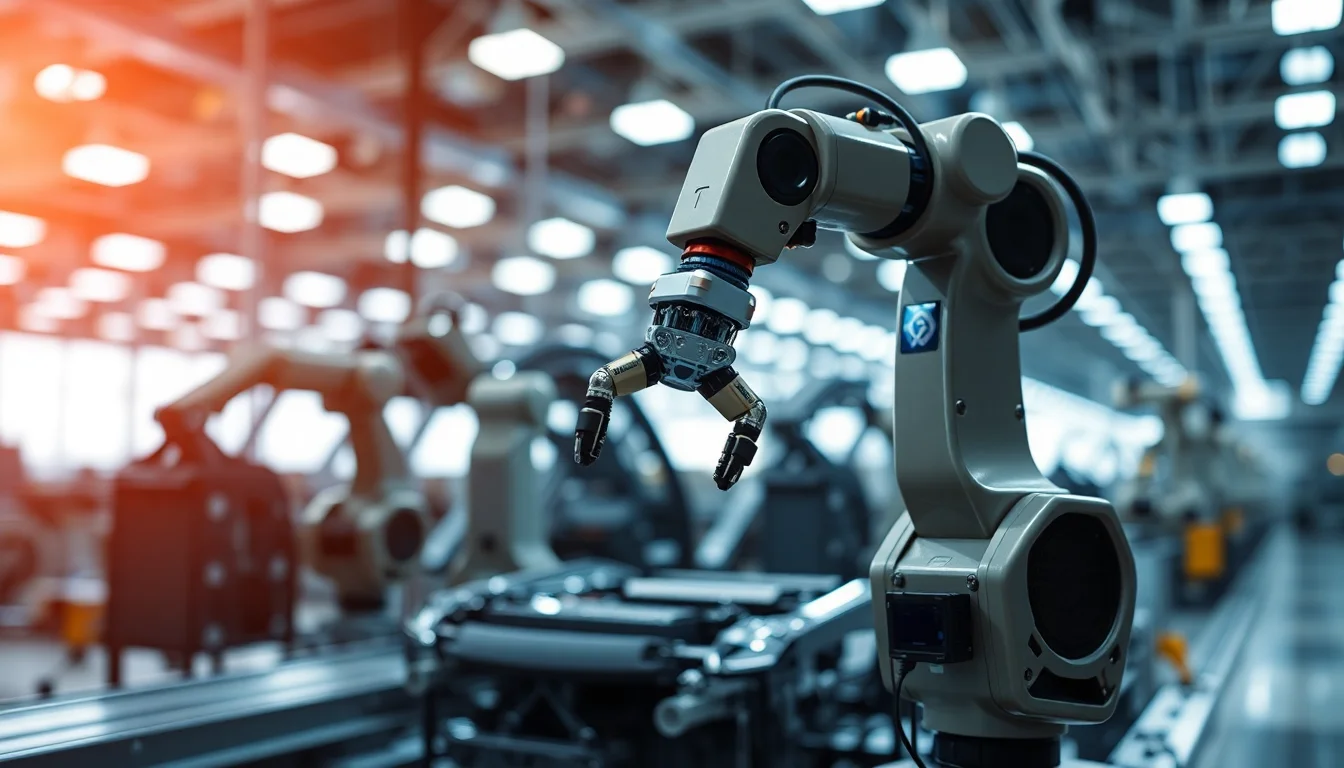
GFT is taking a familiar manufacturing AI pattern and pushing it one step further. Instead of stopping at visual inspection, the company’s new robotic arms are designed to intervene physically on auto assembly lines, removing or repositioning defective parts before they move deeper into production.
That matters because the biggest constraint in many factory AI deployments is not perception, but actuation. Vision systems can identify anomalies quickly, but they still hand off the problem to a human or a separate downstream process. GFT’s pitch is that the system closes the gap between insight and action by tying detection directly to real-time actuation on the assembly line.
According to the company’s launch, the setup uses three robots stationed along the line. One robot is equipped with a camera and gripper for scanning and handling parts, while the others support the sequence needed to identify defects and then physically remove or reposition the affected component. In practice, that kind of tri-robot workflow implies a closed loop that spans perception, grasping, and placement decisions at production speed.
For auto manufacturers, the appeal is straightforward: fewer defective parts should be allowed to continue down the line, and the factory may avoid some of the delays associated with manual intervention. The economic motivation is equally clear. The source material cites recall remediation costs of upward of $500 per vehicle in some cases, with totals that can climb into the tens of millions. That does not automatically justify every deployment, but it explains why defect handling has become a serious automation target.
The business case, though, depends on more than the robot arm itself. A system like this has to fit into existing manufacturing software and safety layers, including MES and SCADA environments, and it has to do so without introducing new bottlenecks. If the robots cannot keep pace with line speed, or if they slow the inspection-and-remediation loop, the cost of the technology can quickly outweigh the value of the defects it catches.
That is why the rollout strategy matters. A deployment path that starts with pilots and expands carefully is more credible than a factory-wide flip of a switch. Operators need to understand when the system is allowed to act autonomously, when a human must confirm a decision, and how safety interlocks behave if a part is misread or a grab fails. On a live line, the control logic is as important as the model accuracy.
This is also where GFT’s offering stands apart from standard AI vision stacks. Most industrial AI vendors still sell detection: identify the flaw, score the image, alert an operator. Closing the loop turns that into a different category of product. Once AI can not only see a defect but also act on it, the benchmark shifts from classification performance to end-to-end manufacturing control.
That broader implication matters for the rest of the market. If the system proves practical, it raises expectations for what industrial AI should do in automotive production: not just monitor quality, but participate in remediation. The result is a new reference point for auto manufacturers thinking about modernization—one that treats inspection, robotics, and control software as a single workflow rather than separate tools.
The technical caveats are significant. Assembly lines are dynamic environments, with part variance, lighting changes, fixture drift, and occasional exceptions that can confuse even strong models. Any system that is allowed to intervene physically needs robust safety interlocks, clear escalation paths, and ongoing model maintenance so it can adapt to changing parts and line conditions. Human oversight will still matter, especially in early deployments and in edge cases where confidence is low.
Still, the direction of travel is notable. Manufacturing AI has spent years proving it can detect defects. GFT is betting that the next phase is about action: a system that sees a problem and then does something about it immediately, on the line, before the defect turns into scrap, delay, or recall exposure.


