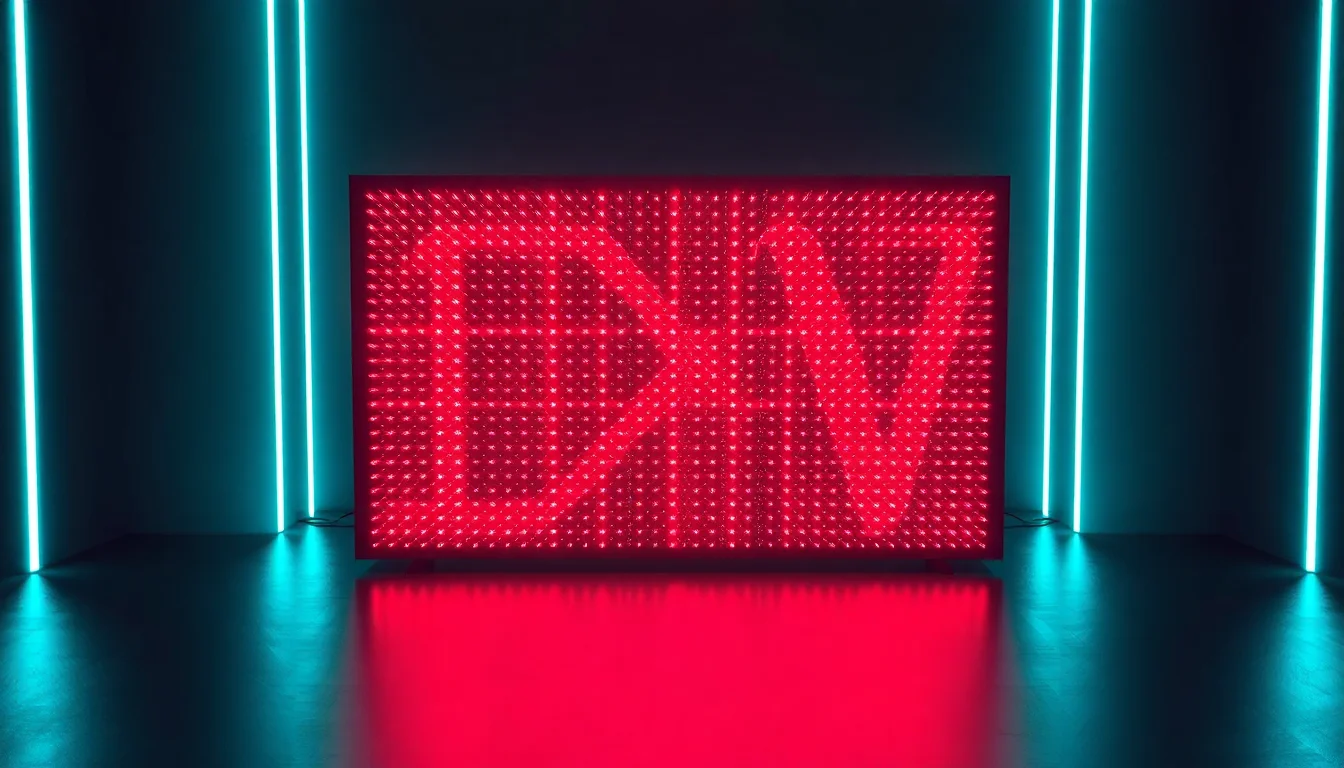
Govee’s new Lightwall is less an accessory than a shift in form factor. The company is moving beyond the familiar hanging curtain-light setup and into a self-standing LED wall that can be deployed where there is no convenient wall, and not necessarily even a nearby outlet. According to The Verge’s coverage, the Lightwall can run from a standard outlet or a large battery, making it usable in places where the older Curtain Lights Pro would have been constrained by mounting and cabling.
That change matters because it alters the product from a decorative fixture into something closer to a portable visual surface. The Lightwall ships with a self-standing aluminum frame that can be assembled in 10 to 15 minutes without tools, and when deployed it measures 7.9 feet wide by 5.3 feet tall. Inside that frame sits a 48×32 grid of 1,536 color-changing LEDs, spaced about 1.96 inches apart. For a consumer ambient-light product, that is a substantial panel density, and it is dense enough to make patterns, text-like shapes, and animated visuals more coherent from a distance than a looser curtain layout.
The technical significance is not just the LED count. The frame changes how teams think about setup, transport, and placement. Hanging panels are inherently dependent on the architecture of the room: a wall, a curtain rod, a supported surface, a safe mounting point. A freestanding frame broadens the set of valid sites. In practice, that means a demo space, a studio corner, a temporary installation, or a field-facing display at an event can be treated as a self-contained visual node rather than as a wall decoration that happens to light up.
Power flexibility reinforces that mobility. Govee’s decision to support both outlet power and a large battery is what makes the Lightwall distinct from many fixed-install displays. It does not turn the product into an untethered signage system in the industrial sense, but it does reduce dependence on building infrastructure. That is useful for temporary setups, pop-ups, and controlled environments where running power would otherwise slow deployment or limit placement options. The water-resistant design adds another layer of practical flexibility, though it does not remove the usual caution around weather, cable management, and battery runtime.
For technical readers, the more interesting question is what this enables in visual workflows. The hardware itself does not imply any built-in AI feature set, and The Verge’s reporting does not claim one. But a dense, self-standing, battery-capable panel is exactly the sort of display surface that can absorb externally generated visual content with minimal staging overhead. In other words, if a team wants to iterate on edge-generated graphics, live data visualizations, or model-driven motion experiments, the Lightwall removes several physical barriers that tend to slow those tests down: mounting, fixed power, and permanent installation assumptions.
That said, the economics are hard to ignore. At $449.99, the Lightwall costs more than twice the Curtain Lights Pro, which Govee lists at $199.99. The premium buys more than a larger LED count. It buys a self-standing aluminum frame, a denser and more presentation-friendly layout, and the ability to place the display almost anywhere power can be supplied by an outlet or a large battery. Those are meaningful upgrades if the goal is rapid deployment or flexible staging. If the goal is simply to hang a bright decorative panel on a wall, the value equation is less compelling.
That is where the product strategy gets interesting. Govee is not just selling more LEDs; it is selling a different deployment model. The Lightwall is a better fit for users who care about portability, repeatable setup, and the ability to move a display between environments. It also nudges the product line closer to use cases that resemble lightweight event signage or experimental visual surfaces, even if the company is still packaging the product as a smart-home lighting accessory.
The unresolved question is durability and ecosystem maturity. A tool-free frame and battery-friendly design are appealing on launch day, but long-term value will depend on reliability, software support, and how well the system plays with third-party control or content pipelines. For AI-adjacent workflows, that compatibility will matter more than the industrial design. A dense panel is only as useful as the software stack that feeds it, and the most important test will be whether the Lightwall can stay simple enough for consumers while remaining open enough for technically inclined users to treat it as a serious visualization surface.


