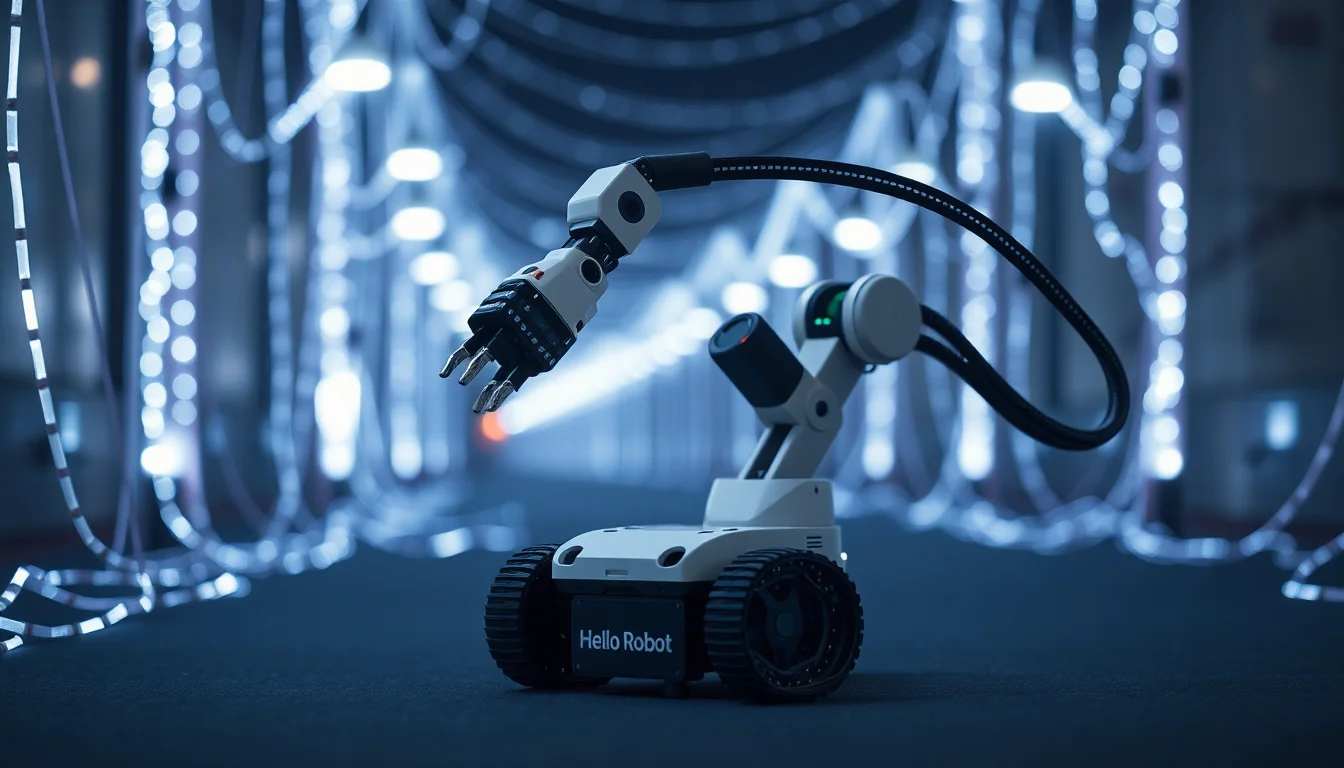
Hello Robot is trying to move open robotics from demo culture to deployment-ready tooling
Hello Robot’s new Stretch 4 matters less as a flashy robot announcement than as a signal about where research robotics is headed. Priced at $29,950 and released as an open-source platform, Stretch 4 is aimed squarely at researchers, developers, and application engineers who want a serious mobile manipulation system without stepping into the cost and opacity that often define enterprise robotics stacks.
That positioning is the point. For years, much of the robotics conversation around Physical AI has been dominated by impressive videos and narrow demos. Hello Robot is arguing for something more operational: a compact robot that is designed to work around people, integrate into real lab workflows, and expose enough of the system to let builders actually study, modify, and extend it.
A dense sensing stack is doing the safety and perception work
Stretch 4’s technical architecture is built around a sensor-rich envelope rather than a single headline capability. The platform includes two LiDARs, multiple cameras, and six laser sensors. That mix is important because mobile manipulation in shared human spaces is less about raw speed or theatrical dexterity than about awareness: knowing where the robot is, what is moving around it, and how to keep the system within safe operating bounds while it navigates and manipulates.
The design choice suggests Hello Robot is treating sensing as a systems problem. Dual LiDAR coverage can help with navigation and spatial understanding; camera arrays support object perception and scene interpretation; laser sensors add another layer of local detection around the platform. Taken together, the stack is intended to reduce blind spots that become operational liabilities when a robot is expected to function near people rather than in a fenced-off demo area.
That matters for researchers because the sensing layer shapes what kinds of autonomy stacks can be tested, tuned, and compared. A platform with transparent, well-instrumented perception is easier to plug into experimental pipelines than one that hides critical details behind proprietary interfaces.
Safety-first and people-first is not just branding here
Hello Robot is explicitly framing Stretch 4 as a robot designed to operate safely shoulder-to-shoulder with people. That phrasing sounds simple, but in robotics it implies a bundle of constraints: conservative motion planning, careful interaction design, reliable stop conditions, and an emphasis on predictable behavior in the kinds of environments where robots and humans actually overlap.
The company’s language around being “people-first” is also telling. Rather than positioning the platform as a maximal-performance machine, Hello Robot is presenting it as “simply useful” — compact, lightweight, and ready to work. That posture matters in applied research, where the barrier to adoption is often not a lack of capability in isolation, but the amount of engineering required to make a robot usable around other humans.
In practice, safety-first design changes the integration burden. Labs do not only need locomotion and manipulation primitives; they need a platform that fits into shared spaces without forcing every deployment to become a bespoke safety project. Stretch 4 appears to be aiming at that gap.
Open-source hardware and software change the research economics
The open-source dimension may be the most consequential part of Stretch 4. In robotics, openness is not just about ideology; it affects how quickly teams can iterate, how easily they can reproduce results, and how much they can trust the abstractions they are building on.
With an open-source stack, research groups can inspect the hardware design, modify system behavior, and adapt tooling to their own experiments instead of negotiating every change through a vendor. That makes the platform more useful for benchmarking and for building a shared body of work across labs. It also lowers friction for startups and application engineers who need to prototype Physical AI workflows without committing to a closed ecosystem early in development.
The broader implication is ecosystem momentum. Open robotics platforms often become more than products; they become reference points. They give the community a common baseline for algorithms, data collection, teleoperation workflows, and manipulation research. If Stretch 4 gains traction, its real value may come from the number of derivative tools and papers it enables, not only from the hardware itself.
The pricing signal places it in a different class than most robotics systems
At $29,950, Stretch 4 is not inexpensive in absolute terms, but in robotics it is a notable price point for a sensor-rich, open-source mobile manipulator. The pricing positions it between low-cost experimental kits and the higher-cost systems that are typically sold into enterprise programs with more locked-down stacks.
That hybrid position may be strategically important. Academic labs often need something sturdier and more instrumented than hobby hardware, but they also need to avoid the cost and integration constraints that come with closed systems. Early-stage companies face a similar dilemma: they need a platform that can support real-world pilots and software development before they are ready for a fully customized deployment.
Stretch 4 appears designed to occupy that middle ground. It is not being pitched as a universal enterprise robot, and the evidence does not support claims of immediate broad deployment. But it does look like a serious attempt to make research robotics more practical for teams that want to move from prototype to pilot with fewer platform-level obstacles.
The open question is not whether the hardware is useful, but whether the ecosystem compounds
Stretch 4’s long-term significance will depend on whether the open tooling around it stays active and useful. Hardware openness helps, but it is not sufficient on its own. Researchers and developers will still watch for maturity in documentation, software support, maintainability, and the community’s ability to keep the platform relevant as models and control stacks evolve.
There are also the usual robotics tradeoffs. Safety-forward systems can be more conservative than teams want. Open stacks can be powerful, but they can also shift more integration work onto the user. And a well-priced platform still has to prove that it can sustain real-world use outside of controlled lab settings.
What Stretch 4 changes, at minimum, is the baseline. Hello Robot is making the case that open robotics can be sensor-rich, safety-centered, and priced for serious use by the research community. If that combination holds up in practice, it could make the next wave of Physical AI development less dependent on closed platforms and more anchored in tooling that others can inspect, extend, and build on.


