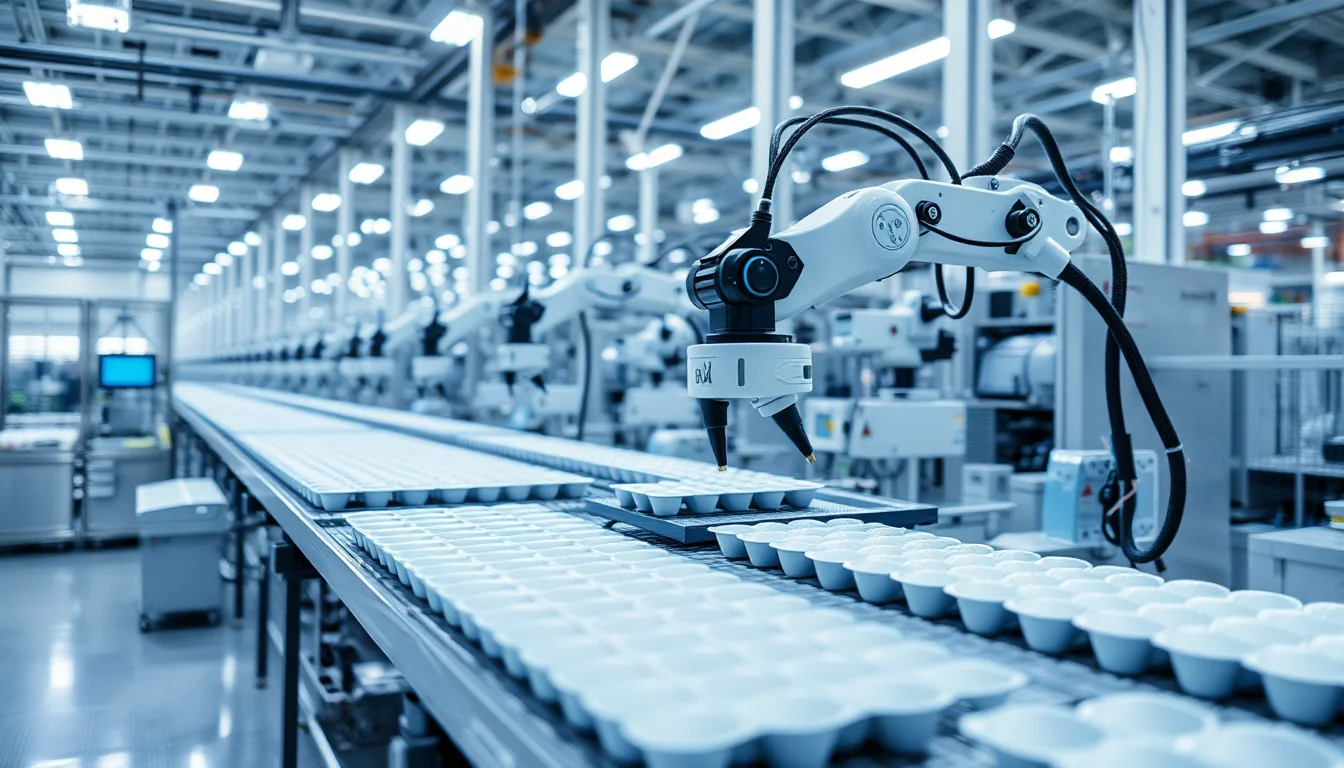
The most interesting thing about HGHY’s pulp molding production lines is not that they are automated. It is that they appear to be automated with relatively little dependence on robots.
That matters because a lot of industrial AI rhetoric still centers on robot arms, machine vision demos, and fully scripted autonomy. HGHY’s system, by contrast, points to a different operating model: robot-free automation built around integrated conveying, centralized monitoring, and AI-enabled control. In a category such as molded fiber production, where throughput, product consistency, and line uptime matter more than cinematic robotics, that architecture may be closer to what scale actually looks like.
According to reporting on HGHY’s equipment, the company is positioning integrated pulp molding lines for egg trays, egg cartons, molded fiber tableware, and industrial packaging as a unified platform rather than a set of disconnected machines. The market logic is straightforward. Manufacturers are under pressure from stricter environmental rules, higher labor costs, and rising demand for recyclable packaging. A system that can push volume while maintaining consistent output across product families has a strong pitch, especially when customers want industrial packaging alternatives that are more compatible with sustainability goals.
Robot-free automation goes to scale
HGHY’s approach is notable because it reframes automation around flow control instead of manipulation. Rather than relying on robots to pick, place, or transfer each item, the line uses integrated conveying to move material through the production process and centralized monitoring to coordinate the whole system. That is a meaningful distinction in pulp molding lines, where the production challenge is less about dexterous handling and more about keeping wet-fiber forming, drying, trimming, and transfer steps aligned.
In practical terms, robot-free automation reduces one class of complexity while introducing another. You may not have to integrate robotic cells, but you do need a tightly orchestrated conveying network, robust sensing, and a control layer capable of seeing the line as a single system. The payoff, if the integration holds, is less mechanical handoff friction and a better shot at higher throughput with more consistent product quality.
This is especially relevant for manufacturers serving multiple end markets. Egg trays and cartons have different process tolerances than molded fiber tableware, and industrial packaging adds its own requirements around shape stability and uniformity. A line architecture that can support those families under one automation stack is attractive because it standardizes the operational core while allowing product-specific tuning at the edges.
Architectural blueprint: how the stack works without robots
The technical idea behind HGHY’s system is relatively simple on paper and much harder in deployment. Conveyors carry the intermediate product through the line. Sensors feed operational data into a centralized monitoring layer. Software then coordinates timing, exception handling, and process adjustments across the production sequence.
That centralized monitoring layer is the key. In a traditional automation setup, control can be fragmented across isolated stations. In HGHY’s model, the line behaves more like an integrated system, with shared visibility across forming, transfer, drying, and downstream handling. For pulp molding lines, that helps because process drift at one stage can quickly show up as defects later in the sequence. The ability to detect and correct issues earlier is central to both product consistency and usable throughput.
The architecture also changes the failure modes. Removing robotics does not eliminate automation complexity; it shifts it. Instead of worrying about robot calibration, collision avoidance, or gripper wear, operators have to manage conveyance reliability, sensor integrity, synchronization across line segments, and software logic that can keep up with changing production conditions. For industrial packaging customers, where production runs may be customized or frequently switched, that control problem is not trivial.
AI in practice: data flows, control loops, and maintenance
The AI angle is credible here only if you treat it as a control and coordination problem, not as a vague layer of intelligence. Centralized monitoring creates the data substrate for AI-enabled control: process telemetry, fault signals, throughput measurements, quality indicators, and equipment-state data can all be fed into models or rule-based optimization layers that help operators manage the line.
That matters for three reasons.
First, process optimization. If a system can correlate temperature, moisture, line speed, and defect rates, it can support faster adjustments when output starts drifting. In molded fiber manufacturing, where material behavior is sensitive to process conditions, small changes can have outsized effects on final product quality.
Second, quality control. A centralized view makes it easier to compare performance across product types and production shifts. That does not automatically make the line “self-correcting,” but it can make variance visible enough to act on before it becomes scrap.
Third, maintenance planning. AI-enabled control is often most useful when it helps teams prioritize intervention. A conveyor fault, sensor degradation, or recurring bottleneck can be detected earlier if the system is built to observe patterns across the entire line rather than only at isolated machines. For customers, that means the real value proposition is not just automation, but fewer surprises.
There is also a governance implication. When line control depends on software and centralized monitoring, data quality becomes an operational dependency. In practice, that means industrial customers need stable schemas, clear sensor provenance, and controls that distinguish between transient noise and actionable drift. AI cannot improve what the instrumentation fails to define.
Product rollout and market positioning: breadth, risk, and timing
HGHY’s product spread is strategically important. Egg trays, molded fiber tableware, and industrial packaging cover distinct but adjacent markets, which gives the company a broader route to revenue than a single-purpose machine vendor would have. That breadth also supports a “one-stop” supplier narrative: customers can source a line family instead of stitching together separate systems for each application.
But broader coverage also tightens the coupling between hardware and software. The more the line depends on centralized monitoring and AI-enabled control, the more deployment success hinges on integration quality. Customers are not just buying machines; they are buying an operating stack.
That raises familiar industrial adoption risks. Site-specific commissioning can be time-consuming. Data integration may require custom work. Maintenance teams may need new diagnostic workflows. If the supplier’s control layer is too closed, customers can end up locked into a narrow service model. If it is too open, reliability and support can suffer.
The timing, though, is favorable. Industrial packaging buyers are under pressure to replace plastics with recyclable alternatives, and molded fiber has become one of the more practical options. HGHY is clearly aiming to meet that demand with a line architecture that promises higher throughput and product consistency without the capital intensity of robotics-heavy automation.
Implications for AI tooling and enterprise deployments
For AI product teams, the takeaway is not that manufacturing has suddenly become an AI-first domain. It is that one of the more credible industrial AI deployments may be a control stack built around centralized monitoring, integrated conveying, and selective optimization rather than autonomous robotics.
That has a few concrete implications.
Interoperable data schemas matter. Industrial AI systems need common definitions for line states, quality outcomes, fault codes, and production events. Without them, centralized monitoring becomes a dashboard rather than a decision layer.
Edge-to-cloud orchestration matters. Many line decisions need to happen close to the equipment, but enterprise reporting, fleet benchmarking, and model improvement often live upstream. If the architecture cannot bridge those layers cleanly, the AI value chain breaks.
ERP and SCADA integration matter. Manufacturers do not buy isolated intelligence; they buy systems that can connect production performance to planning, inventory, downtime management, and service operations. If HGHY’s stack is actually delivering operational value at scale, it is likely because it sits inside that broader enterprise control environment rather than beside it.
This is why HGHY’s pulp molding lines are worth watching. They are not a flashy example of factory AI in the abstract. They are a case study in how industrial packaging and molded fiber production may scale with robot-light automation, centralized monitoring, and AI-enabled control—while also exposing the integration burden, data discipline, and reliability tradeoffs that come with turning software into a production dependency.


