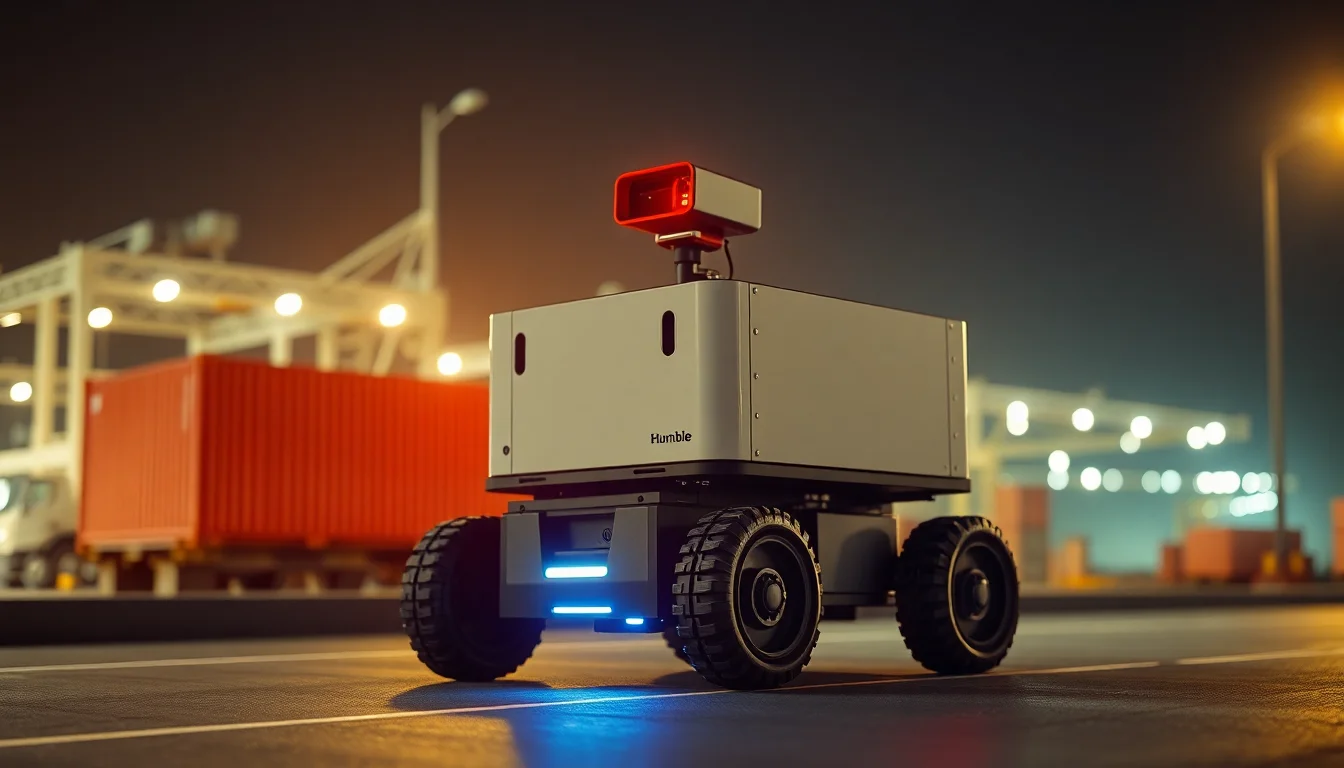
Humble Robotics has come out of stealth with something more concrete than the usual autonomy teaser: a cabless autonomous electric heavy hauler aimed at moving containers directly between docks and freight-handling areas. For an industry that has spent years hearing about self-driving freight in the abstract, the specificity matters. This is not a promise of long-haul robot trucking so much as a targeted bid to automate one of logistics’ most repeatable handoff points.
That shift from stealth to product trajectory is reinforced by the financing behind it. Humble says it has raised about $24 million in seed funding led by Eclipse, with additional backing from Energy Impact Partners and others. In practical terms, that capital level suggests a company trying to build and validate a systems product, not just a demo vehicle: hardware, perception stack, integration work, and the operational pilots needed to prove the economics.
Why the architecture matters
The Humble Hauler’s most notable design choice is also the simplest to explain: there is no cab. Removing the driver compartment is not just an aesthetic decision; it changes the vehicle’s mass distribution and makes room for a lighter platform that can be adapted to different freight environments. Humble is positioning the machine as a universal lightweight platform, which is a meaningful claim in a sector where too many autonomy projects are optimized for one facility, one workflow, or one narrow route.
A lighter base can improve payload flexibility and may simplify some deployment scenarios, but the real technical story is the sensing stack. Humble says the vehicle uses 360° sensing through camera, LiDAR, and radar. That combination is now familiar in autonomous systems, but freight yards and ports create a harsher operating envelope than many controlled industrial settings. The vehicle has to see container corners, lane boundaries, neighboring equipment, and human workers across changing weather, glare, dust, and occlusion. A full-surround perception system is a prerequisite for that environment, not a differentiator by itself.
What becomes interesting is how the perception layer ties to the claimed dock-to-dock capability. In container operations, the value is not autonomous motion in isolation; it is the ability to move a load from one operational boundary to another without handoff friction. If the system can approach a dock, align safely, interface with the loading point, and exit into the next zone without human intervention, then autonomy starts to affect cycle time and labor allocation in a meaningful way. That is still an operational claim, not a proven market fact, but it is the right target.
A first vehicle with a narrow but strategic use case
Humble says the first vehicle will move shipping containers. That is a sensible place to start. Container movement is standardized enough to support repeatable workflows, yet complex enough to test whether the autonomy stack can handle real freight conditions rather than an idealized closed course.
The company’s emphasis on dock-to-dock operation suggests it is aiming at the gaps between established automation islands. Many logistics sites already have pockets of mechanization, but the seams between them are where labor, scheduling, and safety overhead accumulate. A cabless autonomous electric heavy hauler is most compelling if it can reduce the number of manual touches in those seams.
The $24 million seed round also signals that Humble is not only building for one facility type. The company explicitly frames the platform for warehouses, railyards, and seaports, which implies a modular approach to deployment. That broad addressable surface is attractive, but it also raises the bar: a platform that claims to move between environments has to prove that its core stack generalizes without requiring a new integration effort every time the site layout changes.
Platform play, not point solution
Humble’s framing contrasts with a lot of autonomy vendors that are effectively selling one of two things: a narrow vehicle for a narrow job, or software bolted onto legacy machines. By contrast, a universal lightweight platform suggests a deeper bet that freight operators want an adaptable base layer that can be configured across use cases.
If that works, the implications are broader than one product category. Ports, warehouses, and intermodal operators are all under pressure to improve throughput while dealing with labor constraints and equipment utilization. A lighter autonomous platform could alter total cost of ownership if it cuts energy use, simplifies vehicle maintenance, or enables standardized fleet management across mixed sites. It could also matter to integrators, who often spend significant effort stitching together controls, site maps, yard management systems, and safety protocols.
But platform strategies only win if interoperability is real. The more environments a vendor wants to serve, the more it has to contend with existing software stacks, equipment interfaces, site policies, and operational edge cases. In freight automation, the technology does not fail only because perception breaks; it fails when a system cannot fit into the rhythms of live operations.
The hard part is still deployment
The big open question is not whether a cabless autonomous electric heavy hauler sounds plausible. It is whether it can be deployed safely and repeatedly in crowded freight ecosystems without creating new bottlenecks.
Dock-to-dock autonomy in a port or rail yard is a cyber-physical problem as much as a robotics one. Safety cases have to account for moving vehicles, human workers, dock infrastructure, and the possibility of sensor degradation or network issues. Cybersecurity matters because these are connected industrial systems with real operational consequences. And even if the vehicle itself performs well, the rollout still depends on regulatory approvals, site-level operational sign-off, and integration with warehouse and port IT systems.
That is where many autonomy companies discover that the market is less interested in capability demonstrations than in boring reliability. A successful pilot is useful, but operators will want evidence that the machine can survive shift changes, weather changes, maintenance intervals, and mixed-traffic conditions while preserving the safety and uptime that freight economics demand.
What to watch next
The near-term test for Humble is not how ambitious the platform language sounds. It is whether the company can show observable progress in live environments.
The milestones worth tracking are straightforward:
- pilot deployments in real freight settings, not just controlled demos
- performance data from container movement and dock-to-dock runs
- evidence that the platform can adapt across site types without bespoke re-engineering
- integration demonstrations with existing yard, warehouse, or port systems
- any indication that the operating model improves throughput or lowers handling cost without increasing safety complexity
If Humble can show those pieces working together, the launch becomes more than another stealth exit. It would suggest that autonomous freight is moving from speculative roadmaps toward a deployable category built around constrained, high-value logistics corridors. If not, the industry will likely file it alongside other autonomy ambitions that made sense technically but struggled against the friction of real operations.
For now, the important thing is that the product is legible. A cabless autonomous electric heavy hauler, a universal lightweight platform, a 360° sensing stack, and an explicit first use case for shipping containers is a much clearer proposition than a generic autonomy claim. In freight, clarity is usually the first sign that a vendor is preparing for the long work of deployment.


