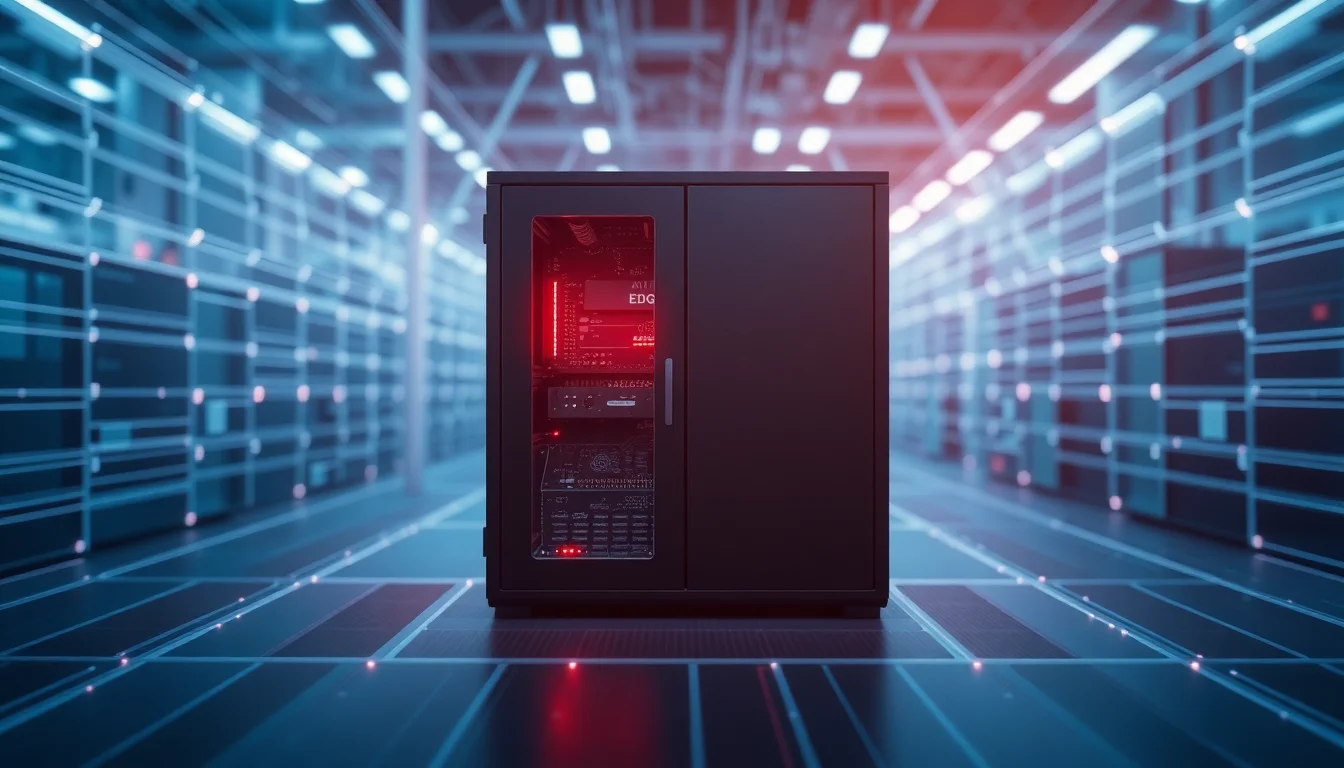
In modern factories, the control cabinet is doing more work than it did even a few years ago. Vision systems, sensors, networking gear, and controllers are all competing for the same limited footprint, and the old assumption that industrial compute belongs in a bulky box somewhere nearby is starting to look dated.
A quiet hardware shift is underway: compact industrial mini PCs are moving into roles once occupied by larger industrial PCs and even desktop-class machines. The appeal is straightforward. Smaller systems take up less space in crowded cabinets, reduce the number of failure points, and can run continuously close to the process they are monitoring or controlling. In a setting where uptime matters more than elegance, that combination is hard to ignore.
The Hystou M9 is a useful marker for the form factor. Built around Intel 12th- and 13th-generation Core i5 and i7 processors, it is positioned less like a general-purpose PC and more like a cabinet-ready controller that can stay inside an automation enclosure and handle automation logic, data processing, and edge workloads without demanding extra floor space or attention. The important detail is not the brand name; it is what the design signals about where industrial compute is going.
Why the shift is happening now
The move toward compact controllers is being driven by more than packaging convenience. Factory systems are getting denser and more data-intensive. Sensors are no longer isolated inputs. They feed machine vision pipelines, predictive maintenance models, quality inspection systems, and control loops that all need timely access to data.
That creates a practical incentive to move compute closer to the machine. When image processing, inference, and control all happen in or near the cabinet, engineers can cut latency, simplify cabling, and reduce the dependency on more remote compute paths. For robotics and automation teams, that can mean faster response times and less network overhead between the machine and the logic deciding what it should do next.
The cabinet also benefits mechanically. Smaller systems can improve layout density, leaving room for I/O modules, power distribution, and networking equipment that would otherwise force awkward compromises. Less hardware in the cabinet can also make cooling easier to manage, which matters in 24/7 environments where thermal margins are often tighter than they look on paper.
What compact mini PCs enable in practice
The most visible advantage is near-machine edge AI.
If a vision system is inspecting parts on a line, or a robot cell is using camera input to adjust positioning, the case for on-site inference is strong. A compact industrial mini PC can host the vision stack, handle preprocessing, execute inference, and pass control signals without shipping every frame to a centralized server first. That reduces latency and keeps the system more self-contained.
This is especially relevant when the workload mixes traditional automation with modern AI tasks. A controller may need to run a PLC-facing application, process sensor streams, and support model inference at the same time. The attraction of a small form factor is that it can consolidate those functions into one cabinet-friendly box rather than scattering them across multiple devices.
The Hystou M9 example matters here because it reflects the kind of hardware spec industrial teams are now considering: contemporary Intel Core CPUs in a compact chassis that is intended to live in an automation environment rather than a general office one. In other words, the market is not just shrinking boxes; it is asking whether those smaller boxes can still handle the mix of control, compute, and vision work that industrial deployments increasingly demand.
The engineering tradeoffs are real
The shift is not frictionless. If anything, it raises the bar on a few technical dimensions.
Determinism and real-time behavior remain the first question. A mini PC may be physically suitable for the cabinet, but that does not automatically make it a trustworthy control platform for time-sensitive applications. Engineering teams still need to verify whether the operating system, drivers, and workload composition can support the timing guarantees the process requires. If deterministic behavior is critical, that compatibility has to be proven in the actual stack, not assumed from the hardware profile.
I/O integration is the next issue. Factories do not run on CPU specs alone. They run on connections to PLCs, fieldbuses, sensors, motion systems, and remote I/O. A compact computer that looks efficient on a datasheet can become awkward in deployment if it needs too many adapters, cannot align cleanly with existing interfaces, or complicates commissioning. In industrial settings, integration time is often the hidden cost.
Thermal design and ruggedization are also decisive. A smaller enclosure can help cabinet density, but only if the device can tolerate continuous operation in a demanding environment. That means attention to airflow, temperature range, vibration, mounting, and long-term reliability under load. If an edge AI workload drives sustained CPU utilization, the thermal envelope matters just as much as the footprint.
Security is another point where industrial and IT priorities collide. A compact controller that sits near the machine may be more operationally efficient, but it also becomes a more attractive target if it is exposed to broader network access. Secure boot, trusted firmware practices, and careful network segmentation are not optional extras in an OT environment. They are part of making the deployment survivable.
Finally, supply-chain resilience and lifecycle planning matter more than many teams expect. Industrial deployments are built around long service horizons. If the compact PC is easier to replace in theory but difficult to source consistently, it can become a liability. Procurement teams should care about continuity of components, support windows, and the ability to standardize a platform across sites.
How teams should roll it out
For engineering teams, the right approach is not to treat compact industrial mini PCs as a universal replacement. It is to use them where the fit is strongest and validate the stack aggressively before scaling.
A practical rollout sequence looks like this:
- Start with a clearly bounded workload. Vision preprocessing, data collection, or a single robot-cell controller is a better pilot than a plant-wide migration.
- Test real-time requirements explicitly. Measure timing behavior under load, including worst-case conditions, rather than relying on nominal CPU capacity.
- Map I/O dependencies early. Confirm how the system will connect to PLCs, fieldbuses, sensors, and any legacy equipment already in the line.
- Stress thermal and environmental limits. Validate operation inside the cabinet, not just on a bench.
- Review security features with OT policies in mind. Secure boot, firmware update paths, identity management, and segmentation should be part of qualification.
- Check vendor continuity. Ask for lifecycle commitments, configuration stability, and a migration path if the platform is later refreshed.
For procurement, the market-positioning question is equally important. The right mini PC is not simply the cheapest or smallest option. It is the one that can be standardized across a deployment without creating integration debt. That means favoring vendors that can document real-world industrial use, support long-term availability, and provide a clean upgrade path from older industrial PCs.
The broader trend is easy to miss because it looks incremental: a smaller box here, a tighter cabinet there. But the operational consequences are real. Compact industrial mini PCs are making it easier to place compute where it is actually needed, which is exactly why they are becoming more common in robotics and automation.
What they are also doing is shifting the burden of proof. As compute moves closer to the machine, the engineering question is no longer just whether a device fits in the cabinet. It is whether it can maintain determinism, survive the thermal and security realities of the shop floor, and integrate cleanly with the control stack already there.


