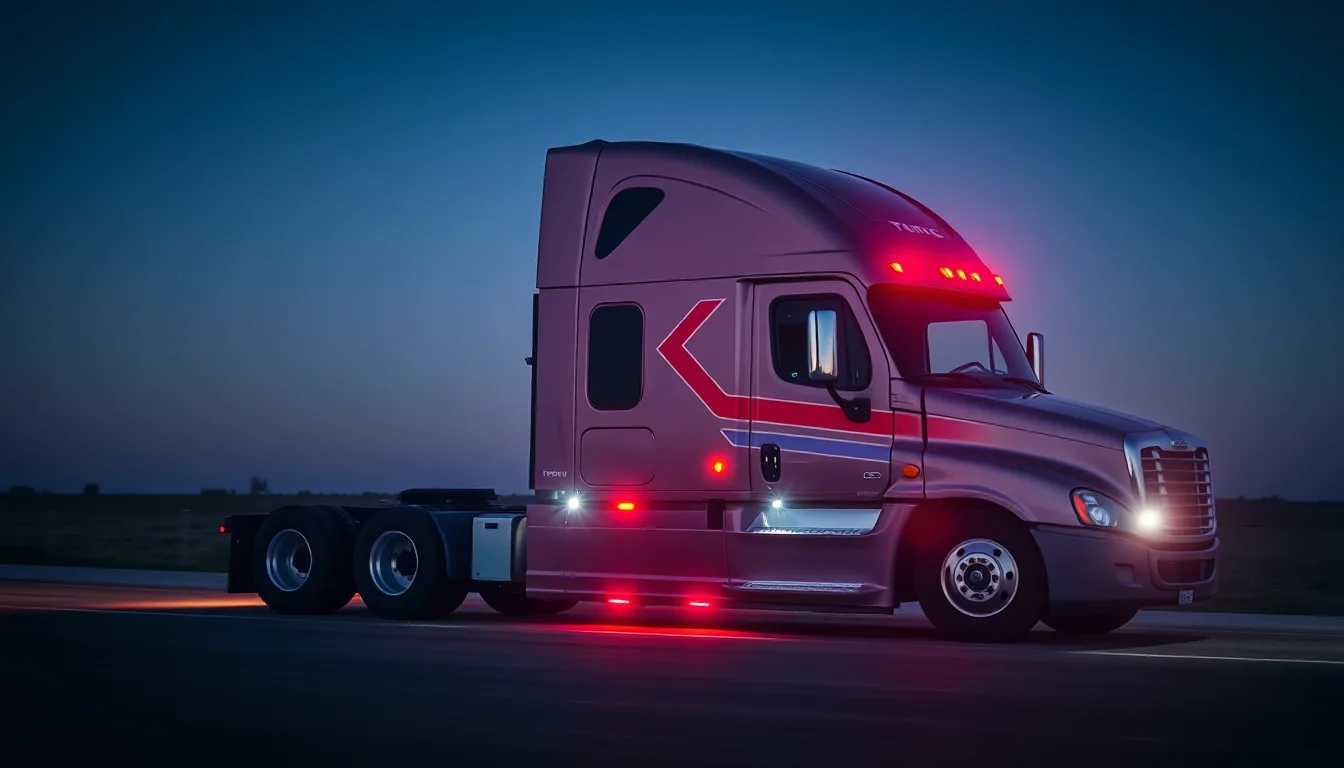
Inside Torc Robotics
Torc Robotics is crossing a line that has defined autonomous trucking for years: the distance between long-running R&D and something that looks, operationally, like a commercial program. Its Level 4 system is now being deployed on the Freightliner Cascadia in partnership with Daimler Truck, with testing spread across Texas, Virginia, Michigan, and an expanding presence in Ann Arbor. That matters because the question is no longer whether autonomous freight can be demonstrated on constrained routes, but whether it can be maintained, validated, and scaled inside an OEM-backed platform that has to live in the real world.
For readers tracking AI products and deployed autonomy, the significance is not the branding of the truck. It is the shift in operating assumptions. A Freightliner Cascadia running Torc’s stack is not just a vehicle with autonomy software bolted on; it is an OEM-integrated system that has to respect hardware constraints, service workflows, vehicle diagnostics, and the safety expectations that come with commercial freight. That changes the technical bar. It also changes who has to trust the system: not just a test team, but fleets, maintenance organizations, regulators, and an OEM with a long-term product roadmap.
Scaling the autonomy stack is mostly a systems problem now
At Level 4, the core challenge is not proving that perception works in a clean demo environment. It is keeping perception, planning, and control coherent under varied road geometry, traffic behavior, weather, and operational edge cases, while preserving enough determinism for a credible safety case. Torc’s move toward commercial deployment suggests that the stack is being treated less as a research artifact and more as a production system.
That distinction matters. To scale across a fleet, the autonomy stack has to do several things at once:
- fuse multiple sensor streams with low latency and enough redundancy to handle partial degradation;
- maintain fault-tolerant planning when inputs become noisy or incomplete;
- coordinate actuation with the timing constraints of a heavy vehicle platform;
- support software update and validation workflows that do not destabilize fleet operations;
- preserve traceability for safety reviews, incident analysis, and continuous improvement.
In autonomous trucking, the architecture cannot be judged only by peak capability. It has to be assessed by failure handling, maintainability, and the ability to prove that the system behaves within its intended operational design domain. That is where OEM partnership becomes technically meaningful rather than merely strategic: Daimler Truck involvement implies tighter integration between autonomy software, chassis systems, diagnostics, and the broader product lifecycle of the Freightliner Cascadia.
Multi-state testing is a validation problem as much as a deployment one
Torc’s testing footprint across Texas, Virginia, Michigan, and Ann Arbor points to a practical truth about commercial autonomy: scale is geographic before it is numerical. The more sites and operating conditions the system spans, the more the team has to manage data consistency, fleet telemetry, localization performance, and maintenance cadence across environments that are not identical.
That creates a data architecture problem. Distributed testing requires a pipeline that can ingest high-volume sensor logs, annotate edge cases, compare behavior across routes, and feed model iteration without breaking traceability. If the same autonomy stack is being exercised in multiple states, then the company also needs clear rules for configuration control, software versioning, and validation gates. Otherwise, it becomes difficult to know whether performance changes are caused by the model, the route, the weather, the truck configuration, or the operational process around it.
Ann Arbor is especially notable because it signals that Torc is not just accumulating road miles in isolated corridors; it is building a broader engineering and validation presence. That kind of footprint is usually a sign that the hard work has moved from singular demonstrations to repeatable operations. In practice, that means more time spent on simulation-to-road correlation, remote monitoring, and safety-case evidence than on headline-grabbing milestones.
The Daimler Truck partnership changes the commercialization math
The Daimler Truck relationship is central to understanding why this deployment is more than another autonomous vehicle announcement. An OEM-backed platform changes both the risk profile and the path to market. It gives the autonomy developer access to a production-grade vehicle architecture, manufacturing discipline, and service infrastructure that a standalone startup would struggle to replicate on its own. It also imposes discipline: the autonomy system has to fit the truck, not the other way around.
That matters for customers. Freight operators evaluating Level 4 autonomous trucking will care less about abstract autonomy claims than about uptime, serviceability, and how the vehicle behaves in a fleet context. An OEM-supported Cascadia program can make the offering easier to evaluate because it ties the autonomy stack to an established truck platform rather than a one-off prototype. It also raises the bar for vendor support, because the whole system has to be compatible with commercial maintenance schedules and operational accountability.
For the market, the implication is clearer competition around integrated freight autonomy. If the platform is genuinely commercialized, the field will increasingly reward companies that can pair autonomy software with manufacturing, support, and fleet integration. That favors partnerships that look less like technology licensing and more like product co-development.
Readiness now hinges on safety validation, not just capability
The biggest constraint on any Level 4 deployment is still safety case maturity. The system has to demonstrate that it can operate within a defined envelope, detect and respond to failures, and remain robust enough that fleet operators can rely on it at scale. That requires not only on-road performance but also a documentation and verification process that can withstand scrutiny from OEM engineers, insurers, and regulators.
The near-term milestones that matter most are not dramatic. They are operational:
- expanding validated operating domains without weakening reliability;
- showing that software updates can be introduced safely and repeatably;
- proving that sensor, compute, and vehicle subsystems remain stable under long-haul duty cycles;
- integrating safety monitoring with fleet operations and maintenance routines;
- building evidence that the system behaves consistently across states and deployment sites.
Those are the markers that separate a promising autonomy stack from one that can support commercial deployment. If Torc can sustain that discipline inside a Daimler Truck-backed program, the Freightliner Cascadia rollout will look less like a technical showcase and more like the beginning of a scalable freight autonomy product line. If it cannot, the gap between demonstration and fleet readiness will remain visible in the most unforgiving way possible: in commercial operations.
What makes this moment notable is not that autonomous trucking has suddenly become easy. It is that the industry is being forced to treat it as an industrial engineering problem. Torc’s expansion across Texas, Virginia, Michigan, and Ann Arbor, on an OEM-backed Cascadia platform, suggests the conversation has moved to the right level of abstraction: not whether autonomy can be shown, but whether it can be sustained, verified, and supported like a real freight product.


