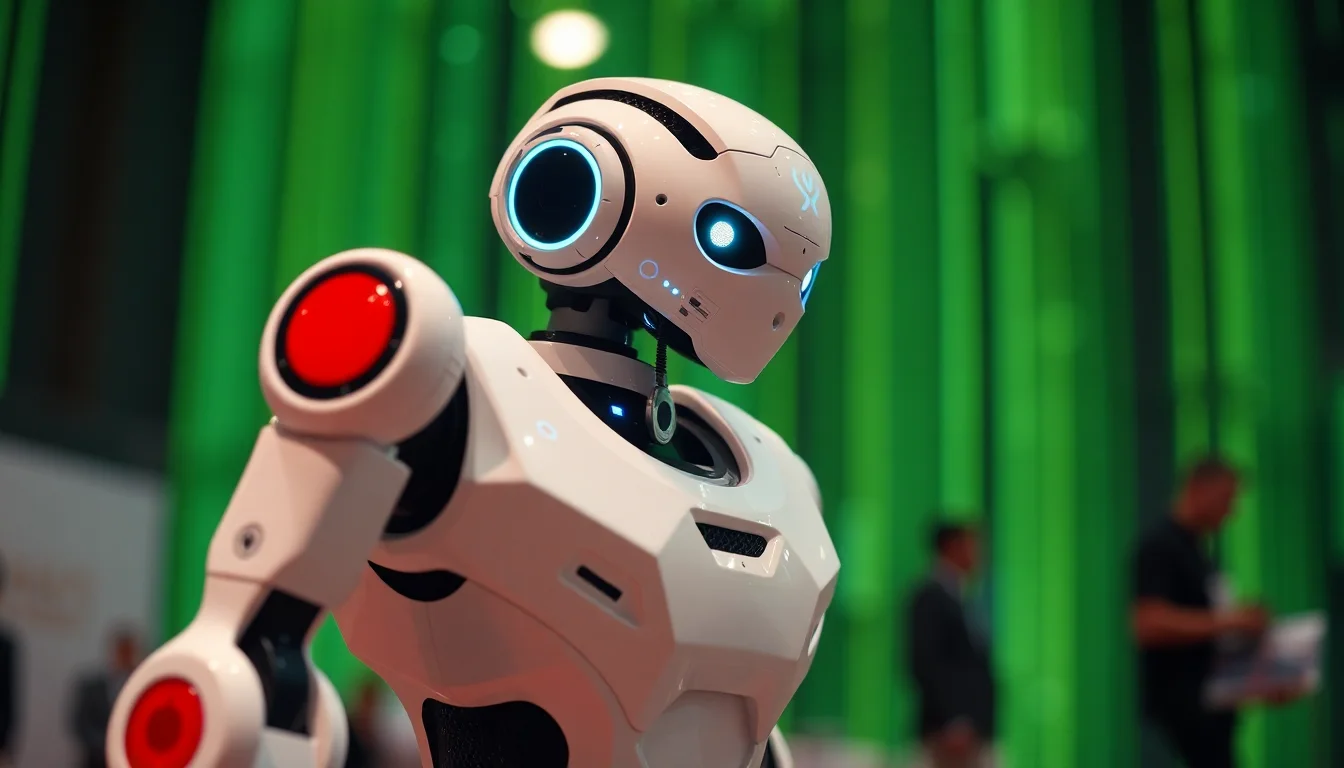
Kawasaki Robotics used Automate 2026 to make a clear technical statement: the next phase of industrial AI is not just smarter software bolted onto existing robots, but robots designed from the start to coordinate perception, planning, and motion in one control stack.
The company’s centerpiece was the RL030N, Kawasaki’s first 8-axis, or 8DoF, robot platform built for Physical AI. The pitch matters less as branding than as architecture. Instead of treating AI as an upstream planning layer and the robot controller as a separate downstream system, Kawasaki is positioning the RL030N around a real-time KRNX control API that coordinates AI software, ROS, machine learning, and vision systems. In practical terms, that creates a tighter control loop for tasks that need continual sensing, re-planning, and motion correction in constrained workcells.
What changed at Automate 2026
The significance of the RL030N launch is that Kawasaki is not simply adding another manipulator to its catalog. It is introducing a platform that assumes the robot will be part of a larger software-defined automation stack. That is a different design target from conventional multi-DOF industrial robots, where the motion controller often sits apart from the higher-level perception and optimization tools.
An 8-axis platform gives integrators more freedom to avoid awkward repositioning when fixtures, tooling, or part geometry make a standard 6-axis arm run out of kinematic options. The extra degree or pair of joints is not inherently novel, but it becomes strategically important when paired with software that can exploit that added dexterity in real time. Kawasaki’s framing of the RL030N as a Physical AI robot suggests that the company expects perception and planning to be continuous inputs, not intermittent pre-processing steps.
That shift was reinforced by the company’s live demo of its patented Pulseboard weld inspection technology, shown in a robotic welding context developed with Fives DyAG. Rather than presenting AI as a generic analytics layer, Kawasaki put it into a task where sensing, inspection, and robotic action have to stay synchronized if the system is to be useful on the shop floor.
Inside RL030N: architecture, KRNX, and the AI loop
The technical idea behind RL030N is the coupling of an 8-axis mechanical platform with a control interface designed to orchestrate multiple software domains. Kawasaki describes KRNX as a real-time control API for coordinating AI software, ROS, ML, and vision. That matters because these components usually live in different timing regimes.
ROS-based perception pipelines are often modular and flexible, but not automatically deterministic. ML models can improve decision quality but introduce latency, versioning complexity, and validation burdens. Vision systems contribute high-value context, but they also need to be synchronized with motion planning and safety logic. KRNX appears to sit at the boundary between those layers and the robot controller, aiming to make them act like one coordinated loop rather than a set of loosely connected services.
That integration problem is where many industrial AI projects stall. A model may identify a seam, defect, or part pose correctly, but if the robot cannot consume that result within the timing constraints of the application, the insight does not translate into action. Kawasaki’s bet is that a real-time API surface can reduce the glue code and middleware sprawl that typically accumulates when vision, ML inference, and motion control are stitched together by system integrators.
The question, of course, is how far that coordination extends in practice. The tighter the loop, the more demanding the requirements become around latency budgets, synchronization, fault handling, and safety certification. A platform that exposes more of the control path to software can be more capable, but it also narrows the margin for error.
Dexterity in practice: welding, inspection, and confined-space tasks
The Pulseboard weld inspection demo is useful because it grounds the product story in a real manufacturing workflow rather than a generic autonomy narrative. Weld inspection is a good stress test for Physical AI because the robot has to operate in a structured but imperfect environment: seams vary, access can be tight, and the system must inspect and react without losing positional context.
In that setting, the value of an 8DoF platform is not abstract. Additional articulation can reduce the need to reorient the entire workpiece or the robot base, which can simplify cell design in cramped layouts. It can also help maintain tool orientation during inspection or welding paths where a 6-axis arm would need more elaborate trajectory planning or compromise on approach angles.
Kawasaki’s live demo suggests the company is aiming at workflows where perception-to-action latency and geometric flexibility matter at the same time. That is important for manufacturing teams evaluating whether AI should be a bolt-on inspection layer or a more deeply integrated control capability. If the robot can inspect, interpret, and adjust in one loop, then the performance metric is no longer just cycle time or accuracy in isolation. It becomes end-to-end task completion under real plant constraints.
Productization and ecosystem: MXP360L, BA013L, and tooling
Kawasaki also used the event to introduce the MXP360L and BA013L industrial robots, broadening the immediate product backdrop around RL030N. That matters because platform shifts rarely land as a single product; they usually arrive as a family of hardware, software interfaces, and integration paths meant to reduce adoption friction.
For developers and integrators, the real issue is not whether Kawasaki can demonstrate a compelling cell on a trade-show floor. It is whether KRNX becomes a credible tooling layer for building production systems across AI software, ROS components, ML services, and vision stacks. If the API is genuinely real-time and sufficiently documented, it could streamline a class of applications that today rely on custom middleware and brittle coordination logic.
But that same architecture can also create a stronger vendor dependency. The more the control loop is centered on a proprietary interface, the harder it can be to swap components, reuse models across platforms, or standardize tooling across a mixed fleet. Manufacturers already face that tradeoff with robot controllers and vision systems; a Physical AI stack intensifies it by putting more of the application logic inside the vendor-defined coordination layer.
That is why ecosystem maturity will matter as much as hardware capability. Integrators will want to know how KRNX fits with existing ROS deployments, what latency it can tolerate, how failures are surfaced, and how much of the stack can be audited or simulated before deployment. In industrial settings, software elegance is secondary to maintainability, observability, and predictable behavior under load.
Implications for the market
Automate 2026 is increasingly functioning as a signal for where robotics and AI are converging in industrial automation. Kawasaki’s RL030N launch fits that trend, but it also sharpens the market’s core question: are vendors moving toward truly integrated physical AI systems, or are they simply rebranding advanced robot control with AI vocabulary?
The evidence here leans toward the former, at least architecturally. An 8-DoF robot built explicitly for Physical AI, paired with a real-time API that coordinates ROS, ML, and vision, is a different proposition from a conventional robot arm with a vision add-on. It suggests that the next wave of automation products will be judged not just by payload or reach, but by how well they unify sensing, reasoning, and actuation.
Still, the launch also highlights the risks. Real-time reliability, safety validation, and integration overhead remain hard problems. If the platform is too closed, it may slow adoption among teams that rely on heterogeneous toolchains. If it is too open without enough guardrails, the burden shifts back to the integrator. Either way, the commercial success of this category will depend less on demo quality than on whether manufacturers can deploy it inside existing operational, safety, and maintenance workflows.
Kawasaki’s message at Automate 2026 was therefore less about one robot than about a new integration model. The RL030N shows how the company thinks Physical AI should be built: as a coordinated system where motion, perception, and decision-making are designed to work together in real time. The next test is whether that model can survive the messy realities of production environments.


