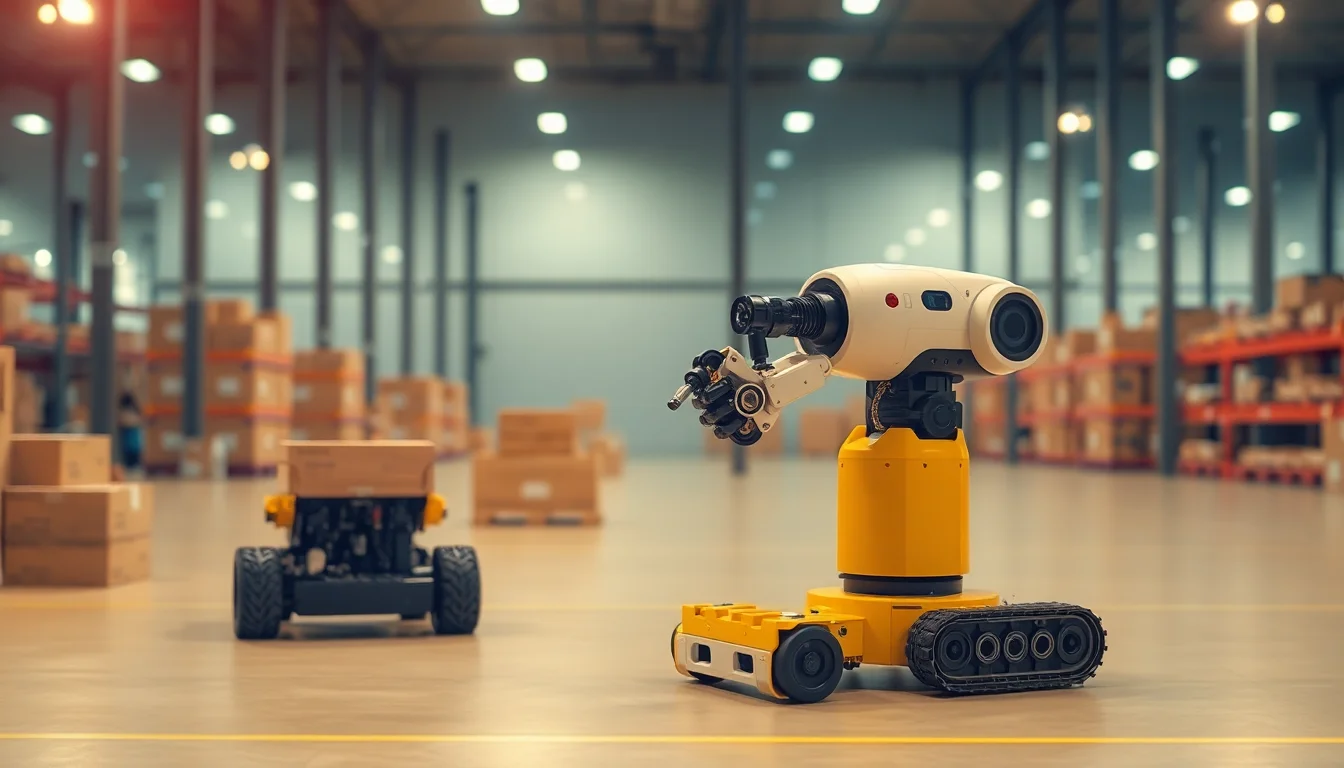
Locus Robotics’ acquisition of Nexera Robotics is less a bolt-on purchase than a clear statement of direction: the company wants to move from autonomous navigation and robot-to-goods workflows toward a fuller hardware-software stack for warehouse manipulation. According to Locus’ announcement, Nexera’s NeuraGrasp end-effector will be integrated into the Locus Array platform, giving the system a more capable manipulation layer at a moment when warehouse operators are asking autonomy systems to handle messier inventories, tighter space constraints, and more of the pick cycle without human intervention.
That matters because the hard part of warehouse autonomy is no longer just getting a robot to the right shelf location. The bottleneck is often the grasp itself: identifying a viable contact point, adapting to varied packaging, recovering from partial occlusion, and completing the transfer reliably enough for production use. Locus is signaling that it wants to widen the autonomous mobile manipulation envelope by combining its existing mobile platform with Nexera’s specialized grasping technology rather than relying on perception-and-pick pipelines alone.
What NeuraGrasp adds to Locus Array
Nexera’s NeuraGrasp end-effector is the core of the deal. In practical terms, it is meant to extend manipulation beyond simple pick motions into a more adaptive grasping layer that can deal with varied SKUs and object presentations. The company’s framing emphasizes AI-driven grasp planning and dexterous manipulation, which suggests the value is not only in the mechanical end-effector itself but in the software that chooses and executes grasps under real warehouse conditions.
For a platform like Locus Array, that should broaden the set of items it can handle across end-to-end fulfillment workflows. The obvious gain is SKU reach: packages with irregular shapes, less predictable surfaces, or orientations that complicate standard suction or fixed-gripper strategies become more tractable when the grasping system can adapt in real time. Just as important, NeuraGrasp appears aimed at in-hand transitions and other manipulation tasks that sit between “locate object” and “complete pick,” which is where many warehouse systems lose reliability.
The acquisition announcement also points to an API surface and integration path rather than a closed appliance. That matters for deployment because the value of an end-effector is partly determined by how cleanly it can be orchestrated from the existing stack. If the API exposes grasp proposals, execution states, and error conditions in a way that Locus Array can consume, then the new capability can be integrated into the same operational framework that already governs navigation, task allocation, and fleet control.
The integration architecture will hinge on a perception-to-pick loop
The technical challenge is not merely attaching a new gripper to an existing robot. The planned integration has to stitch together perception, grasp planning, motion planning, and low-level control into one coherent loop. In warehouse terms, that means the system must first perceive the item and its context, then propose a grasp, then execute the motion needed to realize that grasp, and finally validate success before handing off the item or retrying.
That loop has to be resilient. In production environments, perception often produces incomplete or noisy object poses, grasp planners can produce feasible but brittle candidates, and control systems have to deal with physical variance such as item slippage, unexpected friction, or bin clutter. The acquisition makes sense precisely because it gives Locus more control over the manipulation side of that loop rather than treating grasping as a generic commodity function.
Safety and fault tolerance will be central to whether the integration is operationally useful. A more dexterous end-effector can also introduce more ways to fail if the system does not bound force, detect collisions, and define crisp abort conditions. That means the stack will need conservative motion constraints, explicit recovery behavior, and validation gates that decide when to retry a grasp, re-perceive the scene, or fall back to a safer manual intervention path. The interesting question is not whether the system can attempt more types of grasps, but whether it can do so without degrading uptime or increasing incident risk.
Operational impact: more SKUs, but also new failure modes
If the integration works as intended, the most immediate operational effect should be broader SKU handling. Locus is already positioning Array as an autonomous robot-to-goods platform; NeuraGrasp should push it closer to end-to-end fulfillment by reducing the class of items that sit outside the robot’s reliable grasp envelope. That could mean better coverage across bins and totes, fewer exception items, and a higher share of picks that can stay inside the autonomous workflow.
Throughput is the harder metric to call, and the announcement does not provide hard performance numbers. Still, the likely operational story is straightforward: even modest gains in grasp success and SKU coverage can improve effective throughput if they reduce interruptions, retries, and human handoffs. In a warehouse setting, the system that completes more picks without exception handling often matters more than the one with the highest theoretical pick rate in a controlled demo.
The tradeoff is that expanded capability usually comes with a wider failure-mode profile. More dexterity can mean more sensitivity to calibration drift, object variability, and edge cases that were previously handled outside the robot’s scope. Operators should expect new monitoring requirements around grasp success rates, retry frequency, item damage risk, and any latency added by the perception-grasp-control cycle. In other words, the acquisition may improve the ceiling, but deployment teams will still need to watch the floor.
A platform play in a crowded autonomy market
The broader market implication is that Locus is leaning into platform-centric autonomy at a time when competitors are also trying to move beyond narrow task automation. Mobile robotics vendors have long differentiated on navigation, fleet coordination, and workflow software; the next layer of differentiation is whether they can consistently perform useful manipulation in unstructured warehouse environments.
By combining a mature autonomous mobile base with a specialized grasping layer, Locus is trying to set a higher baseline for what “fulfillment autonomy” means. That is a stronger strategic position than selling a standalone manipulator or a navigation stack in isolation, because warehouse buyers increasingly want systems that can bridge the full sequence from task assignment to item transfer. Competitors will be pressured to answer with either better grasping, tighter software integration, or a clearer proof point on uptime and deployability.
Rollout will likely be staged, not immediate
Locus has not disclosed a full deployment schedule or customer-by-customer migration plan, so the prudent expectation is a staged rollout. Initial pilots will likely focus on representative SKUs and conditions that stress the grasping stack without overwhelming it: varied packaging, mixed object geometries, and warehouse layouts that force the system to show whether the perception-to-pick loop is robust under production noise.
For existing customers, the key question will be how much of the upgrade is additive versus disruptive. If NeuraGrasp can be integrated as a capability layer inside the current Locus Array software stack, customers may be able to adopt it without reworking their broader fleet operations. But any new manipulation module also brings support implications: revised validation, updated uptime expectations, new exception handling procedures, and training for operators who will need to interpret a richer set of robot behaviors.
That is the real test of the acquisition. The market does not need another robotics announcement about autonomy in the abstract; it needs evidence that a platform can handle more inventory, more gracefully, without making the system harder to run. Locus is betting that Nexera’s grasping technology will help it do exactly that. The technical promise is credible. The execution challenge is still substantial.


