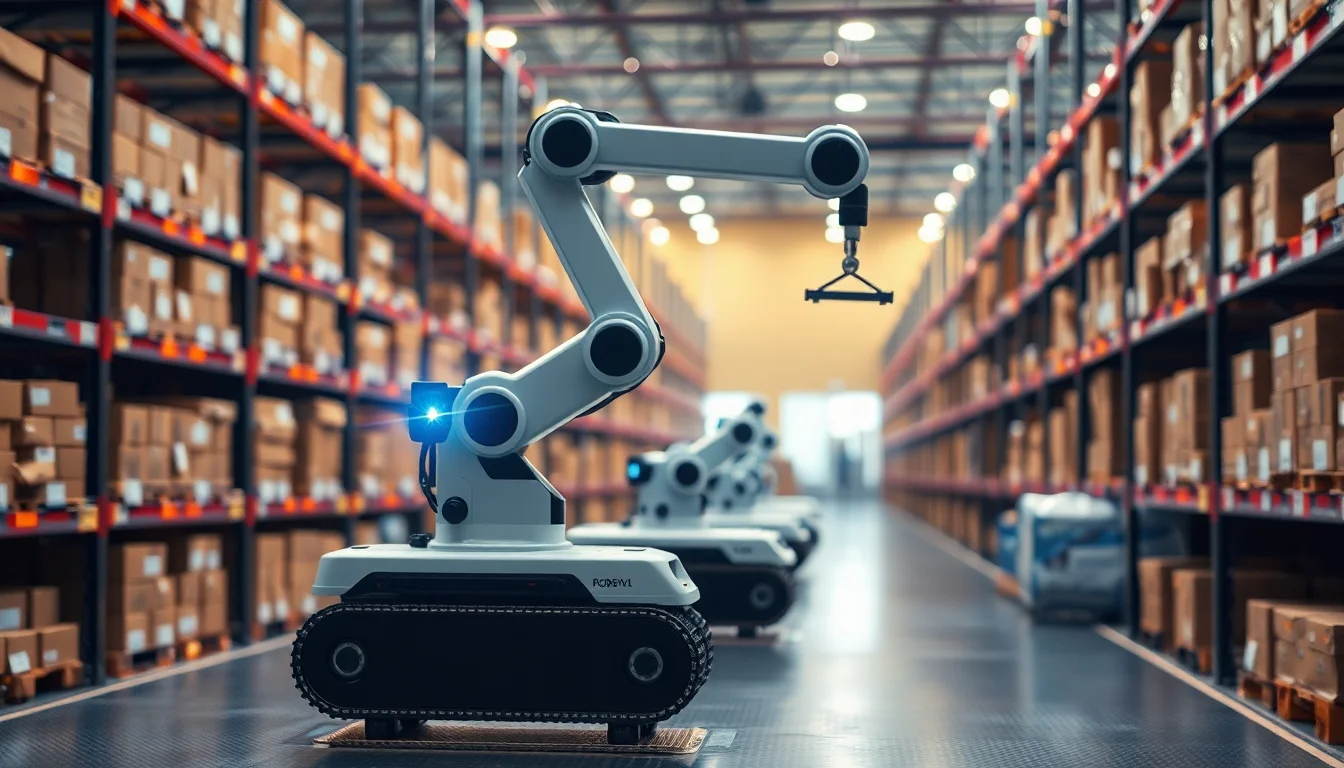
Locus Robotics is making a pointed claim with its latest launch: warehouse automation is moving from partial task automation toward a fully autonomous fulfillment stack. The company’s new Locus Array is being positioned as an end-to-end system that combines mobile robots, an integrated robotic picking arm, and AI-powered perception to execute workflows without manual intervention.
That framing matters because most warehouse automation systems have historically been modular. They automate a slice of the operation—transport, storage, picking assistance, sorting—but still rely on humans to bridge the seams between those functions. Locus Array is being pitched as something more integrated: a platform-level approach in which perception, planning, and execution are orchestrated as one system rather than stitched together as separate tools.
According to Locus Robotics, deployments are already underway with early access customers in North America, and DHL Supply Chain is among the named users in live operations. The company says it will scale the platform beyond the initial region into Europe and APAC, signaling that this is meant to be a commercial rollout rather than a lab demonstration.
What changed in warehouse autonomy
The significance of Locus Array is not that it introduces robotics to fulfillment. Locus already operates in warehouse automation. The shift is that the company is now claiming the orchestration layer itself can manage an end-to-end fulfillment flow.
That is a higher bar. In a modular warehouse stack, an autonomous mobile robot can move inventory, a separate station can handle picking, and a warehouse management system can coordinate the work. But the handoffs are where real-world complexity accumulates: item localization, exception handling, congestion, shifting demand, and the mismatch between planned routes and physical conditions on the floor.
Locus’s pitch is that Array reduces those seams by fusing the elements into a single operating model. The company describes the system as combining mobile robotics, an integrated picking arm, and AI perception to complete workflows with no manual intervention. In practice, that implies a more tightly coupled control loop: perception identifies the state of the environment, planning determines the next action, and execution carries it out through the robots and arm as one coordinated process.
That architecture is what gives the product its strategic weight. If it works reliably, it would move warehouse automation away from a collection of point solutions and toward a system that can absorb variability without requiring a human operator to mediate every edge case.
The technical stack: perception, planning, and execution
The details in Locus’s announcement point to a classic autonomy stack, but applied to a warehouse setting where the environment is structured, yet far from static.
At the front end is AI-powered perception. In a fulfillment setting, perception is not just about recognizing objects; it has to understand the robot’s surroundings, the state of the pick location, and any obstacles or deviations from expected conditions. The harder problem is not detection alone, but maintaining a correct, current model of the workspace while things are constantly changing.
That feeds into planning. Here, the system has to decide how to sequence tasks, route mobile robots, and coordinate the integrated arm with the rest of the workflow. In a real warehouse, planning has to account for congestion, priority shifts, inventory uncertainty, and the need to preserve throughput without creating bottlenecks at pick or transfer points.
The final layer is execution, where mobile robots and the picking arm perform the physical work. This is where the promise of “fully autonomous” fulfillment is either validated or exposed as aspirational. The system has to complete handoffs cleanly, recover from small errors without collapsing throughput, and maintain enough reliability that human intervention is unnecessary for routine operation.
What is notable about Locus Array is that the company is not describing these as independent modules loosely connected through software. It is presenting them as a unified stack, with system-level orchestration designed to manage the workflow from end to end. That distinction is central to the product’s positioning.
Deployment model and early customer signals
Locus is rolling out Array first in North America, and it has already identified DHL Supply Chain as a principal early-access customer. That is a meaningful signal for two reasons.
First, early access in a real customer environment suggests the company is betting on operational proof rather than a broad, speculative launch. Warehouse autonomy often looks strongest in controlled demos and weakest in live facilities where labor patterns, SKU mixes, and throughput targets shift continuously. Deploying with an established logistics operator gives the platform a test bed that is closer to production reality.
Second, DHL’s involvement gives the launch commercial credibility without implying universal fit. Large third-party logistics providers are among the hardest customers to serve because they operate across many facility types and process profiles. If Locus Array can perform in that environment, it strengthens the case for the platform’s adaptability. But it also raises the bar: the system has to work not just in one highly tuned site, but across operational variability that is intrinsic to enterprise logistics.
Locus also says it intends to expand Array into Europe and APAC. That suggests the company is thinking in terms of platform rollout, not one-off deployments. Cross-region expansion, however, is where autonomy products often encounter their hardest constraints: local compliance, infrastructure differences, integration requirements, support models, and the need to retrain deployment and operations teams for different site conditions.
What this means for automation economics
The economics of warehouse automation have always depended on more than raw speed. Buyers are evaluating labor availability, peak demand handling, uptime, exception rates, and how much operational complexity the system pushes back onto the customer.
Locus Array’s value proposition is tied to the premise that fully autonomous execution can reduce the human coordination burden that still surrounds many automation deployments. If the system can sustain consistent throughput and reliability in live operations, it could change how operators think about labor allocation, capacity planning, and the cost of absorbing variability.
But that is the conditional part: if. The business case for a system like Array will depend on how well the stack handles the messy realities of warehouse work. Labor constraints and demand volatility are real, which is why interest in autonomous fulfillment persists. Yet automation economics do not turn on marketing claims; they turn on whether the system reduces intervention, preserves uptime, and integrates cleanly with existing warehouse software and processes.
That is especially important for enterprise buyers who already run a mix of warehouse management systems, material handling tools, and legacy infrastructure. A platform that promises end-to-end autonomy has to prove that it can sit inside that environment without introducing new operational fragility.
The risks: robustness, safety, and integration complexity
The technical ambition behind Locus Array also highlights the risks.
A system that combines perception, motion, and manipulation has to be resilient to edge cases: occluded objects, misaligned items, unexpected human presence, variable lighting, and changing facility layouts. Each of those can degrade performance or force fallback behavior. The more the system is designed to operate without manual intervention, the more important its fail-safe logic becomes.
Safety is not just a regulatory issue; it is an uptime issue. A warehouse autonomy platform has to work around people, forklifts, carts, and other moving equipment while preserving throughput. That means robust sensing, conservative control policies where needed, and clear recovery behavior when the environment does not match the system’s assumptions.
Integration is another challenge. End-to-end autonomy does not eliminate the need for enterprise software interoperability. It increases the burden on the orchestration layer to communicate with upstream planning systems, downstream fulfillment processes, and the operational controls that warehouse managers use to monitor performance.
And then there is scaling. A platform may perform well in a narrow deployment and still prove difficult to replicate across facilities or regions. Cross-region rollout adds local variations in regulation, support, maintenance, and operational practice. If Locus Array is to fulfill its ambition, it has to be reproducible, not just impressive.
Locus Robotics is betting that the market is ready to move beyond incremental warehouse automation and toward a more unified autonomous model. The product’s architecture suggests a serious attempt to solve for that shift. The test now is whether the stack can maintain its claims across the variability of live fulfillment operations, where autonomy is measured not by the elegance of the demo, but by what happens after deployment.


