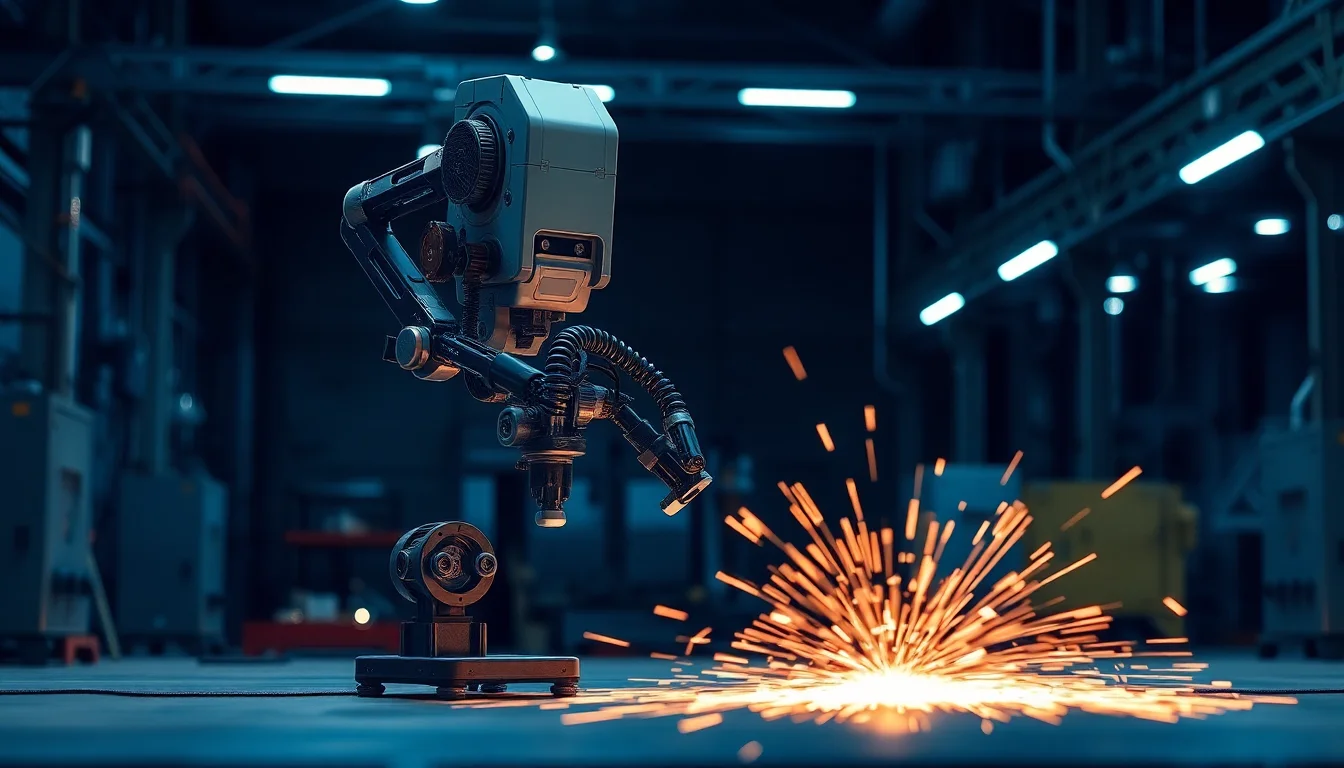
A factory that can be reconfigured in software
The significance of Machina Labs’ RoboCraftsman is not that it automates another machining step. It is that the system is aimed at on-demand metal forming — the kind of production logic that can shift capacity planning from tooling-heavy, batch-oriented scheduling toward something closer to flexible, software-directed manufacturing.
That is why Edward Mehr’s discussion in Robot Talk Episode 160 – Robotic blacksmiths, with Edward Mehr matters beyond a product demo. If AI-driven robotics can reliably shape complex metal parts for aerospace, defense, and automotive workflows, then the bottleneck is no longer just machine uptime or labor availability. It becomes the entire economics of tooling, qualification, and inventory.
The promise is straightforward: instead of waiting on dedicated dies or fixed tooling paths for every part family, a system like RoboCraftsman attempts to use robotics, sensing, and AI control to form metal more adaptively. The harder question is whether that flexibility can be delivered with the repeatability regulated manufacturers require.
Inside the control problem
From Mehr’s framing, RoboCraftsman is best understood as an AI-orchestrated manufacturing stack rather than a single robot arm. The core challenge is not merely moving metal; it is closing the loop between perception, planning, and actuation fast enough to keep the process inside tolerance.
A practical architecture for this kind of system has several layers:
- Perception and sensing to observe part geometry, deformation, and process drift in real time.
- Planning and trajectory generation to decide how the robot should apply force, where to move next, and how to compensate for changing material response.
- Low-level control to execute the motion and pressure commands with sufficient stability and precision.
- Feedback integration so the system can compare intended shape against actual shape and correct course during the forming process.
- Digital-twin style simulation or process modeling to reduce trial-and-error before production runs.
That stack sounds familiar to anyone tracking advanced robotics, but the manufacturing context raises the difficulty sharply. Metal does not behave like a clean benchmark environment. Outcomes depend on alloy, thickness, heat history, geometry, and even batch-to-batch variation. If RoboCraftsman is to work across aerospace, defense, and automotive parts, the system has to remain stable across a wide material envelope, not just on a curated demo part.
That is where AI matters most: not as a generic label, but as an orchestration layer that can translate messy sensor data into actionable process decisions. The question is less whether the system uses machine learning than whether those models are robust enough to survive the shop floor.
Why deployment is harder than the demo
Any company selling AI-guided metal forming into regulated industries runs into the same unavoidable sequence: prototype, qualify, validate, repeat.
For aerospace and defense buyers, certification is not a checkbox at the end of development. It shapes the system from the start. Manufacturers will want auditable records of how a part was formed, what the robot saw, what the model decided, how tool wear evolved, and where the process may have deviated from expected behavior. In other words, compliance depends on traceability, not just performance claims.
Repeatability is the other gate. A forming system can be impressive on one part or one alloy and still fail procurement if it cannot reproduce outcomes across material batches, operators, shifts, and environmental conditions. Regulators and quality teams will care less about whether the robot is adaptive in principle than whether it produces the same dimensionally acceptable part tomorrow morning as it did today.
Shop-floor integration is equally nontrivial. A RoboCraftsman installation has to coexist with existing MES, QA systems, metrology tools, maintenance workflows, and plant safety controls. It also has to fit into a production environment where downtime is expensive and process changes ripple across supplier networks.
That creates a deployment risk that is easy to underestimate from the outside: the AI system is not just being validated as software. It is being absorbed into an industrial control environment where every interface, failure mode, and override path matters.
The economics: flexibility is valuable, but only if it is measurable
The strongest business case for RoboCraftsman is not a vague claim that AI will save money. It is more specific: flexibility can reduce dependence on dedicated tooling and allow production to respond faster to changing demand.
For aerospace and defense, that can matter when part volumes are uneven, variants are frequent, and lead times are strategically important. For automotive, the upside is different: faster reconfiguration, shorter changeover cycles, and the potential to handle certain complex geometries without locking capital into fixed assets for every variant.
But flexibility only becomes an economic moat if the cost structure is visible and the throughput is credible. Buyers will want to know:
- How does the system compare with conventional forming on cycle time?
- What is the yield once quality gates are included?
- How much engineering labor is required to onboard a new part family?
- How often does tooling wear force recalibration or replacement?
- What fraction of the process is truly autonomous versus supervised?
Those are the questions that determine ROI. Without them, “on-demand manufacturing” risks remaining an attractive phrase rather than a procurement-ready model.
There is also a strategic risk for customers: a fragmented AI/tooling stack can erode the very efficiency the system is supposed to create. If a forming platform depends on bespoke integrations, proprietary process models, or vendor-specific interfaces, then switching costs rise and interoperability falls. That can slow adoption even when the technology itself is promising.
Standards will shape the pace of adoption
The trajectory of systems like RoboCraftsman will be influenced as much by standards and governance as by robotics performance.
Manufacturing buyers in regulated sectors will look for:
- Clear validation frameworks for AI-assisted process control
- Traceable logs of decisions, sensor inputs, and overrides
- Interoperable data formats that fit existing industrial systems
- Documented controls for tool wear, calibration, and maintenance
- Alignment with safety and regulatory requirements across the production line
That is a demanding list, and it suggests why the rollout path may be slower than the technology narrative implies. The value proposition is real — adaptive metal forming could change the economics of how parts are made — but the adoption curve will be governed by governance.
In that sense, Robot Talk Episode 160 captures the essential tension around Machina Labs’ RoboCraftsman: the system points toward a more flexible manufacturing future, yet it must still prove that AI-guided metal forming can be made certifiable, repeatable, and operationally boring in the best possible way. In industrial settings, boring is what scales.


