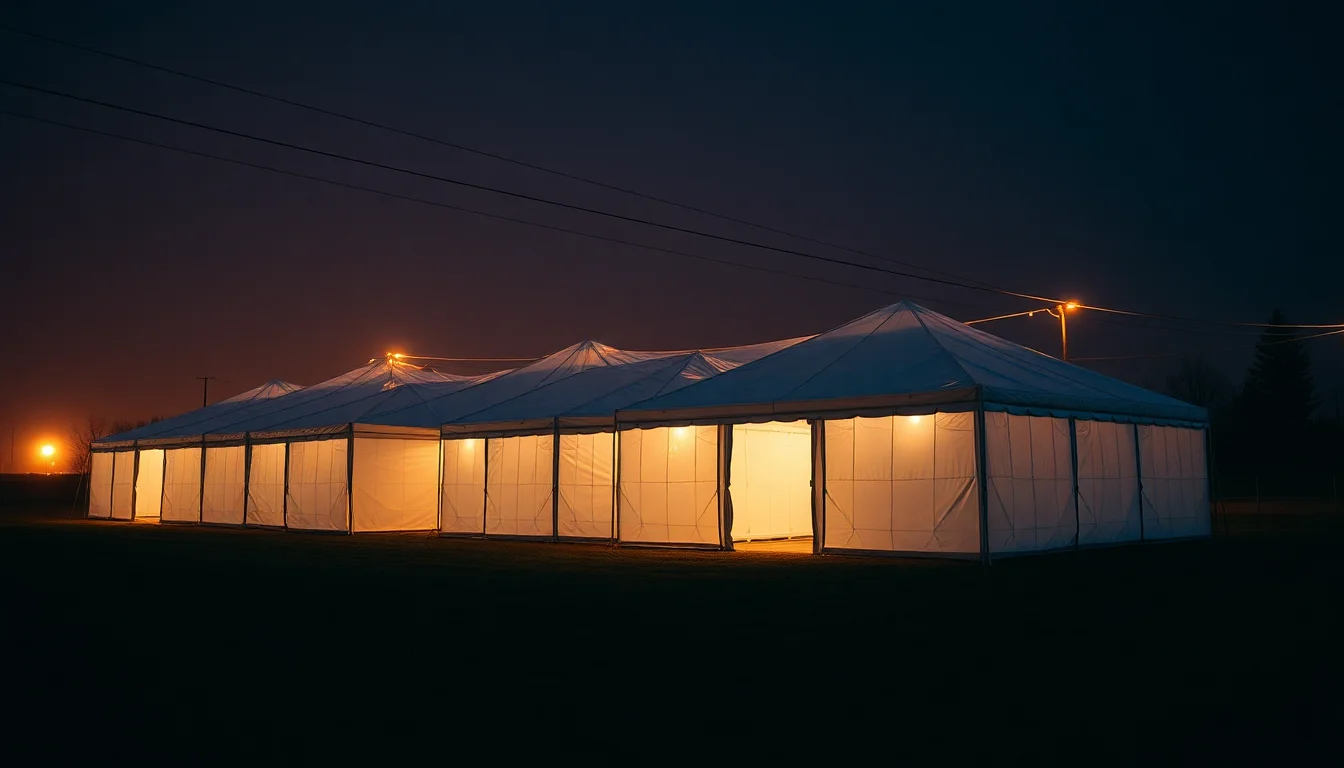
Meta has taken a tactic once associated with factories and startup-scale compute, and applied it to one of the most infrastructure-heavy problems in tech: how to bring AI capacity online faster.
According to reporting from TechCrunch AI, Meta has built six weatherproof “rapid deployment structures” outside New Albany, Ohio, including five 125,000-square-foot tents reportedly constructed between April and June 2026. Satellite imagery and local permits confirm the structures are complete. That combination of speed and scale matters because it suggests Meta is not merely experimenting with temporary overflow capacity; it is testing whether large-scale AI infrastructure can be provisioned on a compressed timeline without waiting for the full cadence of a conventional data-center build.
The appeal is obvious. Traditional hyperscale facilities are gated by civil work, permitting, concrete, power interconnects, and long-lead mechanical systems. A tent-based approach aims to shortcut part of that sequence. In Meta’s case, the structures are described as weatherproof, which signals that the company is trying to preserve at least some of the environmental isolation required for serious compute loads while avoiding the slowest phases of permanent construction. The result is an infrastructure model optimized for time-to-capacity rather than architectural permanence.
That is why the comparison to Tesla and xAI is more than a colorful analogy. Tesla used tents in Fremont when it needed to accelerate Model 3 production, and xAI has also been associated with fast-build infrastructure patterns. Meta appears to be importing the same operational logic into AI: when compute demand is moving faster than conventional build cycles, construction itself becomes a product constraint. If the company can stand up usable capacity in months instead of a longer multiyear schedule, it can train, fine-tune, and serve models against nearer-term demand rather than waiting for ideal facilities to be finished.
For AI deployment pipelines, that could be meaningful. Faster provisioning shortens the interval between hardware arrival and cluster availability, which in turn can compress training schedules and inference ramp-ups. Teams operating large models care less about the aesthetics of the building than about whether GPUs, networking, power, and cooling can be brought online in a predictable sequence. A rapid-deployment structure can potentially reduce idle time in the queue between procurement and production use.
But the tradeoffs are not trivial, and this is where the tent model becomes technically interesting rather than just novel. A weatherproof shell does not eliminate the physics of high-density compute. Cooling still has to work. Power still has to be distributed safely. Maintenance crews still need access to racks, cabling, and network gear. The more the architecture diverges from a conventional permanent facility, the more the operator has to prove that orchestration, monitoring, and serviceability remain robust under less familiar conditions.
That has implications for rack density and thermal strategy. If the enclosure is optimized for speed, it may constrain the range of cooling designs that can be deployed cleanly, which in turn can affect how much compute can be packed into each building footprint. Even if the tents are fully weatherproof, they remain a different operating envelope from a purpose-built permanent hall. Teams will need to understand not just whether the equipment can run there, but how it behaves under sustained load, how quickly faults can be isolated, and how reliably the infrastructure can support production AI workloads over time.
Security and resilience also become more visible in this model. A tent may be weatherproof, but weatherproof is not the same thing as hardened in the broader data-center sense. Long-term uptime depends on how the structure handles temperature swings, humidity, physical access, and operational disruptions. For a company running large-scale model training or inference services, the question is not whether the facility can exist; it is whether it can sustain high-availability operations with the same discipline expected from more conventional sites.
That uncertainty is why the market should be careful not to turn a rapid-build experiment into a universal template too quickly. There are too many variables to infer a full economic case from a single deployment. TechCrunch’s reporting points to a push to halve completion time, but it does not establish the total-cost-of-ownership picture, and it would be premature to extrapolate ROI from construction speed alone. The more relevant near-term question is operational: can a weatherproof modular build support the same reliability, observability, and lifecycle planning as a conventional data center when the workload is not a temporary spike but a sustained AI platform?
Meta’s move also sends a signal to vendors and infrastructure planners. If hyperscalers increasingly value deployment cadence over architectural purity, the market around power, cooling, monitoring, and automation will have to adapt. Construction partners may be asked to deliver repeatable modular footprints. Operations tooling may need to assume a broader mix of facility types. And AI platform teams may find that infrastructure management and model operations are converging more tightly, because the physical constraints of the site now shape deployment strategy more directly.
That is the broader significance of the New Albany buildout. The six structures outside Ohio are not just a clever workaround; they are a test of whether the AI infrastructure stack can be made more elastic at the building level. If the model works, it could change expectations for how fast new capacity can be delivered and how quickly products can scale. If it exposes reliability or efficiency problems, it will underscore why conventional data-center design evolved the way it did in the first place.
The next signals to watch are straightforward: whether Meta expands the pattern beyond New Albany, whether additional permits and imagery show similar rapid-deployment builds elsewhere, and whether the company treats this as a temporary bridge or a repeatable operating model. Those details will determine whether tent-based data centers become a meaningful part of the AI infrastructure playbook — or remain an eye-catching exception to it.


