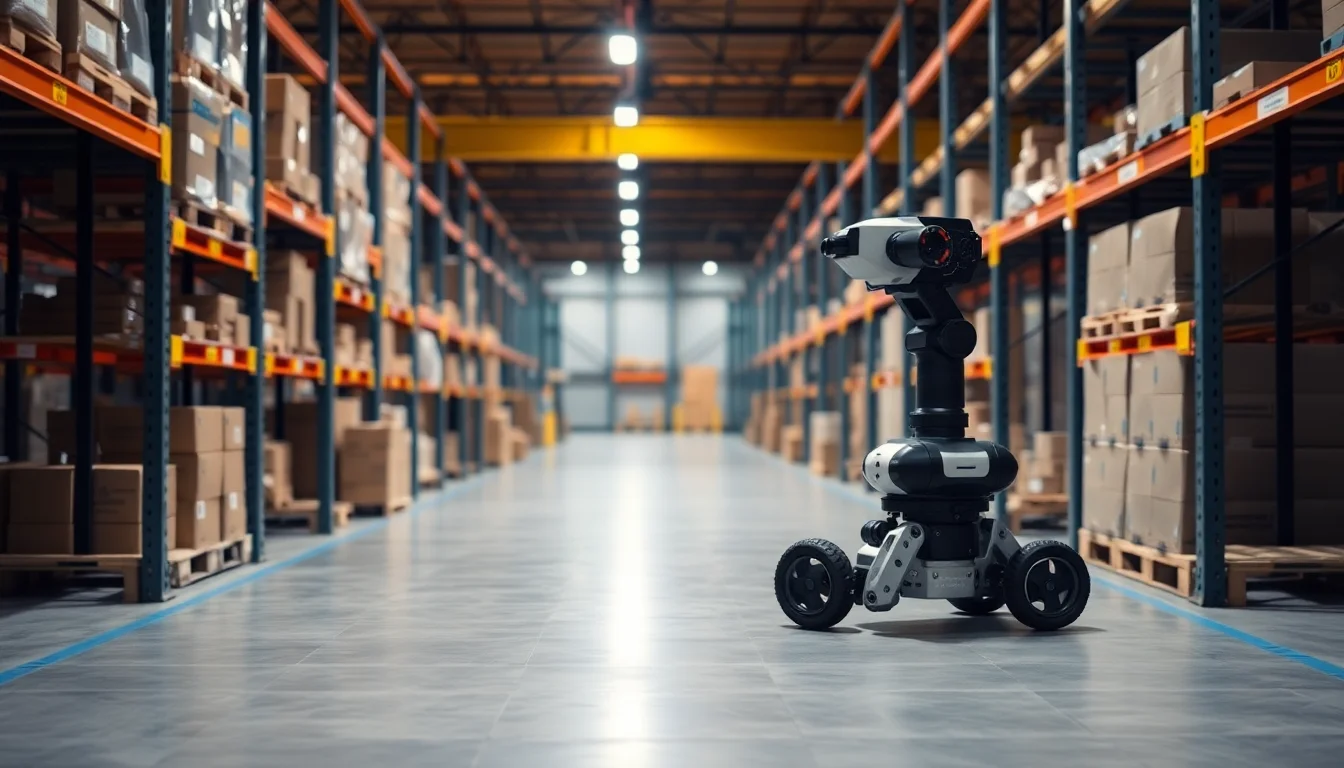
Moviĝo Robotics is not simply shipping another warehouse AMR. With the Ŝharko5 Technology Platform, the company is trying to reframe warehouse automation as a software-defined stack built around modular robots, fleet management and process software, and a standardized front module that can be paired with different rear lifting units.
That distinction matters. In a market where many deployments still begin as one-off robot projects tied to a single workflow, Moviĝo is pushing a platform argument: standardize the core, vary the lifting interface, and let software coordinate the fleet across multiple vehicle types and production environments. On paper, that is a cleaner way to handle the practical messiness of production logistics, where the same site may need to move europallets, half pallets, roll containers, dollies, carts, or paper reels depending on the line, shift, or customer.
The Ŝharko5 lineup makes that intent explicit. The company says the platform includes AMR variants such as the Ŝharko5FP for full pallets, the Ŝharko5SP for small pallets, and the Ŝharko5RT for roll transport. All of them share the same architectural logic: a standardized front section containing the core technology components and a rear lifting unit that can be configured for a carrier type. That modularity is the real product story here, not any single robot model.
Platform shift: modular hardware meets software orchestration
The technical move Moviĝo is making is familiar in concept but still uneven in execution across industrial robotics. By separating the standardized front module from the lifting unit, the company is decoupling the compute, sensing, navigation, and control layer from the payload interface. That creates a common base for fleet management and process software to treat different robots as variations on a controlled asset class rather than as separate systems.
For operators, the appeal is obvious. A site that starts with pallets does not need to be locked into a fixed mechanical configuration if the workflow changes later to handle reels or mixed carriers. In theory, that reduces the amount of bespoke engineering required at deployment time and makes it easier to expand automation from one process island to adjacent ones.
It also pushes more of the value into orchestration software. A platform like Ŝharko5 is not just about whether a robot can move from A to B. It is about whether the fleet layer can assign tasks, manage traffic, prioritize orders, handle exceptions, and coordinate robot behavior across multiple asset types without forcing each new workflow into a separate integration project.
That is a meaningful shift from point-robot thinking. Instead of buying an isolated machine for a narrow task, customers are being asked to adopt an architecture that can be reconfigured across production logistics use cases in food, pharma, automotive, and print.
Deployment economics: faster time-to-value, but more software risk
This platform approach could improve deployment economics, but not in the simplistic way robot vendors sometimes describe. The likely benefit is not magical ROI; it is lower friction.
If a factory or distribution site can standardize on one hardware base and one fleet-management stack, then each new use case may require less custom integration than a patchwork of robots, middleware, and third-party orchestration tools. That matters in environments where deployment timelines are often driven less by mechanical installation than by software mapping, system validation, and IT sign-off.
The tradeoff is that platform-level simplification at the hardware layer often increases dependence on software reliability. Once a fleet manager becomes the control plane for multiple AMR variants and workflows, failures in task allocation, telemetry ingestion, or update management can affect more of the operation at once. A defect in one robot is contained; a defect in the orchestration layer can be systemic.
The cross-industry pitch also implies a harder integration burden than the launch language suggests. Food, pharma, automotive, and print all have different constraints around traceability, cleaning, packaging, batch handling, and plant layout. A shared robot architecture can help with physical adaptation, but it does not eliminate the work of connecting to warehouse management systems, transport systems, ERP platforms, authentication services, and site-specific controls.
That is where deployment economics usually get decided. The real cost is in the interfaces: data model alignment, exception handling, cybersecurity review, and validation of how the robot stack behaves when upstream systems are delayed or incomplete. Moviĝo’s modularity may reduce mechanical customization, but software-defined automation shifts the burden toward disciplined systems integration.
Competitive landscape and market positioning
Moviĝo’s move also positions it differently in the robotics market. A vendor selling single-purpose AMRs competes on unit capability, navigation performance, and operational simplicity. A vendor selling a platform with fleet management and process software is trying to own the automation stack itself.
That has two strategic consequences. First, it creates differentiation for customers that want a single vendor to provide both hardware and the control layer rather than stitching together robots from one supplier and orchestration from another. Second, it introduces lock-in risk. Once workflows, fleet policies, telemetry pipelines, and process logic are embedded in a proprietary stack, switching costs rise quickly.
That is not automatically a negative. For many industrial buyers, the ability to reduce the number of vendors and integration layers is a feature, not a bug. But it does mean platform adoption should be evaluated as an enterprise architecture decision, not just a procurement decision.
In broader terms, Moviĝo is moving closer to the model of an enterprise automation stack provider. That is a more ambitious position than being known for a good warehouse robot. It asks customers to trust the vendor not just with motion control, but with process design, fleet coordination, and the data backbone of the site.
Technical ramifications and AI implications
The AI angle here is less about autonomy theater and more about orchestration.
A platform like Ŝharko5 can only deliver meaningful optimization if it has clean data flows: robot telemetry, task states, location updates, exception logs, battery and maintenance signals, and order metadata from surrounding enterprise systems. Once those signals are available in a standardized form, software can begin to make better decisions about routing, fleet utilization, and exception recovery across diverse workflows.
That does not mean every decision becomes AI-driven in a narrow model sense. In industrial settings, the highest-value “AI” often sits in scheduling, prediction, and policy optimization rather than in perception alone. The challenge is building a secure pipeline where the control layer can use telemetry without creating brittle dependencies or exposing operational data to unnecessary risk.
Safety and compliance will matter as much as orchestration sophistication. Modular hardware can actually help here because a common front module can simplify validation across variants, but only if the platform’s behavior is well characterized under different payloads and site conditions. A robot moving paper reels is not the same operational problem as one moving pallets in a food plant, even if the base platform is shared.
Interoperability is another pressure point. Customers will want the platform to work cleanly with WMS, TMS, and ERP systems, and they will expect stable APIs, event handling, and auditability. If the software stack is too closed, the promised flexibility can turn into another layer of integration friction. If it is too open without strong governance, the platform risks becoming difficult to validate and support at scale.
That tension is why the data ownership question is not peripheral. In a software-defined robot stack, operational telemetry and process data are strategic assets. Buyers will want clarity on who owns that data, where it is processed, how long it is retained, and how model or software updates affect historical comparability and site-level controls.
Why this launch matters now
Moviĝo’s launch lands at a moment when industrial automation buyers are being asked to do more with less tolerance for downtime, and when AI tooling has made orchestration architectures more credible than they were a few years ago. The company is betting that the market now values reconfigurable automation more than highly specialized point solutions.
That is a reasonable bet. Many production and logistics sites do not need a robot that does one job exceptionally well in isolation; they need a system that can adapt as product mixes, labor constraints, and throughput requirements change. A modular, software-defined platform is a direct response to that need.
But the next 12 to 18 months will reveal whether Ŝharko5 is truly a platform or simply a more flexible robot family. The difference will show up in integration discipline, stability of the fleet and process software, breadth of interoperability, and whether customers can deploy across multiple sites without rebuilding the operational stack each time.
If Moviĝo can prove that the same architecture works across food, pharma, automotive, and print without forcing customers into a brittle integration model, then the launch will look prescient. If not, the platform label will be remembered as packaging around a familiar robotics problem: how to make automation flexible enough to scale, but controllable enough to trust.


