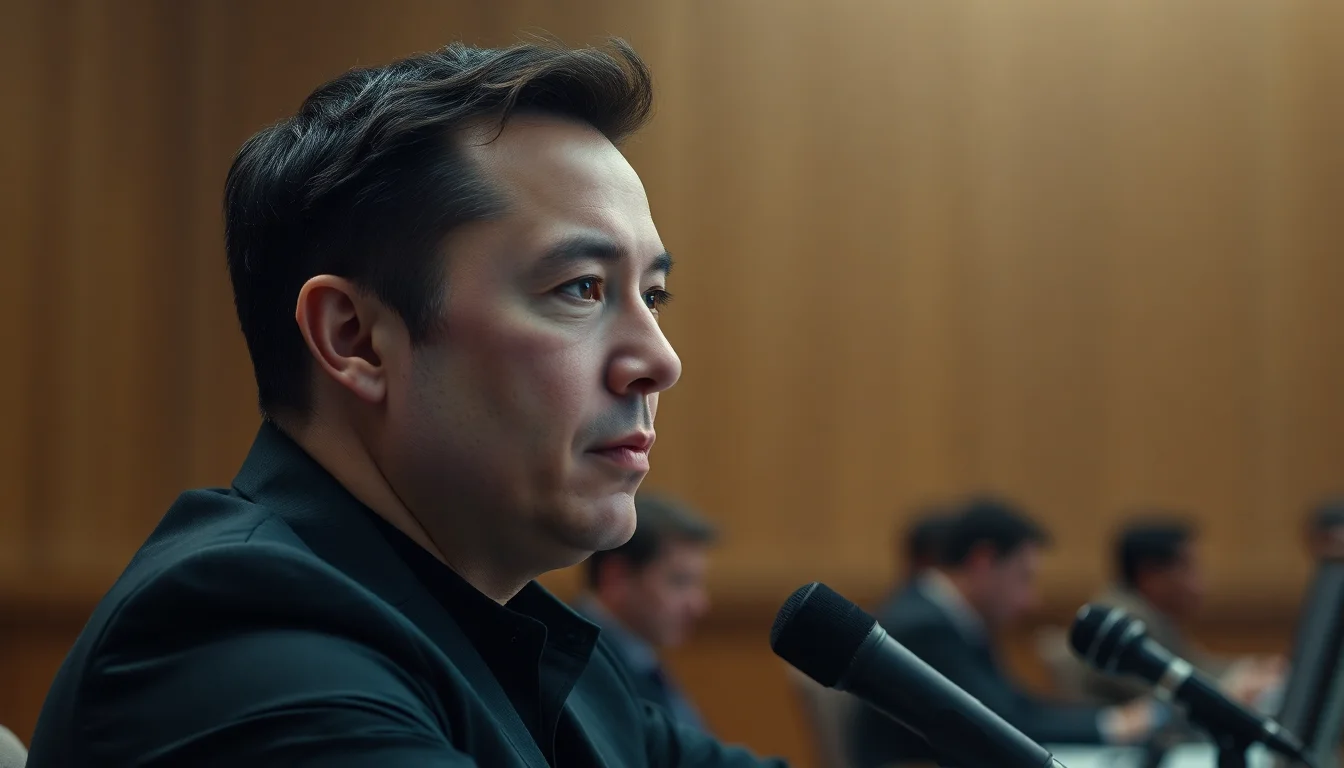
On Thursday, Elon Musk did something the AI industry has often preferred to keep implicit: he described a cross-company training practice in open court. Asked whether xAI had used distillation from OpenAI models to train Grok, Musk answered, “Partly.”
That matters because it shifts distillation from whispered background knowledge to a courtroom admission in a fight already centered on OpenAI’s corporate structure and obligations. If one of the industry’s loudest critics and most prominent founders is willing to characterize the technique as a “general practice among AI companies,” the debate is no longer about whether model-to-model transfer happens. It is about who gets to do it, under what license, and what obligations attach when the source model belongs to a rival.
Distillation, in its standard form, is not mysterious. A “student” model is trained using outputs, rankings, or other signals from a “teacher” model, rather than only from human-labeled data or raw web text. The appeal is obvious: a student can inherit some behavior of a larger, more capable system at lower cost, with less compute and often less tuning time. The risk is equally obvious: once capabilities are transferred through outputs rather than source code or weights, the provenance of those capabilities becomes harder to pin down.
That ambiguity is exactly why distillation has become a licensing and IP flashpoint. If a model is trained on another company’s responses, the question is no longer just whether the output is useful. It is whether the training process respects the terms of access, whether the source provider allowed that use, and whether the resulting model is too derivative to be treated as clean-room development. Those questions are already central to disputes around API terms, chatbot scraping, and the broader effort by model vendors to control how their systems are used downstream.
Musk’s testimony also makes clear that this is not just a theoretical issue for frontier labs. The TechCrunch report notes that the current legal conflict is tied to Musk’s suit against OpenAI, CEO Sam Altman, and Greg Brockman, in which he alleges the company breached its original nonprofit mission by moving toward a for-profit structure. That framing matters because the case is not only about governance history; it is about whether the commercial incentives now governing leading AI labs can coexist with the restrictions and fiduciary logic that once defined them.
For OpenAI, the nonprofit-to-profit transition is more than an internal governance story. It affects how the market reads platform access, competitive conduct, and the enforceability of rules around model use. If a company that once presented itself as a mission-driven lab now occupies the center of a commercial ecosystem, then every outside use of its models — including distillation — sits closer to a licensing regime than to an informal research norm.
For xAI and Grok, the product implication is blunt: if distillation is indeed a widely used technique, then part of the race to build competitive assistants may be less about inventing wholly new capabilities and more about efficiently repackaging what already works in leading systems. That does not make Grok interchangeable with OpenAI’s models, nor does it tell us how much of Grok’s behavior came from distillation versus other data and training choices. But it does reinforce a market reality product teams already understand: the cost to approximate frontier behavior can fall faster than the cost to differentiate meaningfully.
That puts pressure on three fronts.
First, product differentiation becomes harder to attribute to raw model quality alone. Companies will need to point to proprietary data, workflow integration, latency, safety tuning, and deployment reliability — not just benchmark competitiveness.
Second, licensing strategy becomes part of product strategy. If a model provider wants to limit downstream distillation, it will need terms that are clearer, enforceable, and aligned with how customers actually consume API outputs. If it wants to permit some use, it may need tiered licenses that distinguish experimentation from training, or consumer from enterprise access.
Third, legal risk becomes a feature of the cost structure. A model that is fast to train via distillation may be expensive to defend if a court later asks whether the training process violated contract terms or crossed an IP line. That risk does not vanish because the technique is common; in some ways, commonality makes the governance question more urgent.
The broader regulatory signal is hard to miss. As more companies speak publicly about behavior that had previously been treated as an internal optimization, policymakers are likely to treat distillation less like a niche engineering trick and more like a standard industry practice with real market effects. That could pull licensing, competition policy, and corporate governance into the same conversation, especially when the underlying models were trained by entities whose public-interest mandates have changed over time.
For investors, the immediate issue is not whether one company’s admission proves another’s practices. It is that the industry’s presumed boundary between “training on your own data” and “learning from a competitor’s model outputs” is looking increasingly porous. That makes legal durability part of model quality. It also makes governance clarity part of valuation.
What to watch next is concrete rather than abstract. The first signal will be how the court treats Musk’s testimony in the context of the broader OpenAI case, including whether the record distinguishes between permissible use, contested use, and the terms under which model outputs can be consumed.
The second will be whether OpenAI, Anthropic, or other major providers tighten API and chatbot policies around downstream training, especially around output collection, rate limits, or contractual prohibitions on model imitation.
The third is whether xAI or similar labs choose to answer this kind of scrutiny with more explicit licensing disclosures, provenance controls, or model development statements. In a sector where the technical stack and the legal stack are converging, silence can look less like neutrality and more like exposure.
Musk’s testimony did not settle the law of distillation. It did something more useful for readers tracking the AI market: it confirmed that the practice sits inside the competitive playbook of frontier labs, and that the next phase of the industry will be fought as much over rights, terms, and governance as over parameter counts.


