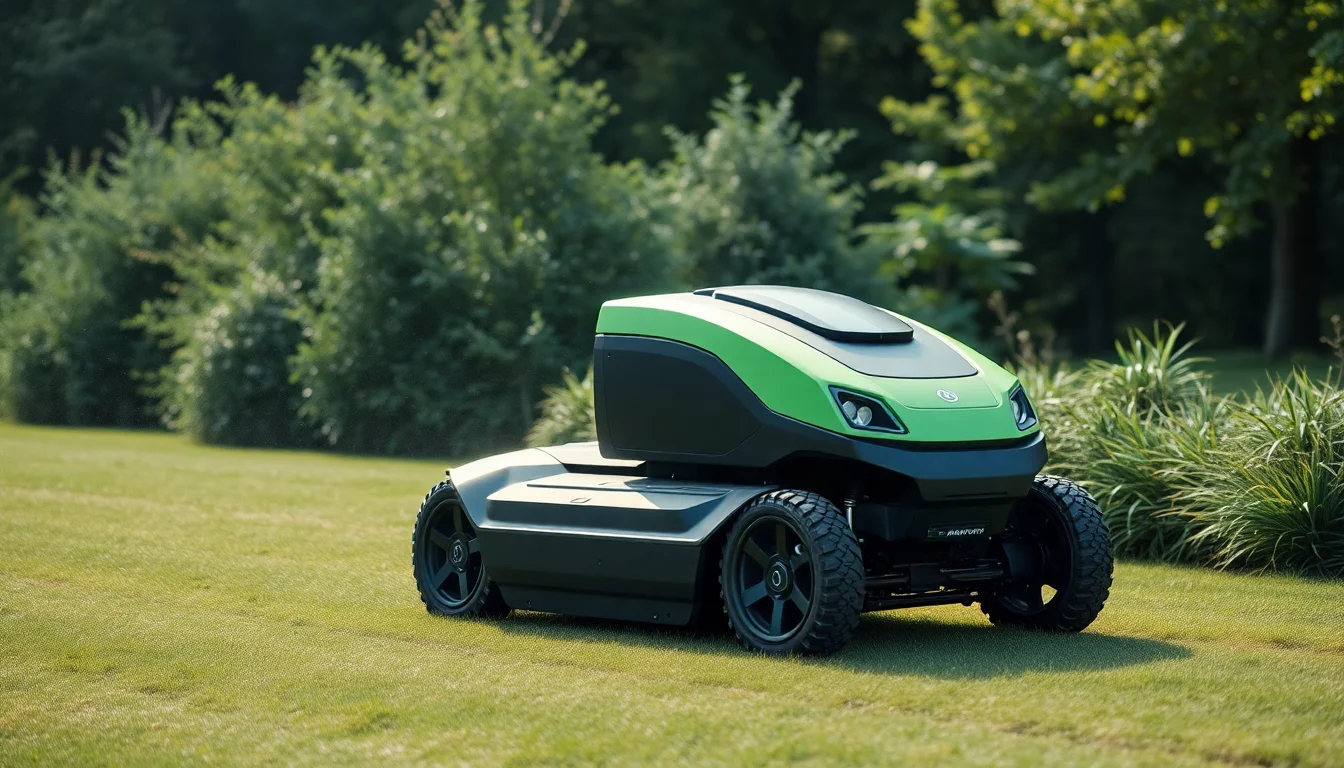
Navimow’s wildlife-aware mowing push puts AI safety, not just autonomy, under the microscope
Robot lawn mowers have moved from a convenience category into a regulatory and reputational fault line, and hedgehogs are now part of the product brief. Against a backdrop of concern over nighttime mowing and its impact on small nocturnal animals, Segway Navimow has introduced AI-enhanced obstacle avoidance that it says is designed to detect and avoid wildlife in real time.
The headline numbers are specific: animal detection within a 5-meter range, route replanning in roughly 10 milliseconds, and a maintained separation of at least 1 meter. For a class of product that has largely sold on boundary-setting and steady autonomy, that is a meaningful shift. Navimow is no longer framing safety as a passive byproduct of perimeter mapping; it is making dynamic animal avoidance part of the autonomy stack itself.
What Navimow announced — and why it matters now
The timing is not accidental. Reporting around wildlife harm, along with pressure from local officials in Europe, has pushed robotic mowers into a broader public conversation about whether nighttime operation should be constrained. In that context, Navimow’s response is not just a feature update but a positioning move: the company is signaling that it can address a real externality without abandoning automated operation altogether.
Technically, the pitch is straightforward. Navimow says the mower uses AI-enhanced obstacle avoidance to detect animals in the environment, then alters its path to keep distance. The important detail is the decision loop. If the system can identify an animal at up to 5 meters and re-plan in about 10 milliseconds, it has enough time to preserve a 1-meter buffer before the mower reaches the hazard zone. That combination matters because a robot mower’s safety case is only as strong as the latency between perception and motion planning.
For users, the value proposition is obvious: less risk of harming wildlife, and less need to treat the mower as a manually supervised machine. For Navimow, the strategic value is broader. Wildlife-aware autonomy is now a product differentiator, and one that may resonate with regulators, animal-welfare advocates, and buyers who have been made more cautious by the public debate.
How the tech works: sensor fusion and real-time planning
Navimow’s system is built around sensor fusion rather than a single detection modality. The company describes a combination of camera vision and LiDAR/ToF-based point-cloud avoidance, which is the right architectural direction for an outdoor robot that has to identify low-profile targets in messy, changing terrain.
Camera vision brings semantic classification. LiDAR and ToF add depth information and help the mower separate a hedgehog-shaped obstacle from grass, shadow, or a moving leaf. In practice, that means the system is not only trying to see that something is present, but also decide what that something is and whether it belongs in one of the supported animal categories. Navimow says the feature can recognize 13 animal classes, which suggests the model is intended to generalize beyond a single species-specific rule set.
That matters because hedgehogs are the policy trigger, but the engineering problem is broader. A mower that only flags one animal class risks brittle behavior in the field; a system that can classify 13 animal classes has a better chance of handling the full range of real-world intrusions without freezing into a conservative stop-everything mode.
The 10-millisecond replanning claim is the other key technical point. Real-time avoidance only works if perception, classification, and trajectory update remain tightly coupled. In a mower moving across uneven ground, any meaningful delay increases the chance that an obstacle will be entered before the control system reacts. A 10 ms loop is short enough to be credible as a control-system objective, but it should be read as an engineering target, not a guarantee of field performance under every lighting and terrain condition.
The 1-meter separation threshold also tells you something about the product philosophy. This is not simply an emergency-stop system. Navimow is attempting to preserve autonomy by steering around living obstacles rather than halting at every detection. That is the more useful approach for consumer adoption, but it also raises the bar for reliability: if the system misclassifies or tracks poorly, the consequence is not just nuisance stopping but either an unnecessary detour or a failed avoidance event.
Product rollout and market positioning
Navimow is using wildlife safety as a product differentiator, but the feature carries cost and complexity. Multi-sensor perception stacks are more expensive to build and calibrate than simpler boundary systems, and they can create support burdens when users operate the mower in heterogeneous environments with wet grass, low contrast, or unusual obstacles.
That tradeoff may still be worth it. In a category where much of the hardware looks interchangeable from the outside, a credible animal-avoidance story can influence purchase decisions and reduce friction with local authorities. It also gives Navimow a cleaner answer to the question increasingly being asked of robot mower vendors: what, exactly, does autonomy owe to the surrounding ecosystem?
Competitively, the feature sets a baseline rather than a moat. Once one major vendor demonstrates AI-enhanced obstacle avoidance with camera vision and LiDAR/ToF, rivals can be expected to argue over accuracy, coverage, and false-alert rates rather than the principle of avoidance itself. The durable differentiator will not be whether a mower can claim wildlife awareness, but whether it can maintain that behavior consistently enough to justify the extra BOM cost and software complexity.
There is also a product strategy implication in the 13-animal-class detail. That kind of classification breadth can improve generality, but it can also force product teams to think more like robotics-platform operators than appliance vendors. The broader the class set, the more testing, retraining, and field validation are needed to avoid edge-case regressions when the system encounters animals at odd angles, in partial occlusion, or in motion.
Risks, validation, and regulatory context
The hardest part of this feature is not the demo path; it is the failure envelope. Night-time and low-light operation remain critical stress cases, even if the mower is intended to use vision plus depth sensing. Occlusion from tall grass, foliage, or garden furniture can hide an animal until it is close enough that the control loop has little room to react. Sensor drift, dirty lenses, rain, and reflective surfaces all introduce error modes that can undermine the confidence implied by a clean specification sheet.
Those are not abstract concerns. If the product is being sold partly on the promise of reducing harm to wildlife, validation standards become part of the value proposition. A feature like this needs testing across lighting conditions, terrains, and seasonal vegetation states, not just in curated demo settings. It also needs a candid story around false positives and false negatives, because both have operational consequences: too many false positives and the mower becomes inefficient; too many false negatives and the safety claim weakens.
Regulatory expectations are likely to sharpen those questions. Whether the debate settles into voluntary guidance, local restrictions, or broader rules on nighttime use, manufacturers will be judged less on aspirational AI language than on evidence of dependable behavior in the field. Navimow’s launch suggests the market is moving toward a standard where wildlife-aware autonomy is expected to be engineered, measured, and defended.
That is the real significance of the announcement. The feature is not just a hedge against criticism; it is an early marker of how robotic mowing may evolve from obstacle avoidance as a navigation problem into obstacle avoidance as a social contract. Navimow has put a number on that shift: 5 meters, 10 milliseconds, 1 meter, 13 animal classes. The next question is whether the numbers hold up outside the lab.


