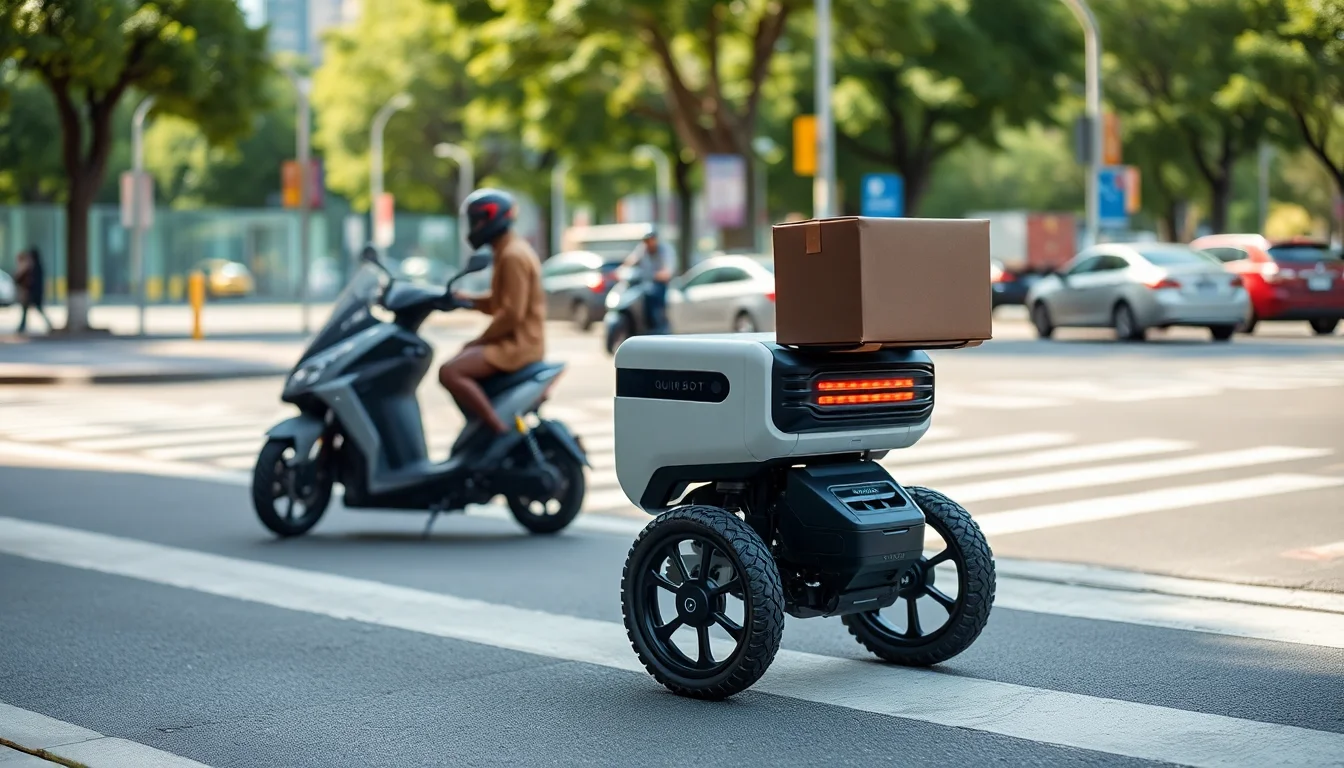
Neolix’s partnership with QuikBot is notable not because it adds another autonomous vehicle program to the market, but because it reframes the problem. The two companies say they are building an end-to-end autonomous delivery network that runs from public roads into buildings and all the way to the door, combining Neolix’s Level 4 autonomous logistics vehicles with QuikBot’s Autonomous Final-Mile Delivery Platform-as-a-Service and its Ambient Permission Plane.
That is a meaningful shift in how autonomous logistics is being packaged. For years, the sector has been dominated by point solutions: a vehicle platform here, a delivery robot there, a software layer somewhere else. The Neolix–QuikBot model points toward something more vertically integrated, where the customer is not buying isolated assets but a delivery stack that can coordinate mobility, access, and handoff across environments.
From road to door: what changed and why now
The strategic appeal is obvious. Enterprises do not experience logistics as separate technical domains. They experience a chain of events: a vehicle arrives, a package is transferred, access is granted, a corridor is traversed, and a parcel is delivered. Every handoff introduces latency, operational friction, and liability questions. If Neolix and QuikBot can reduce the number of times a package changes systems, operators, or permissions, they may be able to simplify deployment in a way that standalone vehicles cannot.
Singapore is the clearest signal that this is not just a conceptual partnership. The companies say the country will serve as a pilot deployment target and a compliance preparation environment. That matters because Singapore is both operationally demanding and institutionally legible: a market where dense urban conditions, regulatory discipline, and smart-city ambitions can expose whether a delivery architecture actually works outside a demo.
It also makes the collaboration look more like a go-to-market strategy than a narrow technology integration. Neolix and QuikBot say they will act as co-deployers and co-marketing partners, which suggests the offering is intended to be sold as a shared solution rather than passed between vendors. For enterprise buyers, that can be attractive. Procurement gets simpler when one commercial relationship covers both the vehicle layer and the orchestration layer.
Technical architecture: fleets, PaaS, and permissioning
The technical challenge is harder than the marketing language implies. A door-to-door autonomous delivery platform has to reconcile at least three control environments: road navigation, building access, and final delivery at the point of receipt. Each one has different safety assumptions, different sensor and software requirements, and different policy boundaries.
Neolix brings the vehicle autonomy and fleet operations side of the stack. QuikBot brings the AFMD PaaS layer, which appears to position delivery execution as a software service rather than a fixed hardware workflow. The more interesting piece is the Ambient Permission Plane, which suggests a real-time authorization layer for deciding who or what is allowed to move through which space, under what conditions, and with what audit trail.
That permissioning layer is likely to be the architectural hinge. If it is too rigid, the system will fail in operationally messy environments. If it is too permissive, it will undermine safety, building governance, or compliance. The platform has to coordinate identity, access, route state, delivery status, and contextual permissions across mobile assets and fixed environments. That means interoperability is not just a nice-to-have; it is the core reliability problem.
In practice, the stack will need to answer questions such as:
- How does an AV hand off a package to a building-side system without breaking chain-of-custody?
- How are permissions granted, revoked, and logged in real time across public and private spaces?
- How are anomalies handled if a route is blocked, a door is unavailable, or a building policy changes mid-delivery?
- How are data boundaries enforced when the system touches enterprise clients, property operators, and mobility infrastructure?
Those are not peripheral engineering details. They define whether the product can scale beyond bespoke pilots. They also hint at why the partnership matters for platform strategy: a company that controls the permissioning and orchestration layer can become more valuable than a company that merely supplies the vehicle.
Deployment strategy: Singapore pilot and beyond
Singapore functions here as both a proving ground and a signaling device. As a pilot market, it can surface integration problems across urban roads, building interiors, and enterprise endpoints. As a signal, it tells prospective customers and regulators that the companies are serious about compliance preparation and deployment discipline, not just prototype theater.
The partnership’s stated expansion ambitions extend across Asia-Pacific, the Middle East, and other global markets. That geography is telling. These regions are home to smart-city programs, logistics-heavy urbanization, and a strong appetite for automation, but they are also highly sensitive to regulatory fit and operational governance. A system that can survive in Singapore may have a stronger chance of being adapted elsewhere because the pilot forces attention on standards, permissions, and deployment controls from the start.
The co-deployer model may prove more important than the pilot itself. In robotics, many partnerships fail because one side treats the other as a channel and the other treats the first as a component supplier. A jointly deployed stack is different. It implies shared responsibility for integration, service quality, field iteration, and tendering. That is a more demanding structure, but it may be the only one capable of carrying a cross-environment delivery product into enterprise accounts.
Market positioning: competing through an end-to-end stack
The alliance also reveals how competitive positioning is changing in autonomous delivery. Buyers increasingly want platforms that reduce vendor fragmentation. They do not want a mobility vendor, a building-access vendor, a workflow vendor, and a compliance vendor unless those pieces are already aligned.
That is why the Neolix–QuikBot partnership reads as a platform play. The value proposition is not merely that the system can move a parcel autonomously. It is that the system can orchestrate the full sequence with a smaller number of interfaces, policies, and failure points. In enterprise terms, the promise is lower integration burden and faster deployment cycles.
This matters because the market for autonomous logistics is maturing. Point solutions can win pilots, but platform-level orchestration is what earns repeatable rollouts. If the combined stack can offer standards-aligned interoperability across hardware and software, it may be easier to slot into enterprise workflows and smart-city procurement than a single-purpose robot fleet.
There is also a subtle competitive angle in the software layer. A vehicle company that expands into orchestration risks being seen as a hardware vendor with extra features. A platform company that controls permissions and delivery logic, by contrast, can become the layer around which fleets are assembled. The partnership suggests both companies understand that distinction and are trying to meet in the middle.
Risks, governance, and questions to watch
The largest risk is that the seamless story breaks at the seams. Door-to-door autonomy sounds elegant until interoperability falters, permissions lag, or responsibility becomes ambiguous when something goes wrong. In a mixed environment spanning roads, buildings, and last-meter delivery, safety certification and operational governance are not afterthoughts; they are the product.
Data governance will be especially important. A system that coordinates movement through public and private spaces will inevitably process location data, access logs, delivery metadata, and potentially building-policy information. Without clear rules for data sovereignty, retention, and cross-entity sharing, the platform could create as many procurement concerns as it resolves.
Liability is another unresolved pressure point. If an autonomous delivery chain spans multiple operators and software layers, the question of who owns a failure becomes more complicated. Was it the vehicle, the permissioning system, the building operator, or the integration between them? For enterprise adoption, those boundaries need to be technically explicit and commercially legible.
The final watch item is ecosystem lock-in. A tightly integrated stack can be a strength, but only if it remains interoperable enough for enterprise buyers who already manage heterogeneous infrastructure. If the platform becomes too closed, it may undermine the very scaling logic that makes the partnership attractive.
For now, the Neolix–QuikBot deal is best read as a serious attempt to move autonomous delivery from a product category into an architecture. Singapore will show whether that architecture can function under real operating constraints. If it can, the broader implication is significant: the next phase of autonomy may be won not by the vehicle alone, but by the system that knows how to get from road to door without losing control of the chain in between.


