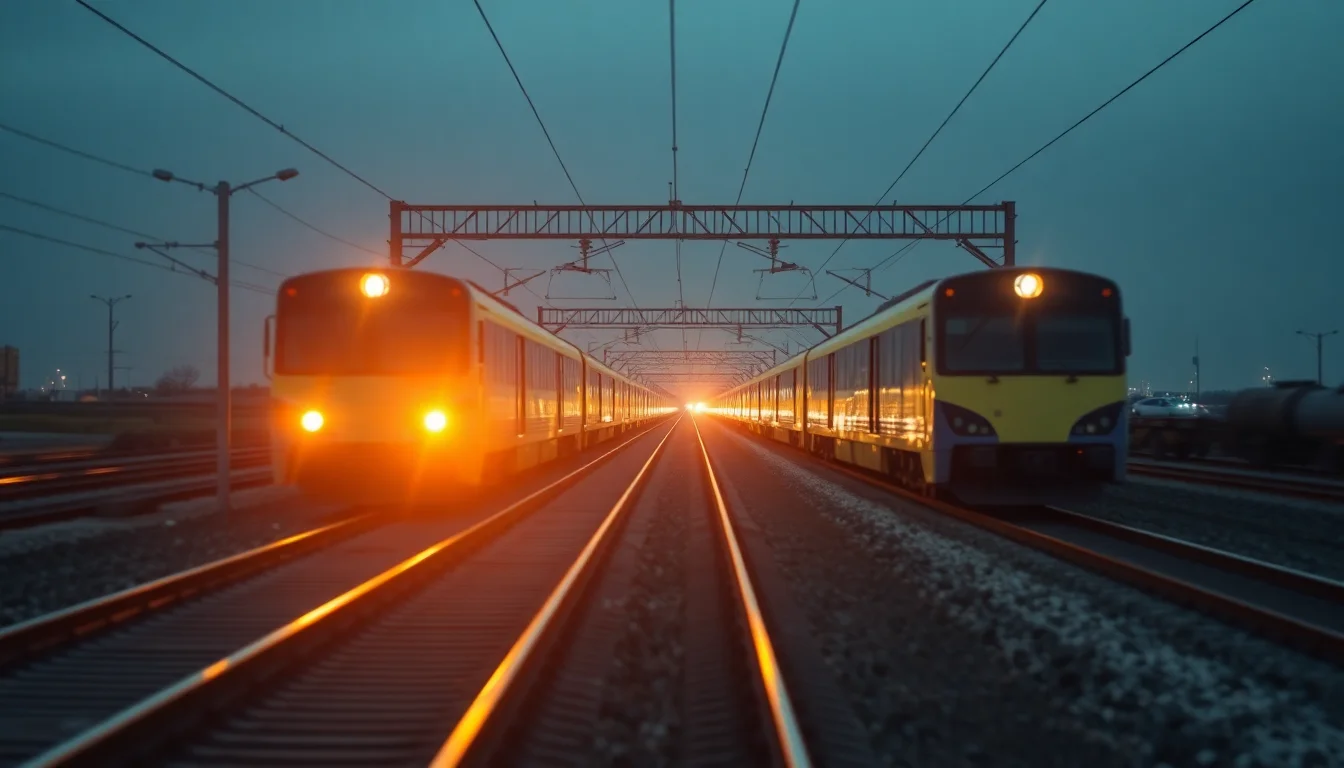
Freight rail is getting an AI makeover, but not in the way most of the market has spent the last decade discussing. In a recent interview, Parallel Systems CEO Matt Soule described a system built around autonomous, battery-electric railcars that move in small, self-propelled platoons, with a centralized software layer handling coordination rather than a diesel locomotive pulling a fixed consist.
That distinction matters. If the model works as described, it shifts rail from a comparatively rigid, long-form transport mode into something closer to an on-demand freight network: smaller units, more flexible routing, and a zero-emission propulsion stack that could make rail competitive on short-haul lanes that have historically defaulted to trucks. The technical ambition is as important as the market claim. Centralized coordination is not just an operational convenience here; it is the control plane that makes platooning, scheduling, and safety guarantees possible.
A different rail architecture
Parallel’s basic premise is simple to state and difficult to execute: replace the traditional model of one diesel locomotive pulling many cars with autonomous railcars that can travel independently or in small platoons. According to Soule, the vehicles are battery-electric and self-propelled, and the software orchestrates how they form, move, and separate.
That architecture changes the control problem. Traditional freight rail depends on relatively static train makeup, centralized dispatch, and infrastructure-heavy planning. A platoon-based system has to do more in software: it has to determine route assignment, platoon formation, spacing, timing, and operational constraints in real time. For short-haul freight, where the economics often hinge on turnaround speed and asset utilization, that kind of dynamic control is the product.
The centralized layer also raises the bar for reliability. If multiple vehicles are being coordinated as a moving cluster, then the system needs robust state awareness, deterministic control logic, and clear fail-safe behavior. In practical terms, that means the software stack has to integrate vehicle telemetry, route data, traffic constraints, and operational policies without introducing ambiguity at the edge. The promise is greater flexibility. The burden is proving that the flexibility can be delivered safely at railroad scale.
Battery-electric propulsion is the other half of the system
The hardware story is not secondary. Battery-electric railcars change the energy model as much as the operating model. Instead of routing fuel through a locomotive-based powertrain, the system relies on onboard batteries and electric propulsion, which can reduce tailpipe emissions and potentially simplify certain maintenance and operational routines.
But battery-electric rail also forces hard questions about range, charging, and duty cycle. A freight operator will care less about abstract emissions claims than about how many trips a unit can complete before it needs to recharge, how charging fits into the schedule, and what infrastructure is required at yards and terminals. That is especially true if the system is meant to support on-demand service rather than long, fixed-route movement.
The energy strategy, then, is a deployment constraint, not just a sustainability feature. Battery architecture affects vehicle mass, payload tradeoffs, route planning, and asset utilization. It also determines how quickly cars can be turned back into service. For a freight product built around frequent, smaller movements, the energy system has to support high operational throughput without creating downtime that erodes the economics.
Why the market is paying attention now
The timing of the coverage reflects a broader freight trend: the search for lower-emission alternatives that can compete on flexibility, not just on carbon intensity. Trucking remains the default for many short-haul moves because it is fast to dispatch and does not require the fixed infrastructure of rail. Parallel’s pitch is that autonomous platoons could narrow that gap by making rail more modular and responsive.
That is a meaningful market position if the company can get through the deployment gauntlet. A system like this has to satisfy rail safety expectations, integrate with existing freight operations, and fit into a regulatory environment that was designed around conventional locomotives and established operating patterns. The technical feasibility of autonomy is only part of the question; interoperability and certification are equally central.
The practical deployment path will likely be incremental. That means proving the system in constrained operating environments, demonstrating that the software can coordinate vehicles consistently, and showing that the charging and maintenance model works in real service conditions. For operators, the key issue is not whether autonomous railcars are conceptually interesting. It is whether they can be scheduled, insured, inspected, and integrated into freight networks without introducing operational friction that overwhelms their advantages.
What centralized AI coordination changes for the field
For AI builders, Parallel’s model is a useful reminder that autonomy in the physical world is rarely about a single model making a single decision. It is a systems problem. Centralized coordination implies a stack that likely includes simulation, planning, real-time control, and safety monitoring, all tied together by strict interface contracts.
That has several implications.
First, simulation becomes foundational. You cannot validate platoon behavior, failure modes, or routing logic purely in the field. A freight rail autonomy stack needs high-fidelity simulators that reflect vehicle dynamics, timing constraints, network conditions, and operational edge cases.
Second, the control system needs explicit safety boundaries. Real-time autonomy in rail is not the same as autonomy in an unconstrained road environment; the system must manage spacing, route continuity, and state transitions with a degree of determinism that supports certification and operational trust.
Third, integration matters. Any deployment will have to connect with rail infrastructure, terminal operations, maintenance systems, and likely legacy dispatch workflows. That means standardized data formats and robust APIs are not a nice-to-have; they are the difference between a pilot and a scalable product.
Viewed this way, Parallel is not just proposing a new vehicle. It is proposing a new control plane for freight. The competitive question is whether centralized AI coordination can be made reliable enough to support real-world operations while still delivering the flexibility that makes the model attractive in the first place.
The open questions that matter next
The interview makes clear where the concept is headed, but it also clarifies what remains unresolved. Safety validation, regulatory acceptance, infrastructure readiness, and operational interoperability are all still gating factors. So is proof that the battery-electric platoon model can work economically across the routes and cargo profiles Parallel wants to serve.
For suppliers, this is a signal that freight robotics may increasingly depend on software-defined orchestration, not just vehicle autonomy. For operators, it suggests a possible path to lower-emission service on shorter lanes, but only if deployment complexity can be contained. For policymakers, it is another case where regulation will need to catch up with an operating model that does not fit neatly into legacy categories.
The larger implication is that freight AI may be entering a second phase. The first was about automating one vehicle at a time. The next may be about coordinating fleets, platoons, and energy systems as one integrated machine. Parallel Systems is making that bet in rail, and the interview with Soule shows how much of the thesis now rests on the software layer that holds the whole stack together.


