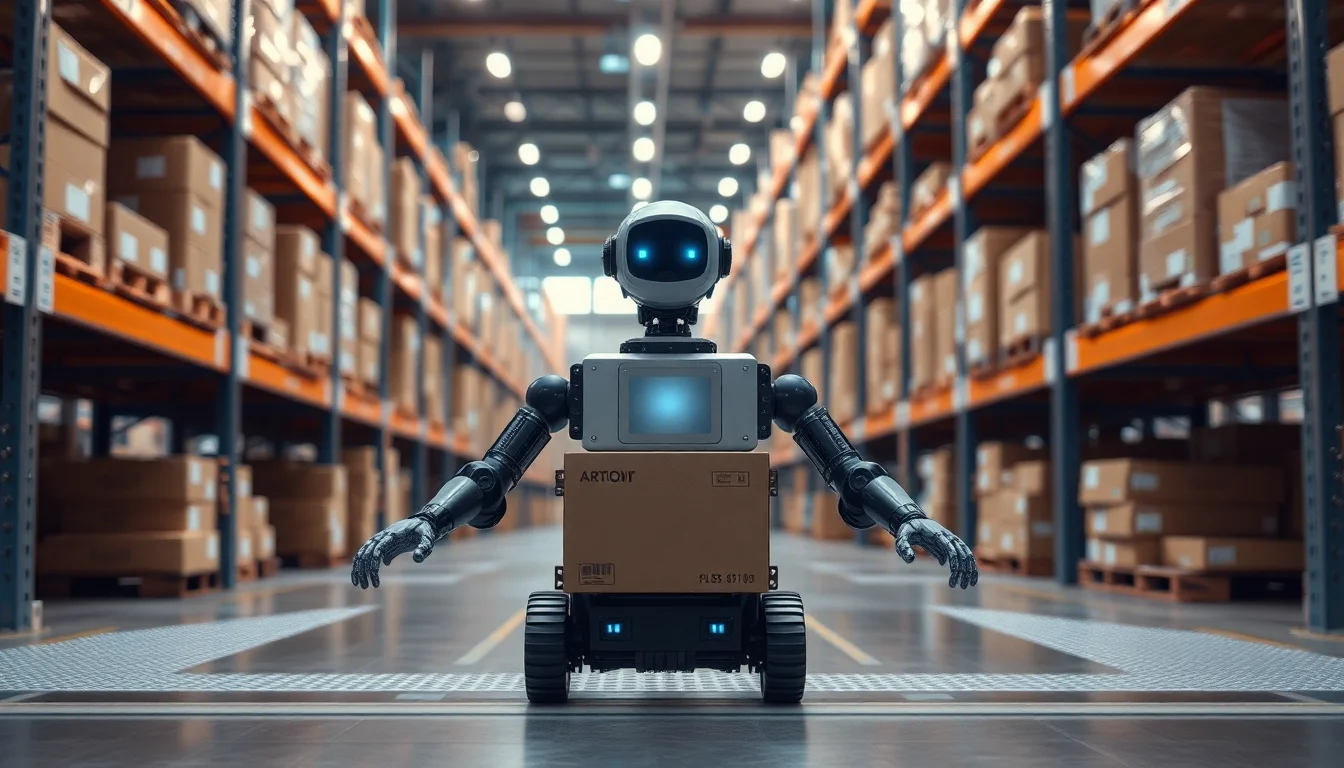
Plus One Robotics has done something that many warehouse automation vendors still avoid: it put an AI-powered parcel induction system on camera for eight uninterrupted hours in a real-world warehouse and let the numbers speak for themselves.
The company says the stream completed 19,784 picks, sustained a reported throughput of 2,488 picks per hour, and held an average pick time of 1.45 seconds. Those figures matter less as isolated performance claims than as a shift in evidentiary standard. In a sector still saturated with curated clips, controlled demos, and heavily edited highlight reels, an eight-hour live demonstration with continuous metrics is a materially different kind of artifact.
That distinction is not cosmetic. A short demo can show a system working when conditions are favorable. A long run starts to reveal how the stack behaves when the workflow drifts, the parcel mix changes, the queue builds, or the system has to sustain tempo without a reset button. Plus One’s livestream was framed as a transparent look at the realities of large-scale warehouse robotics operations, and that framing is important because the industry has spent years blurring the line between isolated function and production readiness.
From staged demos to continuous operation
The significance of the livestream is not that warehouse robotics can pick parcels quickly. That has been demonstrated in many forms before. The more relevant change is that Plus One made the system legible over time, not just at a peak moment.
A live stream broadcast on YouTube and LinkedIn creates a different pressure than a polished product video. Viewers can watch the system in a sustained operating loop, see the reported metrics update during the session, and infer something about operational discipline: whether the platform can hold performance under a real workload, whether the team is comfortable showing the machine state continuously, and whether the vendor is willing to expose the machine to public scrutiny without preselecting the best minute.
That matters because warehouse automation buyers are not evaluating a demo; they are buying a workflow dependency. In parcel induction, the question is not whether a robot can identify a parcel and move it once. It is whether perception, planning, grasp selection, motion control, exception handling, and safety logic continue to cooperate when the system is under load for hours at a time.
The livestream therefore acts as a pressure test for a different kind of claim. “Production-ready” is no longer a vague label attached to a prototype. It implies sustained operation, live observability, and enough confidence in the control stack to let outsiders watch the machine work without narrative editing.
Metric-by-metric, the run says more than the headline
The raw numbers are straightforward: 19,784 picks in eight hours, 2,488 picks per hour, 1.45 seconds per pick. The useful question is what those metrics suggest about the AI pipeline behind the machine.
At this level of performance, the system is not simply seeing parcels. It is making repeated decisions under time pressure: detect, classify, localize, plan, execute, recover, repeat. Even if the livestream does not expose the internal architecture, the output implies that the perception stack and control loop were able to maintain a tight cycle time across a sustained workload in a functional warehouse environment.
A reported 1.45-second average pick time suggests that the system’s end-to-end latency is not dominated by a single slow component. In practical terms, that latency reflects more than arm motion. It includes sensing and localization, confidence gating, grasp planning, path generation, and the safety logic that keeps the system operating around people and equipment. If any one of those layers becomes unstable, the pick cycle stretches and throughput degrades.
Likewise, 2,488 picks per hour should be read as a system-level throughput measure rather than a narrow robot speed metric. It is the product of all the constraints in the loop: camera quality, model inference time, motion planning efficiency, gripper reliability, exception handling, and whatever supervisory logic is used to keep the workflow moving. Throughput in a live parcel induction setting is often less about peak mechanical speed than about how well the software stack manages variability.
That is why the continuous nature of the livestream matters. Short-form demos can hide throughput decay that appears only after a sustained run. An eight-hour session cannot eliminate all uncertainty, but it does surface the question that buyers really care about: can the system keep going when the novelty is gone?
What buyers should now ask for
The broader implication is that the market may be moving toward a higher bar for proof. Vendors that want to make production-readiness claims will increasingly need to show more than selected success clips or single-day totals.
Buyers should expect ongoing KPI disclosure, not just launch-day statistics. That means metrics that can be reviewed over time: pick rate, exception rate, recovery time, downtime, utilization, variance by parcel type, and system availability across shifts. It also means end-to-end monitoring dashboards that make it possible to inspect performance in the same way operators inspect any other production system.
SLAs should reflect real operating conditions, not idealized benchmarks. If a vendor says a system is ready for production, the contract should clarify what happens when performance drifts, how model updates are validated, how often calibration is required, and what visibility the customer gets into failure modes. A live demo is useful only if it leads to a more serious discussion about lifecycle management.
That level of transparency is becoming more important as scrutiny rises across robotics and AI. The sector is attracting capital and attention, but it is also facing the same skepticism that has started to define other AI markets: impressive claims are easy to stage; durable operational proof is much harder to manufacture.
The market signal is real, but so is the risk
The livestream also says something about positioning. Plus One is not just showing a robot. It is trying to reframe what counts as evidence in a category where physical AI and humanoid robotics are heavily marketed but often difficult to evaluate in production terms.
That is a smart move, but it comes with a cost. Once a vendor invites buyers to measure sustained performance, it becomes harder to hide behind anecdote. Competitors will be judged against the same standard, and customers will expect better documentation of reliability, lifecycle behavior, and integration quality.
This is where the market can bifurcate. Vendors able to sustain measurable KPI disclosure will gain credibility with operators who need predictable throughput and manageable risk. Vendors that rely on polished demos will look increasingly fragile by comparison, especially if buyers start asking for the same kind of public or semi-public operational evidence.
The deeper issue is ROI. Warehouse automation only scales economically when the system remains predictable enough to justify integration costs, labor redesign, exception workflows, and maintenance overhead. A strong live run does not prove long-term return on investment, but it does sharpen the terms of the debate. It suggests that the next competitive advantage may not be a flashier demo or a more ambitious roadmap, but the ability to document reliability in the wild.
That is the real significance of Plus One Robotics’ eight-hour livestream. It was not just a performance. It was a transparent look at how an AI-powered warehouse system behaves when the presentation layer is replaced by continuous operation—and that is the kind of evidence buyers are likely to demand more often from here on out.


