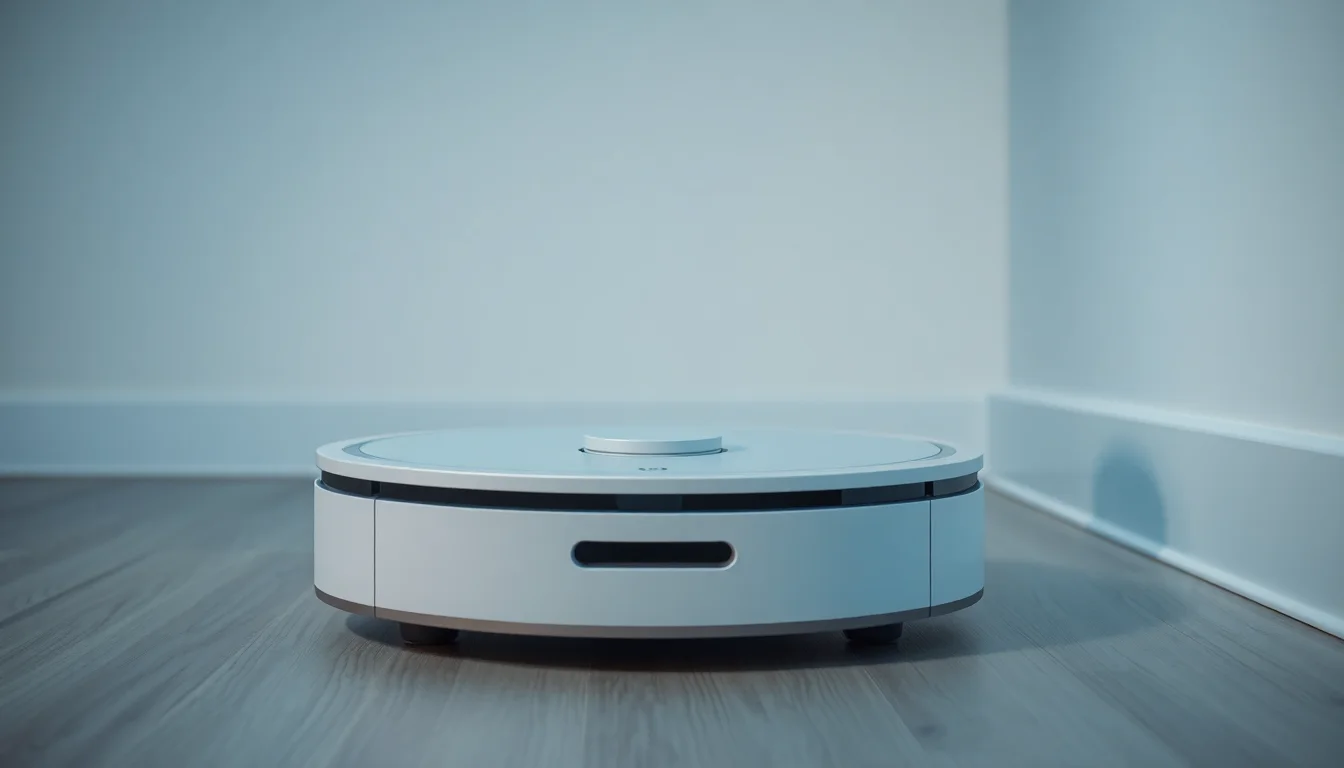
Prime Day is still a week away, but the robot-vacuum category has already become a useful snapshot of where consumer AI is headed. The Verge’s early-deals roundup shows discounts landing across Roborock, Dreame, Shark, Ecovacs, Eufy, and Tapo, with models spanning the budget-to-premium range and bundling in the features that now define the market: obstacle avoidance, self-emptying docks, mopping systems, and in some cases rollers and pads that wash and dry themselves.
That matters because this is no longer just a race on price. The early promotions suggest vendors are using Prime Day to push AI-enabled home robotics deeper into the mainstream, while they still have a chance to shape consumer expectations around what a “good” robot vacuum should do. A basic autonomous cleaner is increasingly a hard sell; buyers now expect the machine to map rooms, dodge clutter, return to base, and manage wet and dry cleanup with as little human intervention as possible.
Roborock’s Qrevo Curv 2 Flow is a good example of the new positioning. The Verge highlights it as the company’s first roller-mop robot vacuum, packaged as a flagship-spec machine at a mid-range price. That combination is telling. The product is not just being marketed as cheaper; it is being marketed as more capable than the tier below it, without fully entering the ultra-premium bracket. In other words, the competitive play is to move advanced automation downmarket fast enough that the feature set itself becomes the selling point.
Eufy’s Omni C28 sits in a different part of the range, but it reinforces the same pattern. The Verge calls it a strong option for smaller spaces, which is exactly where vendors often try to turn feature density into practical value: self-emptying, mop handling, and autonomous navigation can matter even when floor plans are compact, because the buyer is still paying for labor saved, not just square footage covered.
What changed in this Prime Day window is the speed of the rollout. Retailers are front-loading deals before the event itself, effectively using early availability to seed adoption while shoppers are still comparison-shopping. That strategy works especially well in a category where technical differentiators are hard to evaluate from a spec sheet alone. If a vacuum can avoid socks one week and struggle with chair legs the next, the promotional window becomes less about discounts and more about establishing trust in the software stack behind the hardware.
That is where on-device AI starts to matter. In home robotics, the difference between cloud-assisted processing and local inference is not academic. On-device models can reduce latency, avoid depending on network reliability, and limit how much raw household data leaves the device. For a robot vacuum, that means obstacle detection, path planning, and room classification can happen close to the sensors rather than being sent upstream for analysis. The practical result is faster response times and fewer points of failure. The strategic result is that vendors can pitch smarter behavior without implicitly asking users to trade away as much privacy.
It also changes the economics of product rollout. If the intelligence is mostly local, manufacturers can push features into a larger installed base through OTA firmware updates instead of waiting for a new hardware cycle. That is powerful, but it cuts both ways. A faster software cadence can improve mapping, object recognition, and cleaning routines after sale. It can also introduce regressions if firmware QA lags behind the pace of feature churn. In a category where the robot is expected to operate near pets, children, cords, and spilled liquids, reliability is not a cosmetic issue. It is the product.
That is why the current wave of AI vacuum deals should be read as a deployment story as much as a consumer-shopping story. Self-emptying docks and mopping systems are no longer fringe add-ons; they are the visible proof that vendors are trying to close the loop on end-to-end autonomy. But as features accumulate, the risk is feature bloat — a robot that advertises broad intelligence without consistently executing the basics. Buyers will notice quickly if a high-end navigation stack still gets snagged by cables or if mopping logic leaves behind the kind of inconsistent results that make automation feel half-finished.
The market structure reflects that tension. At the lower end, the value proposition is simple: get a robot that can handle routine vacuuming with limited supervision. At the middle, vendors like Roborock are trying to make advanced navigation and mop handling feel attainable. At the top, the pitch becomes a broader autonomy package — better sensing, more capable docks, and increasingly refined software behavior. The point of the Prime Day promos is to compress those tiers by making premium-ish features feel normal at lower prices.
That compression is likely to continue as the hardware matures. Once obstacle avoidance, self-emptying bases, and mopping coordination are expected features rather than luxury differentiators, the pressure shifts to software quality, data handling, and update discipline. The technical advantage will belong less to the vendor that can list the most AI features and more to the one that can make them reliable across thousands of homes with minimal maintenance friction.
For buyers, the near-term checklist is straightforward. Look first at where the AI runs: local inference is generally a better sign than a cloud-heavy design for latency and privacy. Then look at the sensor stack and the dock workflow, since those determine whether autonomous cleaning is genuinely low-touch. Finally, check how the vendor handles OTA updates and what it says about data collection. In this category, the machine is only as smart as the software policy behind it.
For product teams, the lesson is similar but sharper. Prime Day is revealing how quickly consumer expectations can outrun engineering discipline. The next wave of robot vacuums will not be judged only by suction strength or list price. They will be judged by whether the AI is local enough to be responsive, robust enough to be safe, and maintained often enough to stay trustworthy after the sale.


