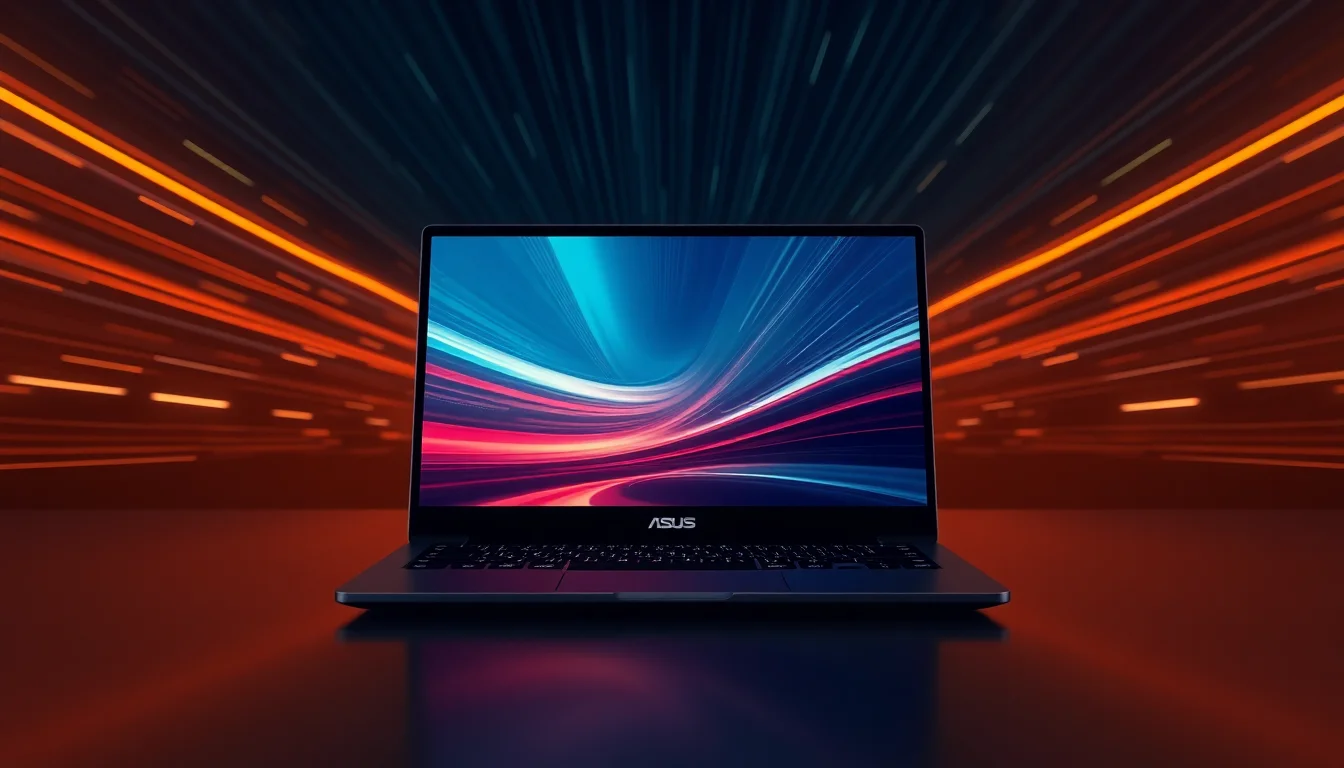
A RAM-rich ultralight arrives: Asus Zenbook A16 as a MacBook Air challenger
The latest benchmark for portable AI work comes from a 16‑inch chassis that weighs in with a surprising amount of memory. The Verge’s review of the Asus Zenbook A16 highlights a configuration with 48GB of RAM priced at $1,599.99, calling it a strong MacBook Air alternative. In short, Asus has paired an ultralight footprint with a memory load that many ultraportables reserve for premium configurations, delivering a price-to-performance signal that few contenders have matched in recent years. The aesthetic note—often mentioned in reviews of premium laptops—fades in priority next to the practical implications: large memory, broad display, and a price that undercuts typical high-memory ultrabooks. The production unit reviewed by The Verge built on a CES scouting impression, bringing the final spec to market with the same memory advantage that impressed the reviewer during pre-production testing.
The Verge: Asus Zenbook A16 review — 48GB RAM, $1,599.99, strong MacBook Air alternative.
Technical implications: on-device AI workloads and memory locality
With 48GB of RAM, local model loading and data caching become a first-order constraint on what teams prototype on-device. The Zenbook A16 shifts memory from a secondary consideration to a primary determinant of what can sit resident in memory during early experiments. In edge workflows, reducing swap pressure and avoiding cloud round-trips for data that fits in RAM translates to faster iteration cycles and more aggressive prototyping turns. Memory locality—the ability for large buffers, embeddings, and feature caches to stay hot on the CPU and GPU—becomes a practical lever for developers evaluating tooling, model loading strategies, and data pipelines in offline or intermittently connected environments.
The Verge notes that this is more than a spec sheet win: it changes how teams think about what can be prototyped locally before committing to heavier deployments or cloud-assisted training loops. The 48GB RAM option in a portable, 16‑inch chassis makes the A16 a compelling platform for early-stage AI work where memory capacity is a bottleneck on smaller notebooks.
Product rollout strategy: price-to-performance undercuts premium ultrabooks
At $1,599.99, Asus positions the Zenbook A16 as a budget-conscious, high-memory option that competes with premium ultrabooks on capability rather than brand premium alone. The RAM-heavy configuration in a comparatively light form factor creates a value proposition that can accelerate onboarding for developers and small teams that want on-device prototyping without paying a premium for memory. The Verge’s framing of the A16 as a “strong MacBook Air alternative” underscores that this is less about niche power users and more about broadening the accessible memory-to-dollar ratio for AI-ready laptops in real-world workflows.
Use-case playbook for AI teams: edge inference, offline prototyping, and privacy
Teams evaluating on-device AI workflows can map several concrete use cases to the A16’s spec: offline model prototyping with larger checkpoints, local data processing pipelines that keep sensitive data on-device, and edge inference scenarios where cloud connectivity is unreliable or undesirable. The 48GB RAM headroom reduces the need to shuffle data between local memory and disk, potentially shortening experiment cycles and enabling more iterative testing of larger models or data slices in a constrained environment. In practice, this translates to faster prototyping loops and more robust demonstration environments for edge AI concepts before scaling to cloud-based training or deployment.
Risks to watch: thermals, reliability, and software maturity
Early reviews also flag the usual caveats that accompany a high-memory, compact chassis: thermal envelopes, reliability of sustained loads, and software maturity for AI-focused workflows. The Verge notes early hardware issues and software bugs observed in pre-production notes, suggesting that a phase-gated rollout may be prudent for teams deploying AI-heavy workloads that stress memory and thermals. In other words, while the A16 sets a new price-to-performance floor for memory-heavy portable AI work, teams should plan for calibration periods and driver/software stabilization as early adopters push the stack.
Overall, the Zenbook A16 reshapes discussions around memory-per-dollar in portable AI-capable hardware. It signals a stronger case for larger RAM footprints in ultralight form factors and invites competitors to respond with comparable memory capacity at a compelling price, raising the floor for on-device AI readiness across the market.


