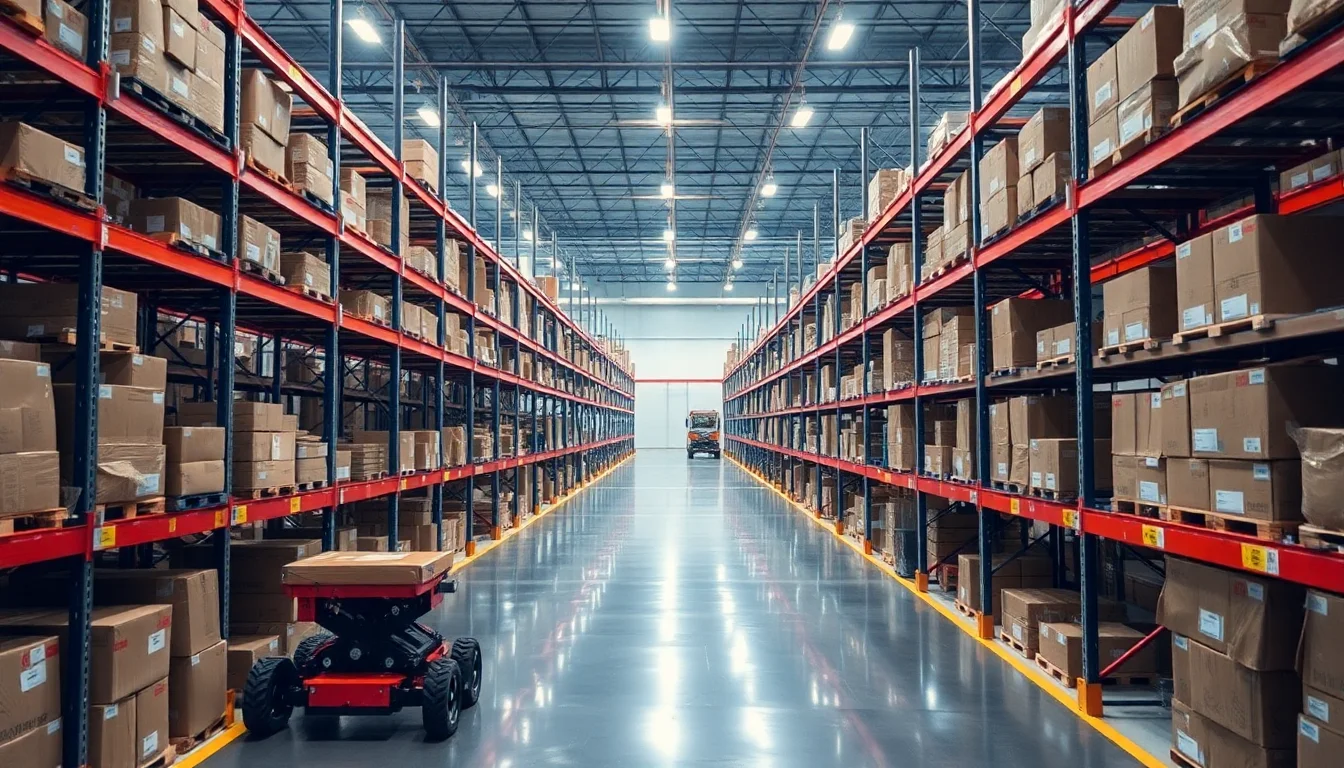
Romark Logistics’ Hazleton warehouse is becoming a live test of a claim that warehouse operators have long treated with skepticism: that you can get real-time inventory visibility without paying for it in throughput.
At the site, Romark is deploying DexoryView, Dexory’s AI-powered warehouse visibility platform, to improve inventory accuracy while keeping operations moving. That matters because inventory counting has historically forced a compromise. Better visibility usually meant more labor, more interruptions, or periodic freezes in activity. Romark’s use case is framed differently: continuous validation, built into the flow of warehouse work, with throughput preserved.
The significance is not just that a warehouse is using automation. It is that the deployment is positioned as an operational layer rather than a sidecar process. For a fully racked facility handling high-volume confectionery products, the problem is less about whether data can be collected than whether it can be collected often enough, and cleanly enough, to matter without disturbing the rhythm of picking, replenishment, and shipment.
AI digital twin plus autonomous robots
DexoryView’s core pitch is a combination of an AI digital twin and autonomous robots. In practical terms, that means the system builds and maintains a digital representation of warehouse inventory and location state, then uses robot-based scanning to continuously validate what is actually in the building.
That architecture is important because it shifts inventory accuracy from an occasional reconciliation exercise to an ongoing data process. Instead of waiting for cycle counts or periodic audits, the platform can compare physical conditions against the digital model as operations continue. The value proposition is not that robots replace the warehouse management system, but that they give it fresher, more reliable inputs.
For technical readers, the distinction matters. A digital twin is only as useful as the cadence and fidelity of the observations feeding it. If the twin drifts too far from reality, it becomes a reporting artifact rather than an operational tool. Dexory’s approach appears to rely on repeated, autonomous verification to keep that model close to the floor state.
Integration with warehouse operations
Romark’s deployment is notable because it is described as integrating seamlessly into existing warehouse operations rather than requiring a separate counting window. That is the operational test any such system has to pass.
A warehouse that cannot pause for inventory counting needs systems that can work around live activity: aisles in use, pallets moving, replenishment in progress, and staff operating against existing workflows. In that setting, autonomy is only useful if it respects the warehouse’s own tempo. If robot runs interfere with picker routes or force process changes elsewhere, any gains in visibility can be offset by friction in execution.
The reporting around Hazleton suggests the platform is intended to avoid that trade-off. The goal is not to create a parallel inventory process, but to embed validation into ongoing activity so the facility can improve control without degrading flow. That is the central promise behind the phrase throughput preserved.
The data layer: latency and architecture
The hardest part of “real-time inventory visibility” is rarely the robot. It is the data path.
To work at warehouse scale, a system like DexoryView needs a reliable architecture for ingesting scan data, reconciling it against warehouse records, and surfacing exceptions quickly enough to affect decisions. That means a practical blend of edge and central processing. Edge-level handling is useful for immediate sensor capture, filtering, and local autonomy. Centralized processing is where the digital twin can aggregate observations, compare them with expected states, and produce actionable inventory intelligence.
Latency matters because the business value of the data decays as the warehouse changes. A pallet that is correctly identified at 9:00 a.m. but moved by 9:05 a.m. only helps if the system can either keep pace or clearly flag the stale state. In other words, real-time visibility is less a single metric than a system property: the window between physical change and digital update has to be narrow enough to support operational decisions.
That also raises the integration question. A warehouse visibility layer has to connect with the systems that already run the site, most obviously the WMS and often the ERP as well. The architecture needs to map robot-observed locations and exceptions into existing item, location, and order records, not merely export a dashboard that lives outside the control loop. If integration is shallow, the result is another analytics tool. If it is deep enough, the visibility layer becomes part of the warehouse’s operating system.
Risks, limits, and what ROI actually depends on
The Hazleton deployment is promising, but it does not remove the usual constraints that govern automation projects.
Robot uptime still matters. If autonomous scanners require frequent intervention, calibration, or maintenance, the effective coverage of the system drops. Data fidelity matters too: the platform has to correctly interpret what it sees in a dense, high-variability warehouse, including occlusions, partial reads, and changes in SKU positioning. And integration complexity can rise quickly when a site has accumulated multiple software layers over time.
That makes ROI harder to generalize than vendor case studies sometimes imply. The economics will depend on how much labor is saved, how much inventory discrepancy is reduced, and how much process disruption is avoided. But those benefits can vary materially by site design, SKU mix, rack density, and the maturity of the existing warehouse systems stack. The strongest claims here should be read carefully: the available evidence supports improved visibility without throughput penalties at this site, not a universal rule that every warehouse will see the same result.
Still, there is a more important point than a single payback calculation. If a warehouse can move toward continuous inventory validation without having to slow its core processes, it changes the baseline expectation for what modern warehouse operations should look like. The bar stops being “Can we count accurately?” and becomes “Can we keep the digital record aligned with the physical one while the building is still running?”
What this means for Dexory, Romark, and the market
If the Hazleton rollout holds up under sustained use, it could become a credible blueprint for AI-driven warehouse visibility that other operators will scrutinize closely. Not because it is universally replicable, but because it addresses the deployment question that usually stalls these projects: whether better data must come at the expense of operating throughput.
For Dexory, the strategic value is in proving that its AI digital twin and autonomous robots can function as an infrastructure layer inside live warehouse operations, not just as a point solution. For Romark, the value is in demonstrating that a distribution site can add real-time inventory visibility without reengineering the whole floor.
The broader market implication is straightforward: vendors will increasingly be judged not only on scan accuracy or dashboard quality, but on how cleanly they fit into warehouse operations, how they handle data latency and architecture, and how much change they require from the people running the site.
That is the real challenge behind the Hazleton deployment. It is not whether warehouse visibility can be automated. It is whether automation can be made operationally invisible enough to scale.


