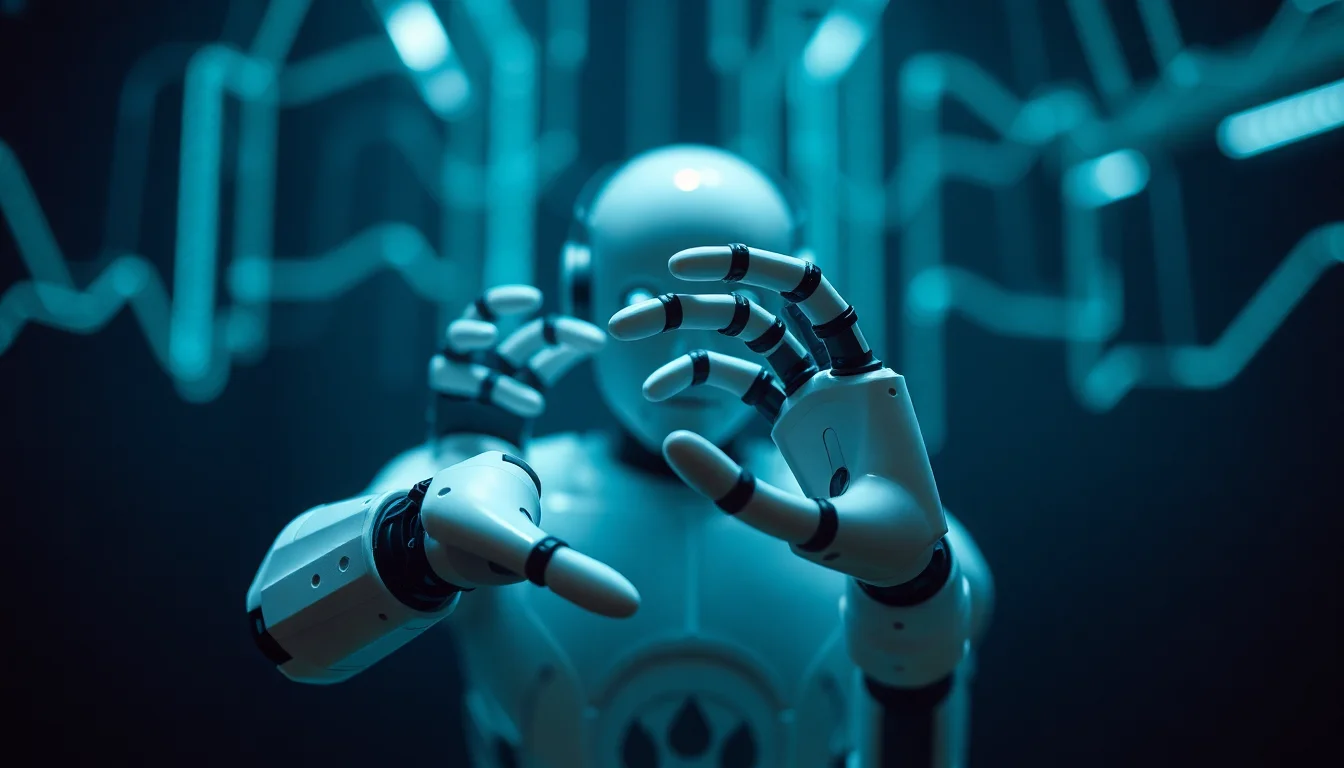
The humanoid robotics conversation has spent years rewarding the most visually legible milestone: movement. Walk, run, jump, balance, repeat. Sharpa’s Alicia Veneziani is pushing the debate in a different direction. In her framing, the harder problem is not getting a robot to cross a room, but getting it to do anything useful once it arrives there.
That distinction matters. The interview makes the company’s core claim unusually explicit: dexterous manipulation is the key to useful humanoid robots. In practical terms, that means hands, tactile sensing, and the ability to learn from human demonstrations are not peripheral features. They are the product.
Dexterous manipulation as the real bottleneck
The industry has not ignored manipulation, but it has often treated it as a downstream problem after locomotion, balance, and whole-body control. Sharpa is arguing the reverse. If a humanoid cannot reliably grasp, adjust, and manipulate objects in unstructured environments, then many of the most valuable use cases remain out of reach, no matter how polished the gait demo looks.
That shift in emphasis is technically important because manipulation is where physical variability bites hardest. Objects differ in weight, texture, compliance, geometry, and center of mass. Surfaces slip. Contact is intermittent. Visual perception alone usually falls short once a hand closes around an object and the scene becomes partially occluded. A useful hand needs tactile feedback, control strategies that can adapt mid-action, and data that captures what happens during contact rather than just before it.
Sharpa’s pitch is that this is the point at which humanoid robotics becomes less about an impressive mechanism and more about a learning system.
Wave: a full-platform hypothesis
Veneziani described Wave hands as a full platform: hardware, data, and AI working together. That wording matters because it signals a strategy broader than selling a component or a polished end effector. The idea is to couple the physical hand with the sensing layer and the learning loop so the system can improve from human demonstrations.
For technical readers, the platform framing has several implications.
First, it changes the unit of development. Instead of optimizing hand mechanics in isolation, the hardware must be designed around the data it can generate and the models it is meant to train. The sensor package, calibration workflow, and control stack all become part of the product definition.
Second, it suggests that the company sees learning from human demonstrations as a growth engine. That makes the quality of captured demonstrations central. If the data pipeline is weak, the platform does not just underperform; it produces poor training signals that can limit downstream model quality.
Third, a hardware-data-AI stack can, in theory, create compounding advantages. If the same platform produces better manipulation data over time, that data can reinforce performance gains in ways a one-off mechanical component cannot. But this only works if the system is stable enough to collect repeatable data under real contact conditions.
From CES demos to deployment: what changes in the real world?
Sharpa’s visibility accelerated after live autonomous demonstrations at CES, where the company’s robots were shown dealing blackjack, taking photographs, assembling pinwheels, and playing ping-pong. Those are not trivial tasks. They show coordination, object handling, and enough autonomy to sustain public demonstrations over multiple days.
Still, the gap between a conference-floor demo and deployment is where robotics companies usually encounter the hardest constraints. Public demos compress uncertainty. Real environments expand it. Lighting changes. Objects vary. People interfere. Hardware wears down. And the same contact-rich behavior that looks impressive in a controlled setting can become brittle when the task distribution shifts.
That is why the demonstration set matters less as a proof of universal capability and more as a signal about the company’s target class of problems. Blackjack, photographs, pinwheels, and ping-pong all rely on fine motor coordination, timing, perception, and touch. They are consistent with a thesis that the hand is the critical interface between embodied AI and the physical world.
The open question is whether Sharpa can turn that thesis into repeatable task performance outside the trade-show environment. The interview supports the ambition, but it does not claim the hard deployment work is already solved.
Market positioning and go-to-market implications
A platform-centric robotics strategy can alter more than product architecture. It can reshape go-to-market structure as well.
If Wave is genuinely meant to be hardware, data, and AI as one integrated system, then partnerships become more consequential. The company may need customers willing to participate in data collection, calibration, and iterative model improvement rather than buy a finished part and move on. That can deepen customer lock-in, but it also raises adoption friction.
There is also a competitive angle. Platform-based differentiation in robotics can create a defensible moat if the ecosystem compounds: the hardware captures better tactile data, the data improves the AI, the improved AI makes the hardware more useful, and integration knowledge accumulates over time. But the same integration can cut the other way. If the stack is too closed, users may worry about vendor lock-in or standards fragmentation, especially in a market that is still trying to settle on common interfaces and integration patterns.
So the platform thesis is attractive not because it is flashy, but because it is economically legible. It turns manipulation into a system problem with potential feedback loops. The challenge is that those loops only work if customers trust the stack enough to let it into their workflows.
Risks, signals, and what to watch next
The interview points to a plausible robotics roadmap, but the constraints are obvious.
Data quality is the first risk. Human demonstrations are only useful if they are captured with enough fidelity to support learning. In manipulation, small errors in timing, contact, or calibration can poison the dataset.
Hardware reliability is the second. A tactile hand that performs well in demos but drifts in the field will not produce the consistency needed for deployment.
The third is scaling the data pipeline itself. A full-platform approach is only compelling if the company can gather, label, and reuse manipulation data without turning each new deployment into a bespoke integration project.
For readers tracking whether Wave is becoming a real platform rather than a concept, the signals to watch are concrete: new datasets, named partnerships, and evidence that the company is building repeatable demonstration-to-training loops rather than one-off showcases. If those pieces start to line up, Sharpa’s hands-first thesis could influence how robotics roadmaps are built. If they do not, the company may still have strong demos without the industrial machinery needed to turn them into a product category.


