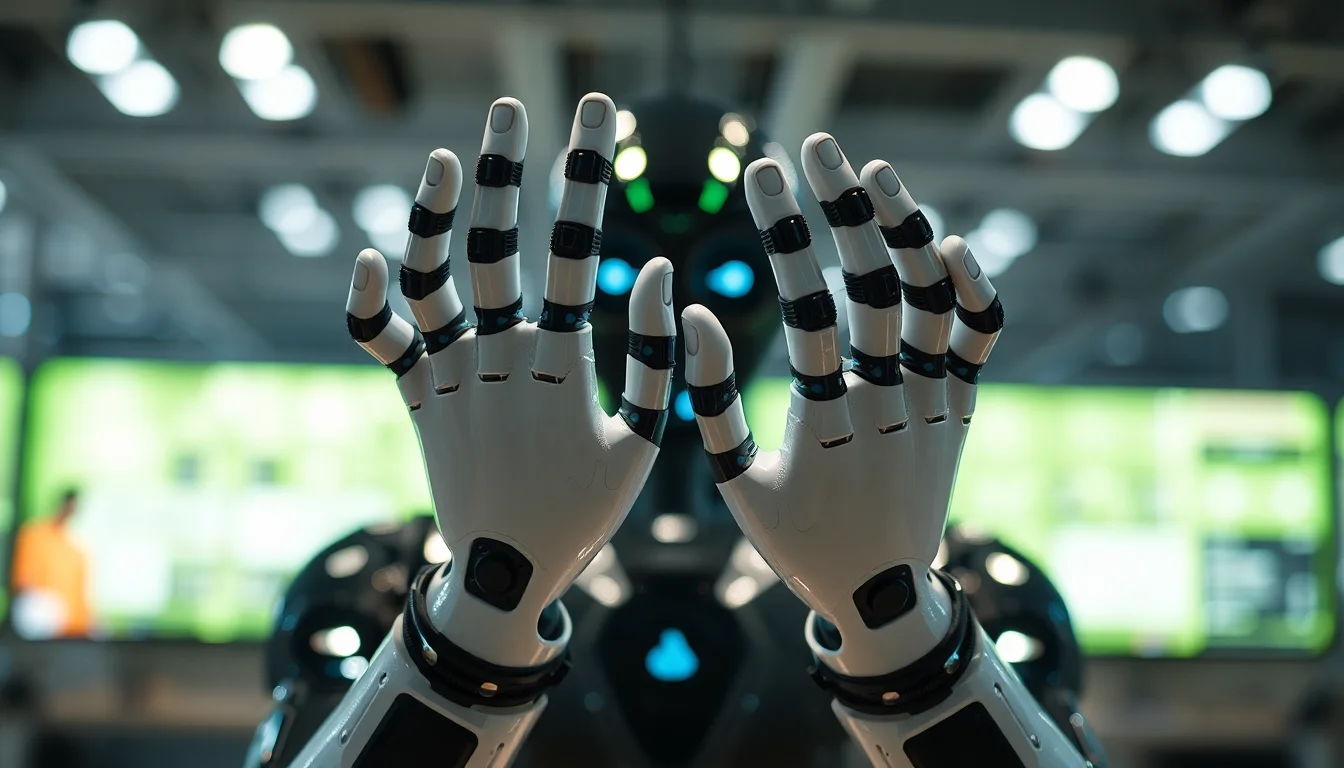
Sharpa’s integration of its Wave tactile robot hands into the Unitree H2 Plus humanoid reference design on Nvidia Isaac GR00T is a meaningful signal for the robotics market because it shifts the conversation from isolated dexterity demos to a more complete development path.
According to Robotics & Automation News, this is the first dexterous humanoid platform built on Nvidia’s Isaac GR00T framework to feature tactile manipulation technology. That distinction matters. In humanoid robotics, the bottleneck is rarely just the arm, the hand, or the model. The hard part is getting all three to work together in a way that survives simulation, training, and eventually deployment. A reference design that explicitly bundles those layers changes the shape of the problem.
What changed and why it matters now
The new stack combines Sharpa’s Wave tactile hands with Unitree’s H2 Plus humanoid hardware, Nvidia onboard compute, and Isaac GR00T development workflows. In practical terms, that means tactile manipulation is no longer being presented as a peripheral add-on to a humanoid platform. It is being treated as part of the baseline architecture.
That is significant because tactile sensing is one of the main differentiators between a robot that can move objects and a robot that can reliably manipulate them. Vision can tell a hand where an object is. Tactile feedback tells the system whether it has actually made contact, whether grip force is slipping, and whether an object is deforming or shifting. For enterprise use cases, that feedback loop is often what separates a promising demo from a system that can be trained for repeatable work.
The reporting describes the configuration as a validated hardware and software platform intended to help robotics developers and researchers accelerate humanoid skill development. That phrasing matters more than the product label. A validated stack implies that the difficult integration steps have been reduced enough to make development more predictable, even if deployment still requires substantial engineering work.
Technical backbone: weaving tactile dexterity into the stack
The key technical shift is the way the hardware and toolchain are being assembled into a single workflow.
Sharpa’s Wave hands provide the tactile manipulation layer. Unitree supplies the humanoid chassis in the form of the H2 Plus reference design. Nvidia contributes onboard compute and the Isaac GR00T development framework, which is being positioned as the environment for simulation, training, and deployment.
That combination is important because humanoid systems usually fail in the seams. A hand may be capable in isolation, but without a compatible control stack, data pipeline, and simulation environment, the system remains hard to train and hard to ship. By packaging these components together, the reference design reduces the number of interfaces developers need to stitch together themselves.
The value of tactile manipulation becomes clearer in this context. A simulation-only pipeline can produce motion policies, but real-world contact is messy. Hands need to understand friction, compliance, object pose changes, and micro-slippage. Tactile sensors provide the signal needed to close that loop. If Isaac GR00T is the development framework and the Wave hands are the sensing and actuation layer, the reference design is effectively trying to compress the path from model training to physical execution.
That does not eliminate the complexity of humanoid robotics. It changes where the complexity lives. Instead of spending most of the effort on basic system integration, developers can spend more time on skill development, dataset generation, and policy improvement. That is a meaningful shift for teams trying to move beyond proof-of-concept work.
Platform economics and developer tooling
The deeper business implication is not the hand itself. It is the packaging.
A validated hardware/software stack can lower the cost of experimentation, especially for teams that would otherwise need to source actuators, tactile hardware, compute, simulation tools, and deployment software from different vendors. It can also reduce the amount of bespoke work needed to move between training environments and physical robots. In enterprise robotics, those handoffs are often where projects stall.
The Robotics & Automation News coverage frames the platform as a turnkey environment for tactile humanoid development. That is an important phrase to read carefully. “Turnkey” in robotics rarely means finished. It usually means less integration debt. For buyers, that can translate into shorter time-to-value, fewer vendor relationships to manage, and a clearer path from research budget to pilot deployment.
It may also change how data is collected. One of the hardest problems in embodied AI is obtaining enough useful interaction data from the physical world. If the platform standardizes the hardware and software environment, developers can gather data in a more repeatable way and potentially reuse training workflows across projects. That is a quiet but powerful advantage, because data quality and consistency often matter more than raw volume.
Market positioning: who wins and who worries
For Sharpa, Unitree, and Nvidia, the integration could be strategically useful even before any broad deployment happens. Each benefits from a consolidated ecosystem: the hand maker gets distribution into a reference stack, the robot platform gains a more differentiated capability set, and the compute and software provider anchors the developer workflow.
That kind of ecosystem effect matters in enterprise robotics, where procurement decisions are often shaped by integration risk as much as by performance. If developers believe the stack is more stable and more reproducible, they may be more willing to build around it. If that happens, the reference design could start to define the default path for tactile humanoid development.
But the competitive pressure cuts both ways. A tightly integrated stack can create lock-in concerns, especially for teams that want modularity or are already committed to alternative hardware, middleware, or simulation environments. Rivals may respond by pushing their own tactile solutions, open toolchains, or more modular humanoid platforms. In that scenario, the market would not converge cleanly around one stack; it would fragment further, with developers choosing between convenience and flexibility.
The business question is whether enterprise buyers value a consolidated development platform enough to tolerate the tradeoffs that come with it. In robotics, the answer often depends on whether the platform demonstrably reduces deployment risk.
Risks, uncertainties, and next milestones
There is still a gap between a compelling reference design and a production-grade robot program.
The most obvious unresolved issues are reliability and safety. Tactile sensing is useful only if it performs consistently across object types, lighting conditions, wear patterns, and long operating cycles. A hand that works well in a controlled setup may behave differently when subjected to dust, temperature variation, impact, or repetitive stress. For enterprise users, those are not edge cases; they are the operating environment.
Pricing is also unknown from the reported announcement, which limits any serious assessment of total cost of ownership. Without public details on the commercial package, it is difficult to know whether the stack is aimed primarily at research labs, early-stage robotics teams, or larger integrators.
There is also the question of what follows the reference design announcement. Public milestones beyond the initial integration appear limited, so buyers and developers will want to watch for evidence of deployment outcomes, benchmark data, and real-world task performance. Those signals will matter more than the launch itself.
For now, the strongest reading is not that humanoid robots are suddenly ready for enterprise deployment. It is that the industry is moving toward a more coherent development pathway. By pairing Wave tactile hands with the Unitree H2 Plus reference design on Nvidia Isaac GR00T, the companies are trying to turn tactile manipulation from a specialized capability into part of a validated development-to-deployment loop.
That may not solve humanoid robotics. But it does make the road to deployment look more legible—and in this market, legibility is a competitive advantage.


