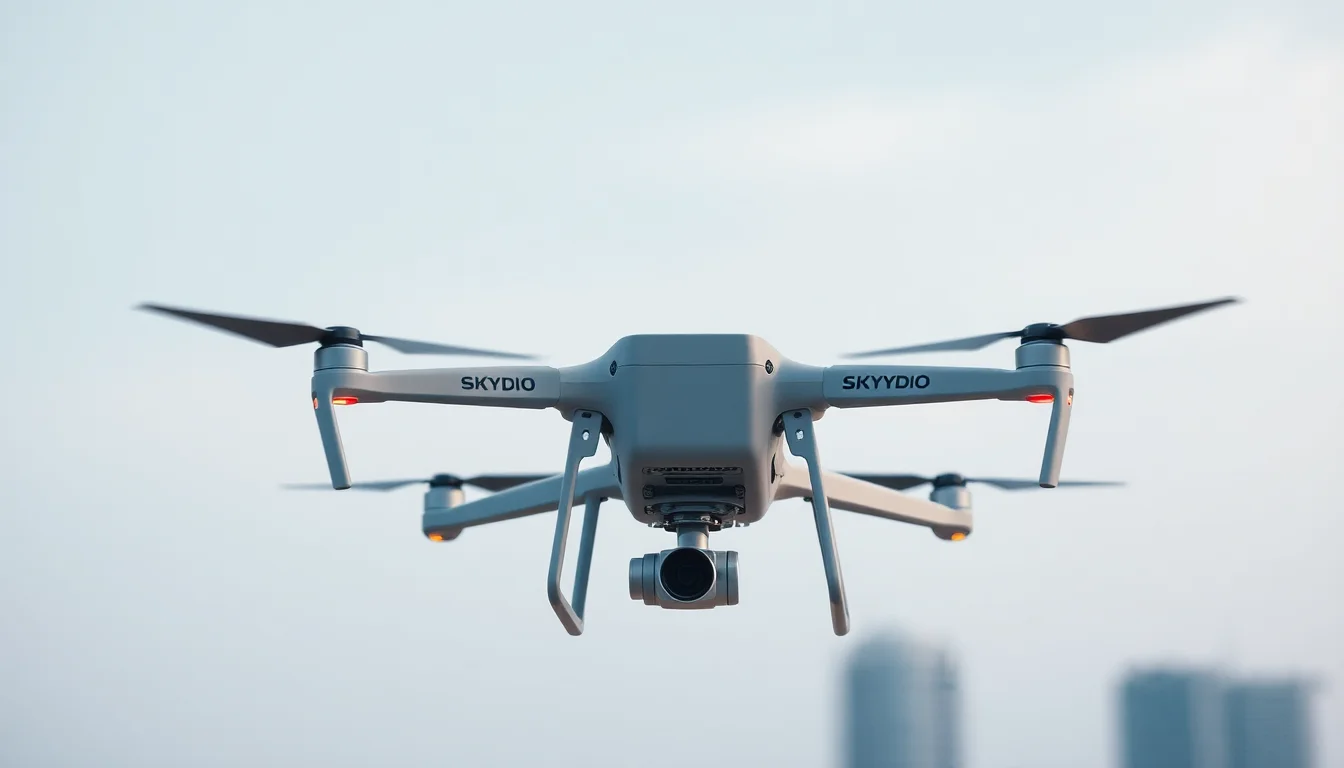
Skydio’s shift away from consumer drones and toward enterprise customers is more than a market repositioning. It reflects a different technical wager: that autonomy-first systems, if built with enough onboard perception and safety discipline, can move from novelty hardware to operational tooling for utilities, public-safety teams, and critical-infrastructure operators.
That is the frame Adam Bry, Skydio’s CEO, put around the company’s strategy in a recent Verge interview on why Silicon Valley shouldn’t draw red lines for drone use. The argument is not that drones should be used everywhere. It is that the most useful systems are the ones that can operate safely, repeatably, and with less dependence on fragile human piloting in complex environments.
A change in the stack
The important shift is not just who buys the drone. It is where the intelligence lives.
Skydio’s pitch rests on an autonomy-first, sensor-rich architecture that pushes perception and decision-making onto the aircraft itself. That matters because enterprise work is not a toy problem. Utility inspections, emergency response, and critical-infrastructure monitoring are environments with bad lighting, clutter, moving objects, and narrow margins for error. The more the system can perceive and plan locally, the less it has to rely on a clean network connection or constant operator intervention.
That architecture is what makes a drone feel less like a remote-controlled camera and more like a field instrument. In practice, that means onboard computer vision, multi-sensor fusion, real-time navigation, and guardrails that keep the aircraft within operational constraints even as conditions change.
The enterprise angle follows from that design choice. A consumer drone can be impressive in a demo. An enterprise platform has to be deployable on Tuesday, by a team that is not made up of drone specialists, in weather and terrain it did not choose.
Why onboard autonomy matters
The technical case for autonomy-first systems is straightforward. If the drone can understand its surroundings on the edge, it can reduce latency and avoid exposing every control decision to the network. If sensors are fused tightly enough, the aircraft can maintain situational awareness when one modality degrades. If planning and safety logic are integrated into the flight stack, the system can make conservative decisions faster than an operator could through a remote interface.
That is the difference between a machine that can be flown and one that can be operationalized.
For enterprise deployments, those distinctions are not abstract. Utility teams need repeatable inspection workflows. Public-safety crews need tools that can be launched quickly and reliably under pressure. Critical-infrastructure operators need systems that fit into existing procedures, logging, and review processes. In all of those cases, safety is not a feature bolted on after the fact. It is part of the product architecture.
That is why Skydio’s sensor-rich approach matters. A drone that is expected to work around poles, wires, buildings, vehicles, and people needs more than a good flight controller. It needs perception depth, obstacle avoidance, and failure handling that are robust enough to support routine use.
Enterprise deployment is a services problem too
The product question is only half of the story. Enterprise rollout is also a governance and operations problem.
A utility or public-safety customer does not just buy a drone and send it into the field. It needs training, maintenance, policy controls, flight review, and a way to show that the system is being used consistently. That is why deployment at scale depends on service ecosystems and measurable safety guarantees, not just a strong airframe or slick autonomy demo.
This is where the enterprise model diverges from the consumer one. Consumer drones sold on features; enterprise drones have to be managed as part of a workflow. That means device administration, fleet controls, data handling, and clear operational limits matter as much as flight performance.
Skydio’s shift suggests that the business value of autonomy is not simply fewer pilot inputs. It is that autonomy can compress the cost and complexity of routine deployments. If an organization can train operators faster, reduce manual flying burden, and standardize mission outcomes, the drone becomes a repeatable tool rather than a specialist exception.
Red lines, governance, and the limits of permissiveness
Bry’s criticism of “red lines” in Silicon Valley lands in the middle of a broader debate: when does caution become a barrier to useful technology, and when does it reflect a necessary boundary?
The tension is especially sharp in public-safety and critical-infrastructure contexts, where drone use can raise legitimate concerns about surveillance, escalation, and operational misuse. Those concerns do not disappear because the aircraft is autonomous. If anything, autonomy raises the bar for governance, because the system may make more decisions locally and more quickly than a human operator would.
That is why the policy conversation cannot stop at abstract principles. The issue is whether a platform can provide verifiable safety controls, auditable behavior, and clear operational constraints. Without those, debates over acceptable use can turn into a deployment bottleneck. With them, organizations have a stronger basis for approving routine work.
So the real question is not whether Silicon Valley should draw any lines at all. It is whether those lines are drawn around the right technical and operational conditions: what the system can sense, how it fails, how it logs, who controls it, and how it is reviewed.
Competitive pressure moves to safety discipline
Skydio’s enterprise bet also changes the competitive frame. The company is not just selling drones; it is selling a platform narrative in which autonomy, data handling, and operational discipline are inseparable.
That matters for the broader tooling ecosystem. If enterprise buyers increasingly expect a drone system to come with strong onboard autonomy, fleet management, and governance features, then competitors will have to match more than flight capability. They will need to match safety architecture and deployment discipline as well.
In that sense, the market is moving toward infrastructure logic. The drone is no longer the main product. The main product is the controlled, repeatable use of the drone inside enterprise workflows.
That is a harder standard to meet, but also a more durable one. And it explains why Skydio’s autonomy-first, sensor-rich stack is being positioned not as a consumer upgrade, but as the basis for mission-critical work in utilities, public-safety, and critical-infrastructure settings.


