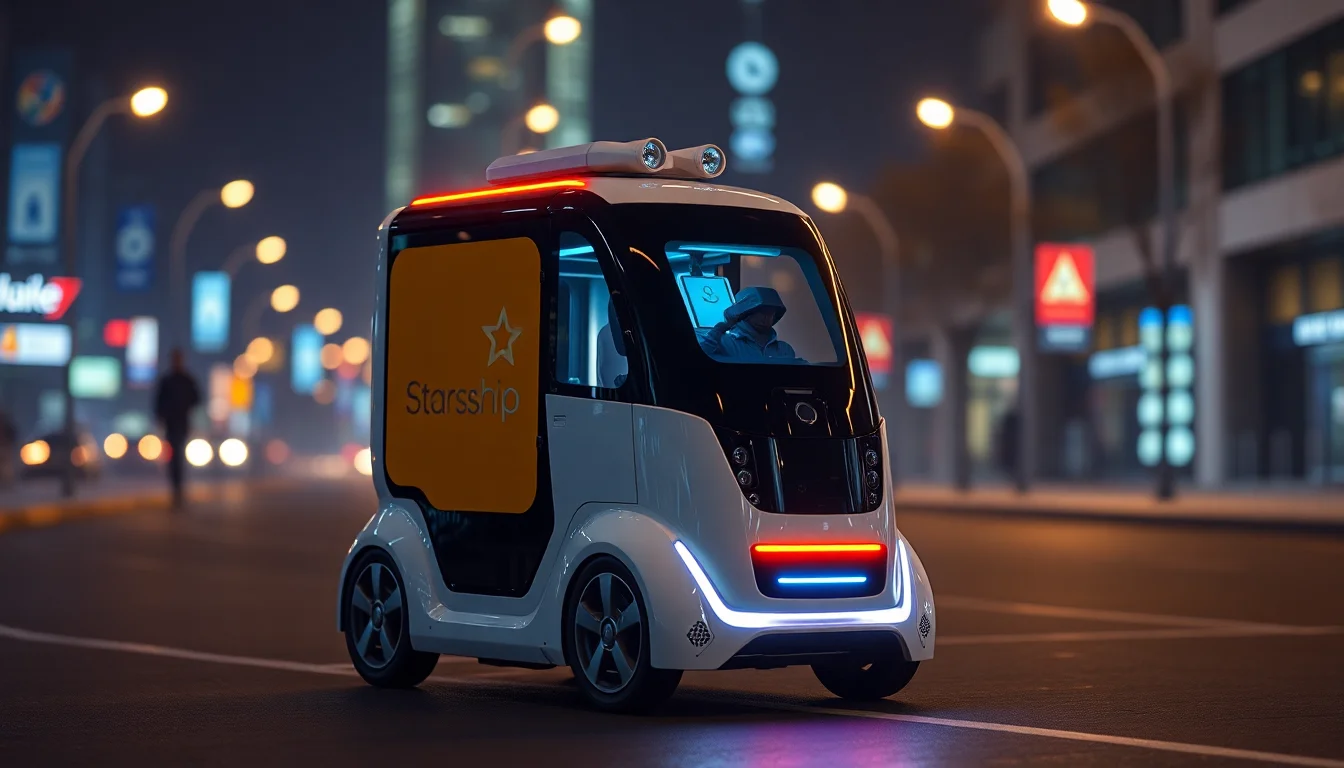
Starship’s latest milestone is not just a larger number on a slide deck. Ten million deliveries, 3,000-plus robots, more than 300 locations, eight countries, 22 million autonomous kilometers, and roughly 200 million road crossings together describe a system that has crossed from pilot-stage novelty into something closer to infrastructure.
That matters because autonomous delivery is one of the clearest tests of whether physical AI can survive contact with the messy, repetitive, economically unforgiving world outside the lab. A handful of demonstrations can prove the concept. Tens of millions of real deliveries force a different question: can the stack hold up when the system is distributed, continuously updated, and exposed to varying weather, traffic, curb geometry, pedestrian behavior, and local regulation?
This isn’t a pilot anymore
The significance of the 10 million-delivery mark is not simply that Starship moved a lot of food, groceries, and parcels. It is that the company now operates at a scale where autonomy is being exercised as a day-to-day service, not as a controlled experiment.
A fleet of more than 3,000 sidewalk robots spread across 300-plus locations in eight countries is large enough to reveal whether the operating model actually generalizes. The easy part is showing that a robot can make a delivery on a good day in a familiar neighborhood. The hard part is sustaining service across different cities, different road rules, different sidewalk conditions, and different demand patterns without falling back on active human supervision.
Starship says its robots operate at Level 4 autonomy, meaning they are designed to function without active human intervention in defined operational domains. That framing matters technically. Level 4 autonomy is not a marketing label; it implies the system must be able to perceive, localize, plan, and execute in the field with enough reliability that remote oversight is not the primary control loop. The more scale you have, the more the system’s real constraints show up in edge cases: signal loss, blocked pathways, degraded sensors, routing ambiguity, and the long tail of situations that rarely appear in demos but do appear in cities.
What the scale reveals about the stack
At this size, the headline metric is not only deliveries completed, but how much autonomy has been accumulated in the wild. Twenty-two million autonomous kilometers and roughly 200 million road crossings point to a fleet that has been trained, so to speak, by repeated exposure to the real environment. That gives Starship something many robotics teams lack: a very large corpus of operational behavior.
The technical implications are straightforward, even if the company does not publish every layer of its architecture. A network of this size depends on fleet-wide perception that can handle lighting variation, occlusion, weather, and the unpredictability of pedestrian traffic. It also depends on edge compute that remains reliable across thousands of units in the field, because low-latency autonomy cannot wait for a remote cloud loop to resolve every decision.
The operational burden grows with the fleet. Every robot is both a delivery asset and a distributed sensing node, which means software updates, diagnostics, and incident handling become fleet-management problems as much as robotics problems. If the system is truly operating without active human supervision, then the reliability stack has to include fail-operational behavior, graceful degradation, and clear recovery logic when the robot encounters an obstacle it cannot clear on its own.
The road-crossing figure is especially revealing. Starship says the fleet now completes about 125,000 road crossings per day, or roughly two per second. That is the kind of number that shifts the discussion away from novelty and toward throughput. Crossing roads safely and repeatedly is not a side feature for a sidewalk robot; it is part of the core autonomy workload. It is also where perception, path planning, and local policy constraints all collide in the same operational moment.
Product rollout and market positioning at the edge of mainstream
Crossing borders is harder than crossing sidewalks. A fleet operating across eight countries has to absorb not only different city layouts but different service expectations, municipal permissions, labor dynamics, and support requirements. That breadth is part of the signal here: Starship is not confining its service to one friendly geography where the system can be overfit to local conditions.
The company’s deployment footprint suggests a market position built around repeatable service rather than isolated installations. That is important for economics. A multi-thousand-robot network only begins to look durable if it can support standardized operations, predictable maintenance workflows, and enough local density to keep utilization high. Broad geographic coverage can help validate the model, but it also raises the bar for serviceability. More jurisdictions mean more compliance work, more part logistics, and more variance in local operating conditions.
For developers and operators, this is the point where autonomy starts to look like a platform business. The question is no longer whether a robot can be built. It is whether the deployment stack can be replicated, monitored, and improved across markets without the economics breaking under maintenance, support, and regulation.
Risks, governance, and the cost of scale
Scale is validation, but it is also stress testing. Once a fleet reaches the size Starship describes, failure modes stop being theoretical. A small defect in hardware reliability, a weak assumption in route planning, or a blind spot in perception can ripple across thousands of units.
Level 4 autonomy raises the governance bar because the system is expected to operate independently inside a defined domain. That creates pressure for robust safety processes, incident reporting, and liability clarity across jurisdictions. If the robot is not under active human supervision, then operators need stronger evidence that the system can detect, avoid, and recover from unsafe conditions without ad hoc intervention.
Maintenance is another understated cost center. A fleet of 3,000 robots is not just 3,000 units of capacity; it is 3,000 sets of batteries, wheels, sensors, chassis wear, and software states that must remain synchronized enough to preserve service quality. At this scale, uptime depends as much on field operations and repair throughput as it does on autonomy performance.
This is where the language of physical AI becomes more useful than the older rhetoric of “robots.” What Starship is deploying is not a single machine in isolation. It is a distributed, continuously managed physical system that has to sense, decide, act, and recover in the real world. That is a materially different operational problem from a proof-of-concept robot running on a closed course.
What comes next: velocity, costs, and practical limits
The next 12 to 24 months will not be about whether autonomous delivery exists. Starship has already answered that. The more relevant question is whether the operating model keeps improving as the fleet grows, or whether scale begins to expose limits in unit economics, maintenance throughput, and regulatory alignment.
The indicators to watch are practical: delivery density per location, repair cycle times, fleet uptime, the pace of software updates that can be safely rolled out across regions, and whether the company can maintain service quality as it adds more sites. Those are the metrics that will separate durable operations from an impressive but fragile network.
For the broader market, the milestone suggests autonomous delivery is moving into a new phase. The debate is shifting from “Can it work?” to “What does it cost to run it reliably?” That is a more serious question, and a more revealing one. It is also the one that will determine whether sidewalk autonomy remains a specialized service or starts to look like a repeatable urban logistics layer.


