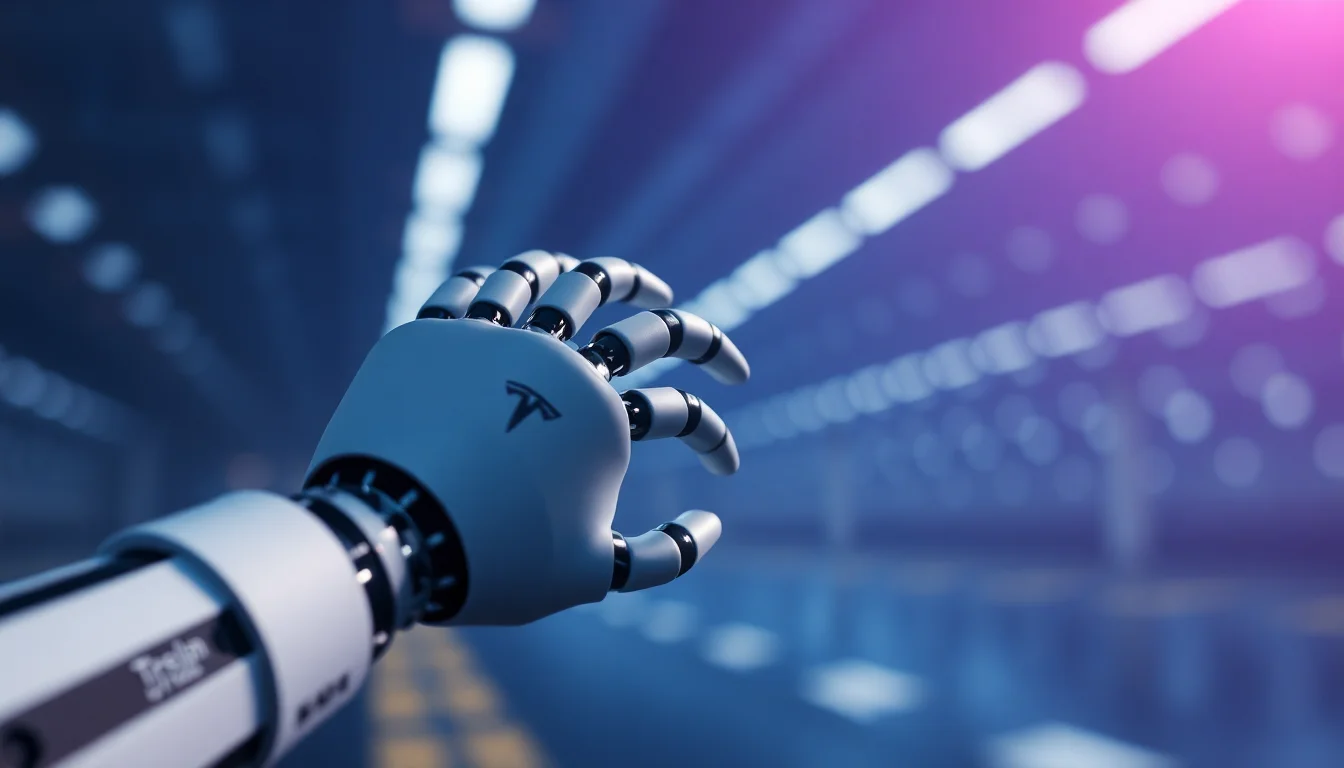
Proception’s week could have been defined by litigation. Instead, it is now defined by runway.
The startup, led by former Tesla Optimus technical lead Jay Li, has settled Tesla’s trade-secret lawsuit and simultaneously announced an $11 million seed round led by First Round Capital, with participation from Y Combinator and BoxGroup, according to TechCrunch. That combination matters because it shifts the company from a defensive posture into an execution phase: the legal overhang is gone, and the financing gives Proception time to pursue a harder but more commercially relevant problem in robotics—making robot hands behave more like human hands.
That is not a cosmetic ambition. In robotics, the hand is where the stack stops being theoretical and starts colliding with the physical world. A humanoid may navigate with relative ease compared with the challenge of grasping a deformable object, orienting an unfamiliar tool, or manipulating an item whose shape, weight, and friction are only partially known. Proception’s emphasis on dexterous manipulation suggests a focus on the interface layer between perception, control, and actuation: sensor-rich hands, fast feedback loops, and control systems that can translate AI planning into reliable motion at the fingertips.
For AI tooling vendors, that matters because the value of model-driven robotics is increasingly measured not just by whether a robot can understand a scene, but whether it can close the loop on manipulation under uncertainty. Dexterous hands are where simulation, perception, policy learning, and real-world control have to meet. A company building for that layer is effectively betting that the next wave of robotics software will depend on more specialized manipulation hardware, better data collection from embodied interactions, and tighter integration with planning systems that can adapt to messy environments.
The settlement changes the risk posture around that bet. Tesla’s dismissal of the suit earlier this month removes a visible cloud over Li and his company, and with it a major source of uncertainty for customers, hires, and investors. In robotics, IP disputes can chill talent movement because the sector is still unusually dependent on people who have worked on the most advanced systems at a small number of large companies. When those employees leave to found startups, the line between legitimate know-how and alleged trade-secret leakage can become a litigation flashpoint. A settlement does not erase those tensions, but it does reduce the immediate legal drag on recruiting and partnering.
That is important for the broader labor market in robotics and embodied AI. The industry has been shaped by engineers moving from major incumbents into startups that promise more focused execution and faster iteration. But legal pressure can make that migration more expensive, both literally and reputationally. Proception’s outcome suggests a more nuanced reality: the legal system can still impose a test, but once a dispute is resolved, founders may be able to convert the visibility of the conflict into a credibility signal rather than a liability. Investors appear to have read the episode that way, or at least decided the company’s technical thesis is worth backing despite the headline risk.
The funding itself is also a signal about where capital is flowing in AI-adjacent robotics. An $11 million seed round is not enough to industrialize a full humanoid platform, but it is enough to hire, prototype, collect data, and narrow a product direction. That implies a near-term roadmap centered on demonstration-grade hardware and software integration rather than mass-market deployment. In practice, a seed round at this stage usually buys iterative cycles: better hand designs, improved sensing, more robust actuation, and enough engineering depth to make the system reliable outside the lab.
That reliability question is where the market gets more realistic. Human-like manipulation is one of the most failure-prone parts of robotics because the environment is unconstrained and every object is a new test case. Even if a hand can grasp well in controlled conditions, commercial deployment depends on endurance, maintainability, calibration, and repeatability. Supply-chain constraints can be just as consequential as model quality, because a clever control policy is only as useful as the hardware stack that can support it at cost and volume.
There is also a go-to-market question. The most plausible early use cases for better dexterity are domains where manipulation quality is worth paying for before full autonomy is achieved: logistics, light assembly, inspection-adjacent workflows, and assistive robotics. Those environments reward incremental improvement, not just dramatic demos. A startup like Proception does not need to solve general-purpose manipulation on day one, but it does need to prove that its hardware can outperform simpler grippers or task-specific end effectors in enough settings to justify adoption.
That is where the settlement may prove strategically useful beyond public relations. If the company can now recruit without the same level of legal uncertainty, it may be better positioned to attract engineers who know that this market will be won by teams that can move across mechanics, control, and machine learning without getting trapped by disputes over prior work. It may also make it easier to talk to potential partners who want exposure to robotics innovation but do not want to underwrite an active trade-secret fight.
Still, the same factors that make dexterous hands attractive also make them hard to scale. Developers will need to watch for how Proception navigates safety, certification, and integration issues if it moves toward customer trials. Hardware systems that interact with people or semi-structured workspaces can face more scrutiny than software-only products, and failures in grip force, tactile sensing, or actuator durability can quickly derail adoption. The technical bar is high, and the market will not forgive a system that is impressive in a demo but brittle in production.
So the significance of this story is not that one startup survived a lawsuit and raised a seed round. It is that the episode exposes a more mature phase of robotics commercialization. Talent is still mobile. IP is still contested. But capital is willing to back teams that sit at the intersection of AI and embodied systems, especially when the technical thesis is specific enough to be testable. In Proception’s case, the wager is that dexterous hands are not just a component, but a gateway to the kind of robotics stack that AI tooling vendors, hardware builders, and early enterprise customers can actually organize around.
If that thesis holds, the settlement was not just a legal cleanup. It was the point at which a high-risk founder story turned into a more conventional startup story: enough money, enough freedom to build, and enough technical ambiguity to make the next milestones meaningful.


