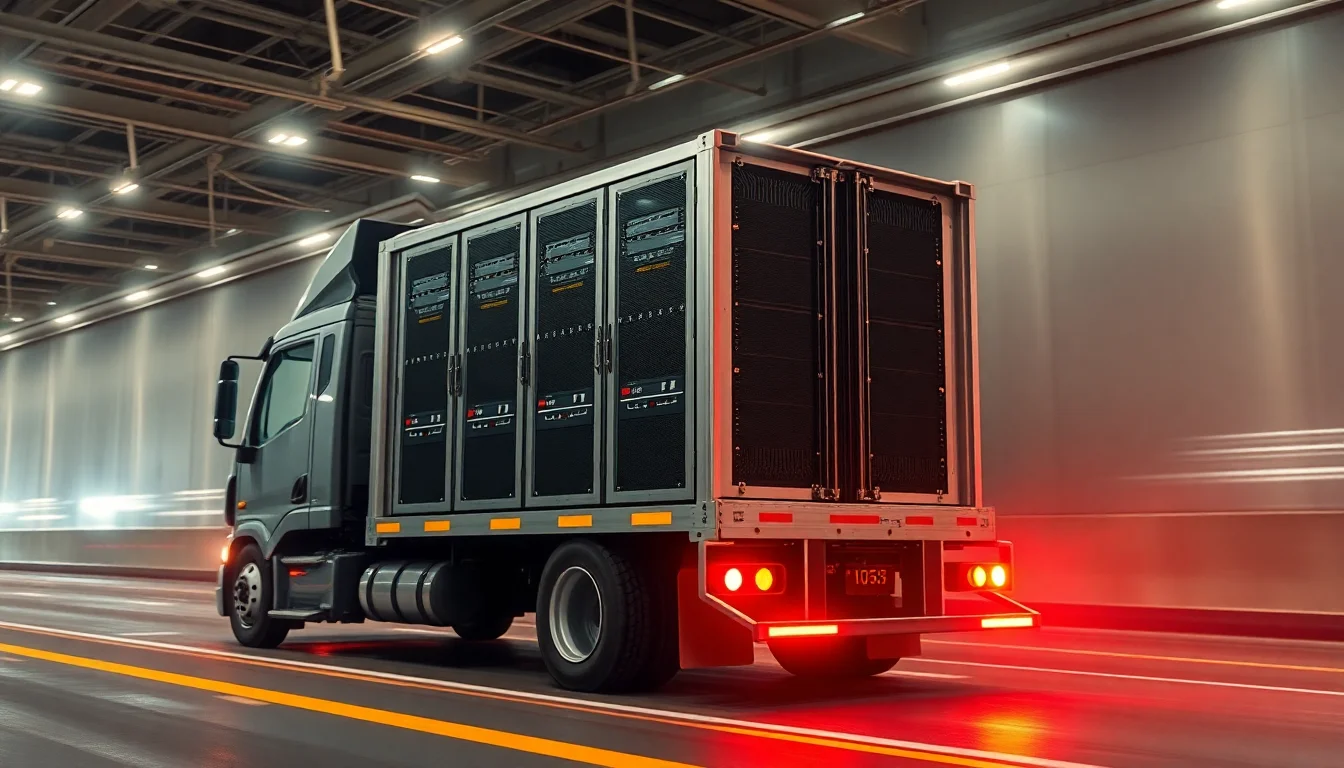
The shipping paradox threatening AI deployment
The industry’s default answer to faster AI rollout is straightforward: build the rack, load it up, and ship it intact. That works on paper because it shortens integration time at the destination. But a June 22 opinion in Robotics & Automation News points to the part of the pipeline that is getting too little attention: once AI infrastructure becomes a finished object moving across roads, runways, and oceans, logistics itself becomes a reliability event.
That matters because these are not light, forgiving assemblies. Fully assembled, heavyweight AI racks now commonly travel in the 3,000- to 8,000-pound range, carrying dense compute, power, cabling, and mounting hardware. The concern is not obvious catastrophic breakage. It is hidden microdamage from shock and vibration — the kind that may not stop a rack from powering on, but can still erode reliability, introduce intermittent faults, or shorten the time before failure.
For robotics deployments, that changes the operational math. The fastest route to production is no longer simply assembly speed or datacenter readiness. It is the integrity of the system after it has been handled by forklifts, loaded into trailers, flown on aircraft, transferred at hubs, and stabilized again on arrival.
Where the microdamage hides: the physics of transport
The transport environment is harsher than many deployment plans assume. A rack can experience different stress profiles on a truck than in air freight, and a different combination again at sea. Each mode introduces shocks, vibration, tilting, braking loads, and handling events that propagate through chassis, rails, connectors, boards, and mounting interfaces.
The key failure mode is cumulative. A single hit may not be enough to produce a visible defect. But small shifts in connectors, solder joints, card seating, cabling strain, or frame alignment can compound. A system that arrives apparently intact may still have suffered enough stress to become less tolerant of thermal cycling, repeated vibration, or routine maintenance.
That is what makes the problem so easy to underestimate. Logistics teams are trained to look for visible damage, crushed packaging, or outright loss. AI infrastructure needs a higher standard: it has to survive not just delivery, but delivery plus immediate deployment plus prolonged service with no latent transport-induced degradation.
The Robotics & Automation News piece frames this directly as a hidden vulnerability in the supply chain for AI infrastructure. The reporting premise is simple but important: if the rack is already assembled and heavily populated before shipment, then the rack is no longer just a product. It is a fragile integrated system in motion.
Why now: robotics deployments are increasing exposure
This is becoming more urgent because robotics adoption is increasing the number of places where AI compute has to be installed quickly and reliably.
Autonomous mobile robots need supporting infrastructure in warehouses. Smarter industrial robots depend on vision systems and local or edge compute. Logistics automation and defense applications are pulling AI into environments where uptime is closely tied to deployment velocity. In each case, organizations are asking for shorter lead times and more repeatable rollouts.
That raises exposure in two ways. First, more racks are moving through more routes, which increases the number of times the transport chain can introduce damage. Second, the tolerance for surprises is falling. If an AI rack arrives with a subtle fault, the schedule impact is not just a failed asset; it can mean delayed commissioning, repeated diagnostics, spare-part pulls, and postponed site acceptance.
In other words, the transport risk is no longer a back-office logistics issue. It is now a gating factor for reliability and deployment timelines.
What the market should infer from this
The practical implication is that AI infrastructure teams need to treat transport as part of the product lifecycle, not as a handoff after the real engineering work is done.
That has consequences for packaging, design, and procurement. Ruggedized packaging is not a cosmetic upgrade; it is part of the reliability stack. Shock isolation has to be engineered for the actual movement profile of multi-modal freight, not for a generic pallet drop. Modular rack architecture becomes more attractive because it can reduce the amount of delicate, fully integrated hardware exposed to shipment risk. And vendors that can prove transport robustness may gain an edge simply because they reduce commissioning uncertainty.
The same logic applies to supply-chain governance. If a rack supplier can assemble faster but cannot demonstrate how it handles transit stress, the apparent speed advantage can disappear in downstream delays. A few days saved in fabrication are easy to erase with a failed acceptance test after shipment.
For robotics teams trying to scale deployments, the lesson is blunt: transport-grade engineering is now deployment-grade engineering.
Mitigations teams can adopt now
There are concrete steps engineers and logistics teams can take without waiting for a new industry standard.
- Add shock-logging to every shipment. Place calibrated shock and vibration loggers inside racks or packaging so the receiving team can compare actual transit exposure with tolerance thresholds.
- Specify transport-tested packaging, not just protective packaging. Packaging should be validated against the real combination of road, air, and sea handling expected for the route.
- Move toward modular and repairable rack architectures. If a system can be broken into subassemblies or isolated modules, it is easier to reduce exposure and easier to repair after transit inspection.
- Standardize in-transit acceptance criteria. Teams should define what counts as a pass or fail before the shipment leaves the factory, including inspection steps for connectors, mounts, boards, and frame alignment.
- Use vibration and drop testing as part of qualification. If a rack is going to travel in a loaded state, qualification should simulate the transport envelope, not just bench operation.
- Align contracts with ruggedization expectations. Procurement language should require transport-grade performance data, acceptable shock limits, and clear responsibility for packaging and route-sensitive handling.
The broader point is not that fully assembled racks should stop moving. They are going to move, because deployment speed still matters. The point is that shipping them intact is not the same as shipping them safely. If the industry wants faster AI rollout without hidden reliability penalties, it has to design for the journey as aggressively as it designs for the destination.


