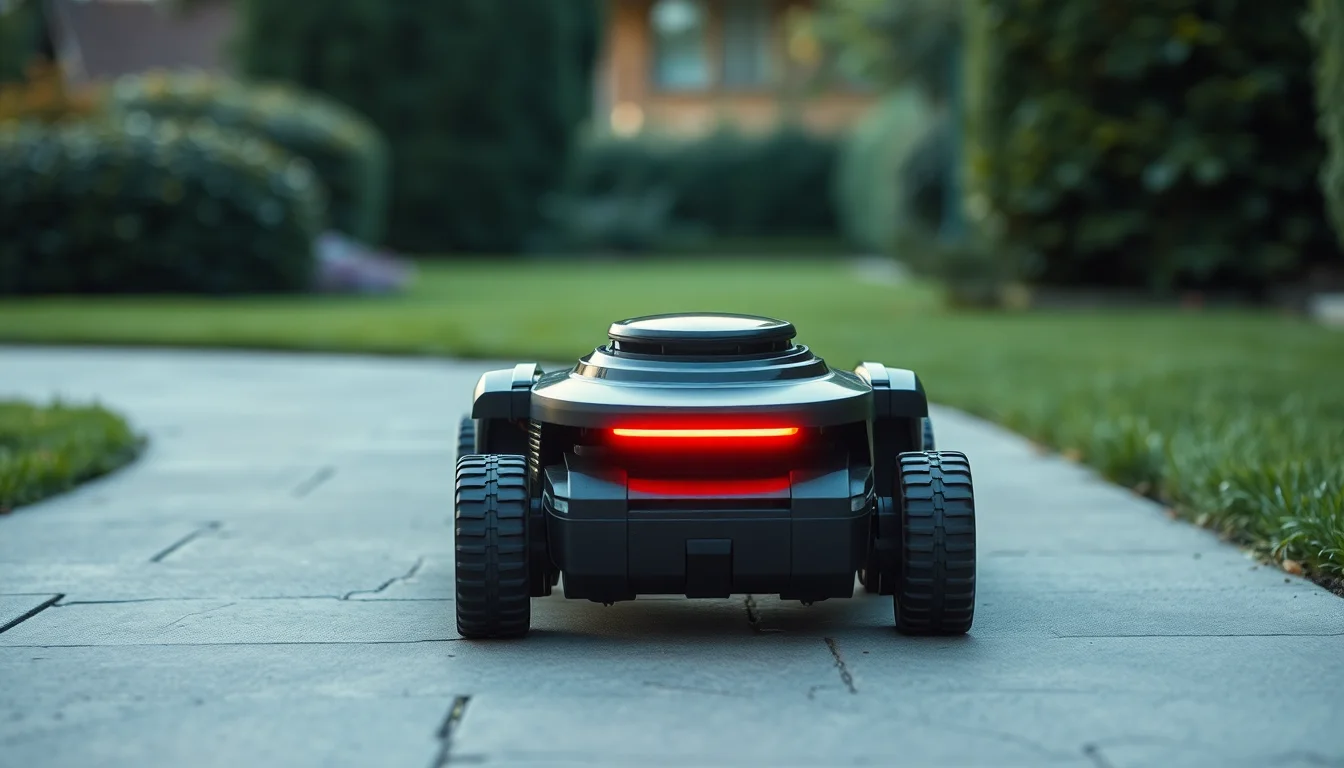
Ranking, in brief:
- Best overall: [Model name from Wired review] — the strongest balance of mapping, edge handling, and low-touch operation, with the fewest interventions once it was set loose.
- Best for complex yards: [Model name from Wired review] — the most capable where terrain and obstacles made route planning harder, but it asked more of the user up front.
- Best budget pick: [Model name from Wired review] — good enough for simpler lawns, but its autonomy and recovery behavior showed why the category still commands a premium.
Wired’s 2026 robot lawn mower field is notable for what it no longer is: a novelty demo disguised as home automation. The decisive change this year is not that the machines cut a little cleaner or ship with a more polished app. It is that the better models behave more like constrained autonomy systems than perimeter-following gadgets. That changes the buying calculus immediately. A robot mower is only worth its premium if it can repeatedly map, navigate, recover, and finish a job without turning the owner into a remote operator. In 2026, the best ones are getting closer to that threshold.
I’m deliberately putting autonomy first because that is where the category now lives or dies. A mower can have a slick interface, a good-looking dock, and a long feature list, and still fail the basic test if it misses strips, hesitates at edges, loses the boundary, or needs intervention every few runs. In practice, the product is not the blade deck. It is the control stack: perception, localization, path planning, obstacle handling, and recovery when the world is messier than the map.
What changed in 2026: autonomy, not just convenience
The most important shift in this class is that the better mowers no longer depend so heavily on old-school perimeter setup or highly managed lawns. The newer generation leans on stronger sensing and mapping so they can understand where they are, where they have been, and what they should avoid without constant boundary babysitting. That matters because the real world is not a flat rectangle.
In Wired’s testing, the quality gap showed up in observable behavior: whether a mower kept its lines across long runs, whether it handled dock recovery cleanly, whether it consistently recognized obstacles instead of nudging into them, and whether it needed human help after routine disruptions. Those are not cosmetic differences. They are the difference between an appliance you trust to run while you do something else and one you supervise like a very expensive pet.
That is why the 2026 class feels like a maturity jump. The market is still expensive, but the better machines are beginning to earn the right to be judged like robotics products, not just lawn accessories.
The engineering stack behind the better mowers
Robot mower performance is a systems problem. The cutting hardware matters, but it is usually not the limiting factor. What determines whether a mower feels robust is the stack underneath it:
- Perception: Can it detect obstacles reliably enough to avoid collisions and awkward reroutes?
- Localization: Does it know where it is on the lawn after turns, reboots, or boundary crossings?
- Path planning: Can it cover the yard without leaving persistent missed strips or doubling back inefficiently?
- Recovery logic: When it gets stuck, can it back out, reorient, and continue without a human rescue?
- Dock behavior: Does it return and recharge consistently, or does it drift around the yard like it forgot the assignment?
These are the mechanisms that separate a promising demo from a usable domestic robot. A lot of the category’s marketing still frames this as “smart” mowing, but that word hides the hard part. Smart is not the same as resilient. A mower that looks intelligent in a controlled video can still fail on irregular ground, around tree roots, along sloped edges, or near narrow passages where path planning becomes less forgiving.
That is also why the newer technical advances matter more than app polish. An elegant app cannot make a mower recover better from a stuck event. A pretty dashboard cannot compensate for weak edge detection or inconsistent mapping. The technical moat is in the machine’s ability to maintain autonomy in imperfect conditions.
Why setup friction is still the real product moat
If there is one thing that still exposes the immaturity of the category, it is setup. The best robot mower is not just the one that cuts well; it is the one that gets through installation and calibration with the least friction, and then keeps requiring the least attention over time.
That includes the boring but decisive stuff: laying boundary wires if needed, defining no-go zones, tuning edge behavior, teaching the mower where the dock lives, and resolving the places where the yard’s real geometry does not match the product’s assumptions. This is where many of the costs of domestic robotics surface. Not in the purchase moment, but in the hours spent turning a backyard into a machine-readable environment.
Wired’s 2026 testing makes that point plain. The stronger mower was the one that needed fewer workarounds once deployed; the weaker ones were the ones that looked easier on paper but demanded more human oversight when the lawn got complicated. That is a meaningful distinction because buyers often overvalue advertised autonomy and undervalue setup burden. In this category, setup is not ancillary. It is part of the product.
The practical deployment constraints are also hard to ignore. Real yards have irregular terrain, wet grass, edges that drop off or feather into gardens, loose debris, toys, branches, and periods of weather that can change traction or visibility. A robot mower has to handle all of that while remaining safe around people and pets. Even a good system will still need supervision at times, and the best models are the ones that reduce those check-ins rather than eliminating them entirely.
Cost, compute, and the economics of domestic robotics
The premium on robot mowers is easy to criticize until you break down what buyers are paying for. They are not just buying a motor and a blade; they are buying sensors, onboard compute, control software, and the integration work that makes those pieces behave like a consumer appliance instead of a hobby robot.
That cost structure is why the 2026 winners remain expensive. Better autonomy is not free. More capable navigation and recovery logic take hardware and software investment, and the category is still early enough that manufacturers are pricing in the difficulty of making all of it reliable enough for mass-market homes.
So the real comparison is not mower versus mower. It is autonomy premium versus labor savings.
If a model reduces the amount of edging, rescue, and relaunching you have to do, the value proposition becomes easier to defend. If it still requires periodic babysitting or fails in the parts of the yard that matter most, the premium starts to look like an unpaid robotics tax. That is the tension Wired’s 2026 rankings surface: the best units are becoming genuinely convenient, but the category as a whole is still asking buyers to pay up for reliability that is not yet universal.
What this signals about the broader robotics market
Robot mowers are a useful bellwether because they operate in one of the hardest consumer robotics environments: outdoors, semi-structured, variable, and full of edge cases. If a mower can survive that context with less supervision, it tells you something about where embedded autonomy is becoming practical beyond the lab and beyond tightly constrained demos.
The broader signal is not that consumer robots are suddenly ready for general intelligence. It is the opposite: the products that are shipping successfully are the ones that get very good at a narrow job in a difficult environment. That is an important lesson for the rest of the home robotics market. Robust autonomy beats flashy claims. Reliable recovery matters more than aspirational AI. And products that can tolerate the real world, rather than merely model it, are the ones that cross from gadget to appliance.
That is why 2026 feels like a turning point. Robot lawn mowers are still expensive, and they still have clear failure modes. But the better ones are now credible enough that the debate is no longer whether the category exists. It is whether the autonomy is robust enough to justify the premium.
For buyers, the answer depends on the yard and the tolerance for intervention. If you have a simple, open lawn and want the most affordable entry, the budget pick is the one to consider. If your property is irregular, obstacle-heavy, or forces the mower to navigate difficult edges, the more capable complex-yard model is the safer bet despite the setup burden. And if you want the best chance of a genuinely low-touch experience, the overall winner is the one that proved most consistent in navigation, recovery, and edge behavior. The one not worth the premium is the mower that still makes you manage the autonomy yourself.