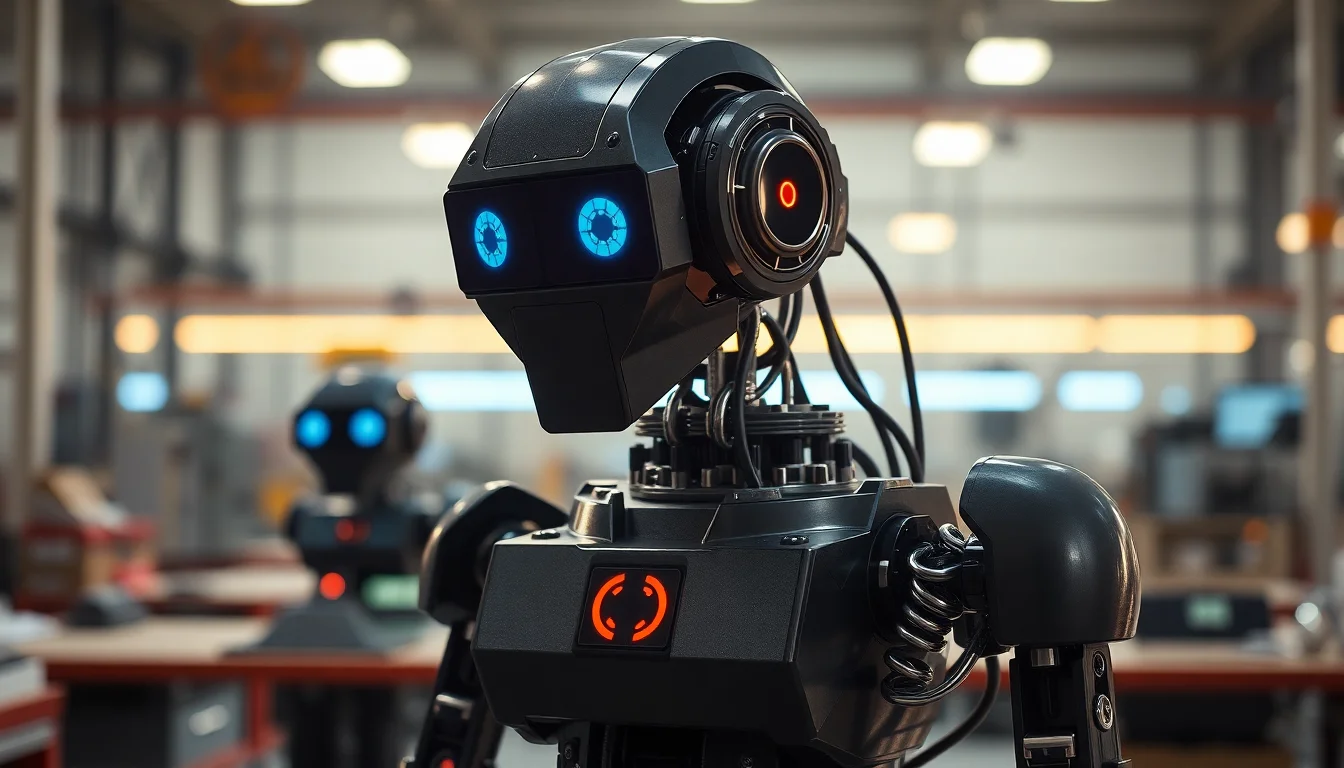
Theker’s $85M bet on modular factory robots tests whether generalist automation can finally work
Theker’s $85 million Series A is more than a financing milestone. It is a direct challenge to one of industrial automation’s oldest assumptions: that the best robot is the one built for one narrow job and tuned to do it forever.
The round, led by CRV with Samsung and Aglaé Ventures among the backers, gives the Madrid-based startup unusually strong early validation for a company pushing a modular, reconfigurable factory robot rather than a fixed-purpose machine. TechCrunch reported that the raise is the largest robotics Series A in Europe, a signal that investors are no longer treating configurable automation as a niche idea but as a potentially new category.
That matters because factory automation has long been optimized around specialization. A robot arm, gripper, camera system, and control stack are typically selected for a defined workflow: pick, place, weld, pack, sort. Theker is arguing that this model breaks down in real plants, where product mix changes, packaging shifts, and labor bottlenecks often appear in tasks that are similar enough to automate but different enough to make single-task systems brittle.
Why this round matters now
The timing suggests the market is testing a different thesis about automation adoption. Manufacturers want faster deployment and less integration friction, but they also want systems that can be redeployed when a line changes or a contract manufacturer adds a new SKU. In that environment, a generalist factory robot has an obvious appeal: one platform, many tasks, less stranded hardware.
Theker’s funding also reflects a broader investor view that robotics is moving from demo-driven novelty toward operational software and systems engineering. Backers such as Samsung and Aglaé Ventures are not just buying into a mechanical concept; they are betting that the software stack, deployment tooling, and commercial model can support enterprise-grade use cases. The presence of Inditex as an early backer adds another important signal: the company is being judged in the context of real industrial workflows, not only logistics showpieces.
What Theker is actually building
According to TechCrunch’s reporting, Theker’s robots are designed around interchangeability. Hands, arms, and even the form factor can be swapped or resized depending on the job, allowing a single system to be reconfigured for different tasks such as sorting packages, packing clothing, or handling bottles and cans.
That modularity is the point. It shifts the product proposition away from “robot trained for task X” and toward “robot platform that can be adapted for task X, Y, or Z.” In theory, that should let customers spread capital across a reusable base platform instead of buying separate machines for each workflow.
But the hardware is only half the story. If the mechanical modules are easy to swap but the software layer is slow to validate, expensive to tune, or fragile under real-world variation, the economics fall apart. Generalist automation only works if the system can switch tasks predictably, maintain performance across changing conditions, and integrate cleanly into plant control systems without a team of specialists standing beside it.
That is the key distinction between a modular machine and a genuinely reconfigurable one. The former is physically flexible. The latter is operationally flexible.
Where the economic case could work
The strongest argument for Theker’s approach is not that it eliminates specialization, but that it may reduce the number of specialized assets a factory needs to buy and maintain.
If a factory can use one robot platform across multiple product variants, the benefits could be straightforward:
- lower capex per task over time
- less idle hardware when one line changes or pauses
- faster redeployment between workcells
- shorter lead times for new automation projects
- better utilization of each robot across variable demand
That logic becomes especially attractive in environments where manual labor is still used for many repetitive but not perfectly uniform tasks. Retail fulfillment, packaging, and light manufacturing often feature enough commonality across workflows to make shared hardware plausible, but enough variation to frustrate traditional fixed automation.
Still, the ROI case depends on more than unit economics on a slide. A modular robot that requires extensive setup, custom fixturing, or frequent human intervention can erase savings quickly. In practice, the comparison is not just against labor. It is against mature single-purpose automation that may be less glamorous but is deeply optimized for uptime and throughput.
In other words, Theker does not need to prove that generalist robots are more capable in the abstract. It needs to prove they are more economical after you account for installation, changeover, retraining, maintenance, and downtime.
The harder problem: reliability at scale
Industrial buyers are usually willing to trade flexibility for certainty. That makes reliability the central technical hurdle for a reconfigurable robot platform.
A factory can tolerate a pilot that works 80% of the time if it lives in a lab. It cannot tolerate a production line that misses shift targets because a vision model drifts, a tool swap is inconsistent, or a task adaptation fails on edge cases. The more varied the task set, the more likely the system will encounter corner cases that reveal gaps in sensing, grasping, motion planning, or safety logic.
This is where modular robotics gets hard. Each additional configuration adds another set of validation problems. Each new tool, hand, or arm geometry expands the surface area for failure. The software stack has to reason not only about the task but about the current physical configuration of the robot and the downstream effects on precision, cycle time, and safety.
That means the company’s success will depend on an unusually strong combination of capabilities:
- robust task adaptation across variants
- standardized hardware interfaces
- low-friction deployment and calibration
- plant-friendly monitoring and diagnostics
- safety assurances that satisfy industrial customers
Without those pieces, modularity can become another form of complexity rather than a reduction in it.
Standards and interoperability will decide how far this goes
Theker’s pitch also raises a broader ecosystem question. If reconfigurable robots are to move beyond bespoke pilots, the industry will need more standardization around mechanical interfaces, software orchestration, and system integration.
Industrial customers do not buy robots in isolation. They buy cells, software, sensors, conveyors, and support contracts that must work together inside existing operational constraints. If a modular robot platform cannot plug into those environments cleanly, the promise of flexibility will be offset by integration overhead.
That is particularly important in manufacturing, where downtime is expensive and change control is conservative. Even a technically impressive robot may struggle to scale if customers perceive the deployment process as risky or too dependent on vendor-specific tuning.
Theker’s challenge, then, is not just to show that a robot can be reconfigured. It is to show that reconfiguration can happen within a predictable operational envelope that factory managers can trust.
How Theker fits the competitive landscape
Theker is entering a field crowded with different automation philosophies. Traditional industrial robotics still dominates tasks that can be tightly defined. Humanoid startups are pursuing a different bet: preserve human-like mobility and try to fit robots into human-built spaces. Theker sits between those worlds, arguing that the better approach may be a purpose-built industrial platform that is flexible without trying to mimic a person.
That positioning could be strategically useful. Humanoids attract attention, but they also inherit the complexity of bipedal balance, human-scale manipulation, and uncertain production economics. Task-specific industrial robots are proven, but they can be expensive to customize and hard to redeploy. A modular generalist robot offers a middle path if it can achieve enough flexibility without inheriting the full complexity of humanoid systems.
The next phase will be about proof, not narrative.
Investors will want to see customer pilots turn into repeat deployments. Manufacturers will look for clear KPIs: cycle time, uptime, error rates, time-to-reconfigure, and payback period. Systems integrators will want evidence that the platform can fit into existing plant software and hardware without endless custom work. And safety and compliance will matter more, not less, as the robots move from controlled demonstrations into real production environments.
What to watch next
Theker’s financing gives it room to move quickly, but the market will judge it on a narrow set of milestones.
The most important questions are whether the company can:
- prove that one platform can handle materially different tasks without major performance degradation
- shorten deployment time enough to justify the modular approach
- demonstrate consistent ROI versus single-purpose automation
- reduce the integration burden on factory customers
- build a software layer that makes reconfiguration operationally routine rather than exceptional
If those pieces come together, Theker could help compress the timeline to multi-task automation across factories that have historically been too variable for conventional robotics. If they do not, the company risks becoming another example of a technically elegant system that is difficult to operationalize at industrial scale.
For now, the Series A says something important even before the product is fully proven: investors are willing to back the idea that factory robots should be built less like appliances and more like platforms. Theker has been given enough capital to test whether that idea is ready for production lines, not just pitch decks.


