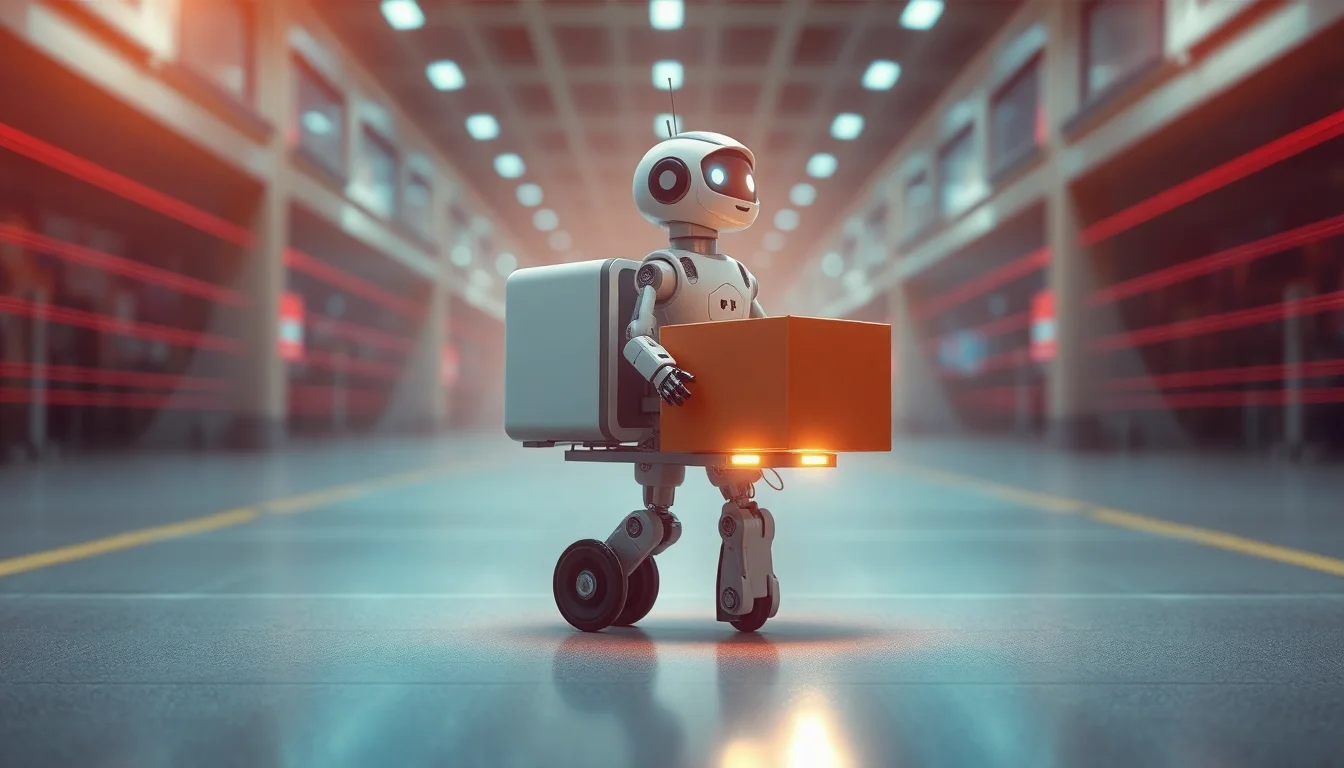
Modern automation is no longer just software orchestrating back-office work. The more consequential shift is physical: systems that can perceive an environment, plan around it, and act in it without constant human intervention. That is why delivery robots are starting to look less like a novelty and more like infrastructure.
What changed is not a single breakthrough but a stack of them. Sensors are cheaper and better. Localization and mapping have become more reliable in cluttered indoor and semi-structured spaces. Planning systems can handle dynamic routing and task allocation with more confidence. And control loops are finally good enough to make autonomous navigation practical outside carefully staged demos. The result is a class of robots that can move through hospitals, warehouses, retail floors, and campus environments as part of an operating model rather than as a side experiment.
From pilot to platform
For years, delivery robots were easy to admire and hard to justify. They worked in bounded pilots, often with heavy operational support, and the business case depended on narrow assumptions about traffic patterns, site layout, and labor substitution. That is beginning to change as the technology matures into a platform problem rather than a one-off robotics project.
The key inflection is real-world operability. If a robot can navigate reliably, recover from routine exceptions, and integrate into an enterprise workflow, it stops being an isolated gadget and becomes a node in a broader automation architecture. That matters because companies do not buy autonomy for its own sake. They buy throughput, consistency, and the ability to extend automation beyond digital tasks into physical execution. In that sense, delivery robots are one of the clearest examples of end-to-end automation moving from concept to deployment.
The technical stack underneath the promise
The technology story is best understood as three coupled layers: perception, planning, and control.
Perception covers the robot’s ability to sense and interpret the environment. In practice that means lidar, cameras, depth sensing, and the software needed for localization, mapping, and obstacle detection. The bar is not perfect understanding; it is robust enough understanding to make safe decisions in messy, changing spaces.
Planning sits above that. This is where route selection, multi-robot coordination, task allocation, and exception handling happen. A delivery fleet in a hospital or retail chain is not just a set of mobile assets. It is a scheduling and dispatch problem with physical constraints, service-level commitments, and human traffic patterns layered on top.
Control closes the loop. It translates plans into motion while preserving safety margins, stopping behavior, and recovery logic when the world deviates from expectation. This is where many deployments still fail in practice: not because the robot cannot move, but because it cannot move predictably enough under load.
The maturation of these perception planning and control stacks is what has made deployment more feasible. As these components become more modular and more testable, teams can validate them separately, simulate edge cases earlier, and build a more defensible reliability envelope before rollout.
Why the economics are tightening
The commercial logic is straightforward, even if the ROI is not universal. Labor costs keep rising in many deployment categories, while labor availability remains uneven. At the same time, last-mile operations are still expensive, operationally brittle, and difficult to scale cleanly when demand spikes or shift coverage becomes thin.
Delivery robots do not eliminate those constraints, but they can compress the payback window when the environment is suitable and the workflow is well integrated. The strongest cases tend to be repetitive, short-horizon, and operationally structured: internal delivery in healthcare, item movement inside warehouses, store-to-floor replenishment, campus transport, or controlled last-mile handoffs in logistics.
What matters is not simply replacing human movement with machine movement. It is reorganizing the workflow so that autonomy handles the predictable segments while staff focus on exceptions, supervision, and higher-value interactions. In that model, the financial value comes from throughput, coverage, and consistency rather than from a simplistic headcount substitution story.
Deployment models are evolving accordingly. The more successful approaches are modular and service-oriented: robots as part of a managed fleet, software exposed through APIs, fleet supervision tools tied into enterprise systems, and support contracts that shift the burden of uptime and maintenance away from the customer. That platformization is important because it turns delivery into a repeatable operating layer instead of a bespoke integration project.
What AI teams need to build for
For product and engineering teams, the lesson is that delivery robots should be designed like enterprise systems with embedded autonomy, not like isolated hardware products.
First, interoperability matters. The robot stack needs clean interfaces into WMS, ERP, dispatch, ticketing, and identity systems. If a robot cannot receive tasks from the systems that already coordinate operations, it becomes a parallel process instead of a productive one.
Second, architecture should stay modular. Perception, planning, and control should be separable enough to test, swap, and update without destabilizing the whole fleet. That is especially important as teams tune behavior across different sites, floor plans, and operating conditions.
Third, simulation-first validation should be a default, not an afterthought. Before physical rollout, teams need a way to stress-test navigation policies, routing logic, stop-and-go behavior, and fallback states across synthetic environments that resemble the real deployment. That reduces the cost of discovering safety issues after the hardware is already on-site.
Fourth, observability is non-negotiable. A delivery robot program should generate operational telemetry that lets teams understand failure modes: where localization degrades, when path planning becomes brittle, how often a human intervenes, and which environments trigger slowdowns. Without that data, every site becomes a guess.
The risks are real, and they shape adoption
The path to scale is still constrained by safety, security, and regulation.
Perception systems can struggle in cluttered, noisy, or visually ambiguous environments. Human behavior is variable, especially in shared spaces where the robot must yield, pause, or reroute without creating friction. Cybersecurity also matters: a fleet that is connected to enterprise systems and remote operations tools is part of the attack surface, not separate from it.
There are also regulatory and policy differences by sector and geography. Healthcare corridors, retail spaces, sidewalks, campuses, and warehouses do not carry the same tolerance for autonomy. That means the near-term market will likely fragment by use case, with the fastest adoption in controlled environments and the slowest in fully public ones.
Data governance is another underappreciated issue. Delivery robots often collect environmental data, video, operational logs, and route histories that may intersect with privacy rules, workplace monitoring concerns, and customer data policies. Companies that treat those datasets casually will face avoidable deployment friction.
What to watch in the next 18 to 24 months
The strongest signal that this sector is moving beyond pilots will be platform consolidation. Winners will not just field robots; they will expose standardized interfaces, fleet tooling, and integration patterns that make deployment repeatable across sites.
Cross-sector partnerships are another tell. When robotics vendors, enterprise software providers, and service operators start bundling capabilities around logistics, healthcare, and retail workflows, it usually means the category is shifting from product novelty to workflow infrastructure.
Watch too for better data reuse. If one deployment can inform another through shared maps, policy tuning, simulation assets, and operational metrics, the economics improve rapidly. That is how delivery robots move from single-site experiments to scalable automation layers.
Over the next 18 to 24 months, the key question is not whether delivery robots can move packages. It is whether organizations can mature their tech stacks fast enough to integrate autonomous navigation, perception planning and control stacks, and enterprise workflow systems before the market settles around competing platform architectures.
That is why delivery robots matter now. They are one of the first autonomy products forcing companies to operationalize AI in the physical world at scale, and that makes them a test case for the next phase of modern automation.


