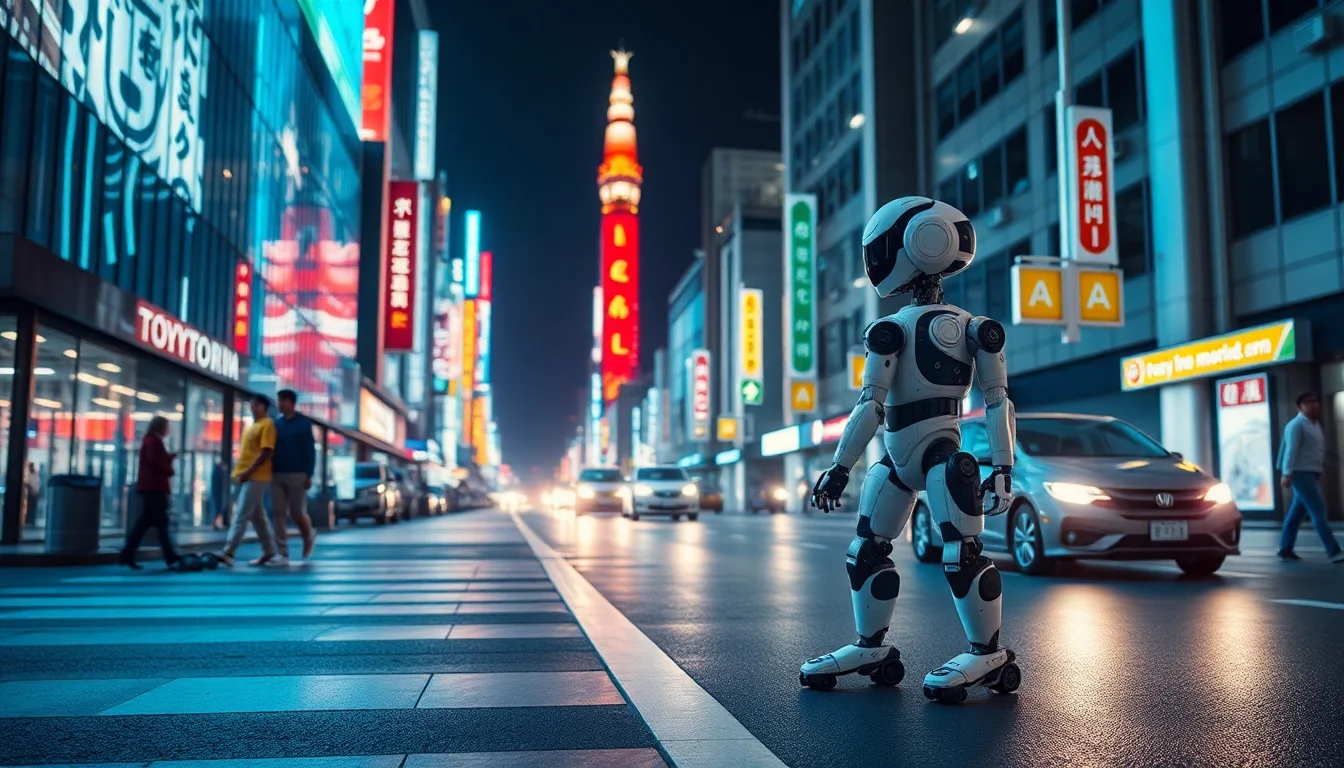
Tokyo is starting to look less like a venue for tech spectacle and more like a proving ground for whether AI can survive contact with the physical world.
That distinction matters. For the last several years, much of the AI conversation in the West has centered on model capability curves, benchmark climbs, and product launches that are impressive in isolation but still far from operational reality. Tokyo’s signal in 2026 is different. At SusHi Tech Tokyo, the center of gravity is not a polished demo booth or a slide deck about future autonomy. It is the floor: interactive robots that people can approach, vehicles being discussed as software-defined platforms, and sessions that bring together Nvidia, AWS, automakers, and venture investors around the question that actually determines adoption—what it takes to deploy at scale.
That shift from proof-of-concept to infrastructure is why Tokyo matters now.
Change on the showroom floor
SusHi Tech Tokyo is notable not because it showcases AI and robotics, but because it stages them in a context that resembles deployment rather than theater. The robots are not described as museum pieces behind glass. They are on the floor and interactive. The conversation around mobility is similarly concrete: Nissan, Isuzu, and Applied Intuition’s Qasar Younis are part of a discussion about software-defined vehicles, which reframes the car as a continuously updatable compute platform rather than a fixed mechanical product.
That distinction is more than semantic. Once a vehicle becomes software-defined, the architecture changes. Compute moves closer to the edge, update pipelines become part of the product lifecycle, and fleet management becomes a software problem with hardware constraints. In other words, the deployment surface expands. Tokyo is valuable because it is forcing that conversation in public, with actual operators and platform vendors in the same room.
The same is true in robotics. The important question is no longer whether a robot can perform a task in a controlled environment. It is whether it can operate reliably in a busy urban setting, alongside people, in a system that includes logistics, maintenance, safety, and policy oversight. That is a deployment problem, not a research problem.
The stack that enables scale
The technical backbone of Tokyo’s appeal is the stack underneath the demos.
Sessions featuring Howard Wright of Nvidia and Rob Chu of AWS are a market signal in themselves. They suggest that the center of gravity is moving toward edge-to-cloud orchestration: workloads that need low-latency inference locally, continuous model updates from the cloud, and infrastructure capable of supporting heterogeneous devices across fleets. For AI builders, this is where the real architecture decisions live. The difference between a prototype and a deployable system often comes down to where inference runs, how telemetry is collected, how failures are handled, and how quickly the cloud can push updates without breaking edge reliability.
Tokyo’s ecosystem appears to be organized around exactly those tradeoffs. Hardware–software co-design is not an abstract preference; it is a requirement for systems that have to function in the field. A robot or vehicle that depends on a model alone is brittle. A robot or vehicle designed with embedded sensing, robust telemetry, edge compute, secure update channels, and cloud-based fleet management is a platform.
That is why the presence of Nvidia and AWS matters. They are not just sponsors or observers. They are infrastructure signals. Nvidia represents the acceleration of AI workloads at the edge and in the datacenter; AWS represents the operational layer that makes fleet-wide orchestration and data pipelines possible. When both appear in the same deployment conversation as automakers and robotics operators, the market is telling you where scale is likely to come from: not from isolated product wins, but from integrated systems.
The automotive component reinforces the point. Software-defined vehicles are not merely a car-industry buzzword. They are one of the clearest examples of a deployment platform for AI because they combine sensing, actuation, communications, diagnostics, and recurring software updates in a constrained but high-value environment. If a company can make software-defined mobility work in Tokyo—where density, regulation, and operational expectations are high—it can port lessons into logistics, industrial automation, and eventually other urban infrastructure.
Resilience-first investment as a deployment multiplier
Tokyo’s importance is also tied to where capital is flowing.
The event’s emphasis on resilience, cyber defense, and climate-tech investment suggests that deployment in Tokyo is not being funded as optional experimentation. It is being funded as infrastructure with failure modes that matter. Eva Chen of Trend Micro and NEC’s Noboru Nakatani are part of the cyber-defense discussion, which is a reminder that as AI systems move into public environments, security becomes a primary design constraint rather than an afterthought.
That matters for urban deployments because the attack surface grows with every connected sensor, fleet endpoint, update mechanism, and vendor integration. A robot fleet or vehicle platform is only as resilient as its weakest link across identity management, data governance, patching, and incident response. In a city context, those gaps are not theoretical. They can become operational or public-safety issues quickly.
The climate-tech side of the conversation is equally important. Investors associated with Breakthrough Energy and Cleantech Group examining capital flows signal that resilience is being treated as a deployment multiplier. Urban AI systems are easier to justify when they address problems cities already have: energy efficiency, infrastructure monitoring, disaster response, transportation optimization, and operational continuity under stress. Funding in this category does not just support clean tech. It supports the governance, maintenance, and risk tolerance required for city-scale rollout.
That is a more disciplined funding lens than the one that often accompanies AI hype cycles. Capital is not chasing novelty for its own sake. It is underwriting systems that can survive regulatory scrutiny, cyber threats, and physical-world variance.
What product teams need to change
For builders, Tokyo’s lesson is uncomfortable but useful: model quality alone is not enough.
If your product is heading toward fleets, facilities, vehicles, or civic infrastructure, then your roadmap needs to account for deployment physics. That means designing for edge constraints, not assuming cloud connectivity. It means treating update management, observability, rollback, and safety validation as core product features. It also means acknowledging that hardware–software co-design is not optional once the system leaves the lab.
Teams that still organize around a “model first, ops later” mentality will struggle in this environment. In a deployment-first market, the product is the system: sensors, compute, software, services, support, governance, and maintenance. Fleet-wide value comes from repeatability, not from one-off technical elegance.
Software-defined vehicles make that especially clear. A vehicle program built for the old world—static hardware, slow iteration, limited telemetry—cannot absorb AI workloads in the same way as a platform designed for continuous software evolution. The same principle applies to robotics in warehouses, city services, or infrastructure inspection. If the control loop is slow, the product will not scale.
Tokyo’s ecosystem is effectively a stress test for those assumptions. It rewards teams that can prove durability, not just accuracy.
Market positioning and the competitive map
For global vendors, Tokyo is becoming a benchmark for where enterprise AI is heading in Asia.
Nvidia, AWS, automakers, robotics companies, and venture investors are not assembling around Tokyo by accident. Their presence suggests a market where platform alignment matters as much as product differentiation. If you are a model provider, middleware vendor, or hardware startup, the question is not simply whether you can sell into Japan. It is whether your stack integrates into a deployment environment that expects reliability, compliance, and operational support from day one.
That creates a useful pressure test for go-to-market strategy. Partnerships are not cosmetic in this market; they are distribution, validation, and integration all at once. A vendor that can work with cloud infrastructure providers, edge compute leaders, and OEMs has a different path to scale than one relying only on direct sales or developer enthusiasm.
Tokyo may also become a blueprint for other Asian cities that are trying to modernize mobility, public services, and resilience systems without inheriting the inefficiencies of older technology stacks. The implication for global vendors is straightforward: if your product cannot fit a deployment-led ecosystem in Tokyo, it may face similar friction elsewhere.
Risks and execution gaps to watch
The strongest argument for Tokyo is also the clearest warning.
Deployment-first ecosystems raise the stakes for governance, cybersecurity, and regulation. Public-facing AI systems expose vendors to data-handling requirements, incident response expectations, safety validation standards, and procurement scrutiny that are often easier to ignore in pilot-heavy markets. The more an AI product touches mobility or urban infrastructure, the less room there is for ambiguity about accountability.
Cyber risk is especially acute. Connected fleets and robotic systems are attractive targets because they combine software complexity with real-world impact. If update pipelines are weak, if identities are poorly managed, or if telemetry is insufficient for detecting anomalies, the system can fail in ways that are expensive and visible.
Regulatory alignment is the other constraint. Cities and operators may be willing to experiment, but they still need systems that can be explained, audited, and maintained. That means documentation, controls, and governance frameworks have to be part of the product, not a legal patch added later. In Tokyo, that may be one reason resilience-oriented investment is so important: it gives deployment teams the capital and operating discipline to address those requirements before they become blockers.
For AI builders and investors, the broader lesson is this: Tokyo is not important because it is fashionable. It is important because it is exposing the technical and organizational conditions under which AI actually scales in the world. If your product depends on those conditions, this is the market to study. If your roadmap assumes them away, Tokyo will show you the gap.


