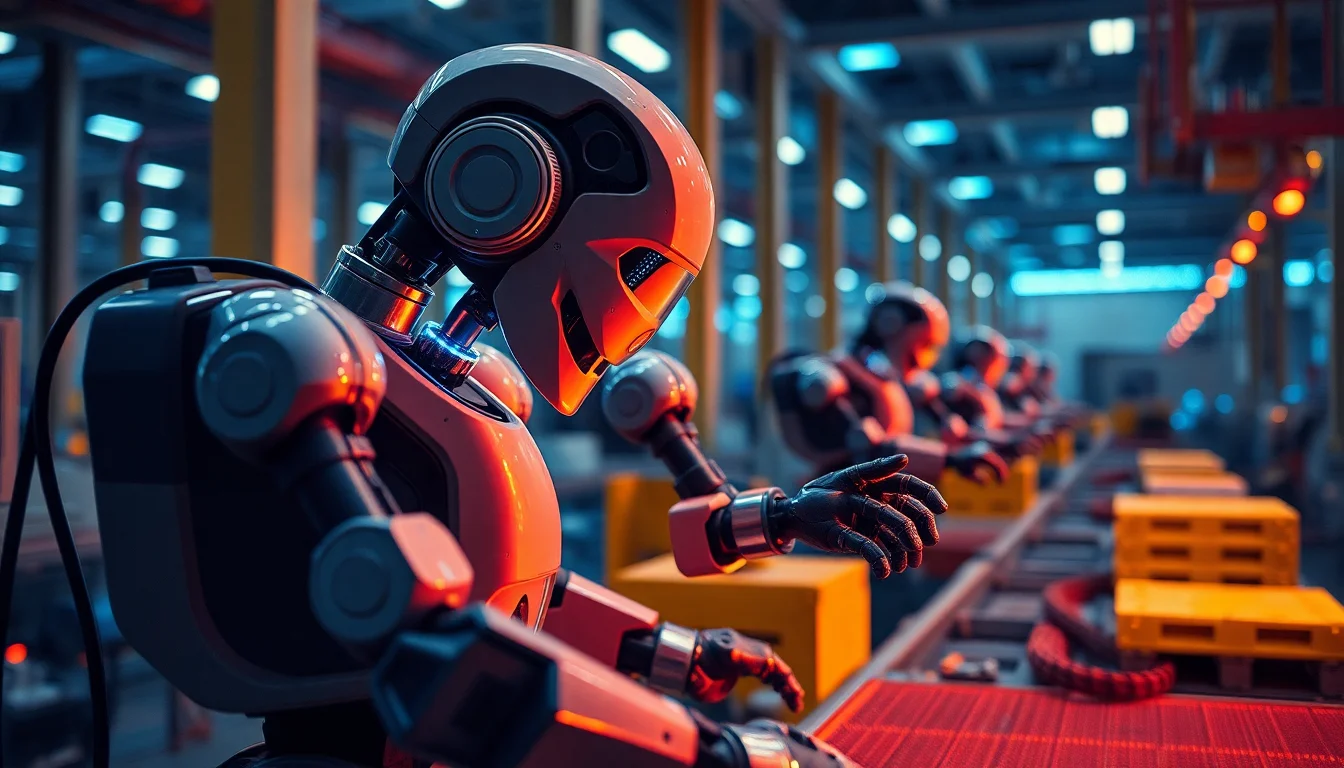
Workr Robotics and the end of embodied-AI wishful thinking on the factory floor
The latest inflection point in industrial automation is not about whether robots can think. It is about whether they can do one specific job, every time, for an entire shift.
That distinction matters because the center of gravity in manufacturing is moving away from embodied AI hype and back toward the kind of engineering that has always decided whether automation survives contact with the floor: repeatability, uptime, integration, and failure behavior. In an interview this week, Workr Robotics CEO Ken Macken argued that the industry’s headline-grabbing advances in large models and general-purpose robotics are still a long way from solving the day-to-day problem manufacturers actually pay to remove. Operators want reliability and exact task performance, not a system that is impressive in a lab and brittle in production.
That is a useful correction to the current mood. The public narrative around robotics has been pushed by demonstrations of increasingly capable systems, by collaborations between major AI and robotics players, and by the idea that embodied intelligence will eventually generalize from one physical task to another. But factories do not reward future potential. They reward deterministic throughput, measurable quality, and the ability to run through the same motions under the same constraints, hour after hour.
Reliability is now the product
Macken’s framing is important because it shifts the technical bar from “can the system reason?” to “can the system be trusted?” Those are very different engineering problems.
In a manufacturing setting, reliability is not a vague slogan. It means a robot or automated system can complete a narrowly defined task across a full shift, across a range of environmental variation, with a low and measurable error rate. It means the vendor can explain the failure modes, bound them, and provide a fallback when the system encounters an edge case. It means the integration does not turn the customer’s existing line into a science project.
That has immediate implications for testing. A vendor cannot simply show a successful demo run and call it ready for deployment. Production systems need validation against the conditions that matter: shift length, part variability, lighting changes, upstream and downstream timing drift, operator intervention, maintenance windows, and the consequences of a missed pick, misalignment, or collision. The relevant question is not whether a model can infer an intention from a prompt or a sensor stream. It is whether the workflow holds up in a deterministic way when the line is under load.
This is why exact task performance has become a better metric than general capability. Manufacturers are increasingly looking for systems with clear service-level expectations, explicit tolerances, and observable performance over time. A robot that is 95% competent in a demo can still be unusable if the other 5% creates downtime, rework, or safety risk. On a factory floor, small errors compound quickly.
Workr Robotics’ hourly model matches how buyers now think
Workr Robotics’ answer to this environment is to sell automation by the hour. That sounds simple, but it is strategically aligned with how enterprise buyers assess risk.
Hourly pricing shifts automation from a capex-style bet on a machine’s open-ended potential to an operating expense tied to visible output. If the system is billed against time or usage, then the vendor has a direct incentive to keep the automation working reliably and to focus on practical, repetitive tasks where the economics are legible. It also makes the value proposition easier to compare against manual labor, overtime, and temporary staffing in settings where throughput matters more than autonomy theater.
That model is not a declaration that every customer problem can be abstracted into a metered service. It is, however, a sign that the market is moving toward narrower claims and more disciplined deployment. In that framework, the important promise is not that the robot can adapt to anything. It is that the robot can do one thing well enough to justify itself over time.
For many manufacturers, that is a more credible path to ROI than a generalized AI robotics stack that needs to prove itself in production before it can be trusted in production. The economics of hourly automation also make failure easier to price. If the system does not deliver, the customer is not left holding a large sunk-cost asset that underperforms outside the demo environment.
Roadmaps are becoming modular, not monolithic
The technical and commercial logic here points in the same direction: product roadmaps are likely to favor composable, validated modules rather than monolithic “thinking” machines.
That means vendors need to think in terms of bounded capabilities. A robust robotic system may combine perception, motion planning, task orchestration, and human oversight, but each layer needs measurable behavior and clear interfaces. The value is not in claiming that one model can do everything. The value is in composing a system where every component has known limits and where the full stack can be monitored.
Observability becomes a product feature, not an afterthought. Operators need to see why a task failed, how often it failed, what changed in the environment, and whether the system recovered without human intervention. Strong integration matters just as much: if automation cannot sit cleanly beside existing PLCs, MES software, sensors, safety systems, and maintenance routines, then it adds complexity rather than removing it.
That is also why “validated” matters so much. In this phase of the market, vendors that can prove performance under defined conditions will have an easier time than those selling a broad story about intelligence. The industry is becoming less tolerant of ambiguity in exchange for capability claims.
What operators should watch next
For buyers, the practical question is how to tell whether this shift is real.
The first metric is uptime, but not as a vanity number. The useful version is shift-level uptime: how often the system remains operational across the actual hours it is expected to produce value. The second is per-task accuracy, measured against the business impact of each failure mode. A system may be technically impressive and still be a poor fit if it introduces rework, inspection overhead, or safety supervision costs.
Throughput per shift is the next check. If a vendor promises automation by the hour, operators should ask how many completed cycles the system delivers under real constraints, and how that changes when the line is noisy, variable, or partially staffed. Maintenance cadence matters too. If a robot requires frequent human tuning to stay on task, the economics can unravel quickly.
Finally, total cost of ownership needs to include integration and monitoring, not just the price of the machine or the hourly fee. A cheaper system that demands constant troubleshooting is expensive in practice. The winners in this market are likely to be the ones that reduce variability, not merely the ones that showcase the most sophisticated AI stack.
The semantic pivot that matters
The deeper shift here is semantic but consequential: the industry is moving from asking whether robots are intelligent to asking whether they are dependable.
That pivot changes what gets funded, what gets deployed, and how vendors position themselves. In a reliability-first market, hype about embodied AI is not enough. General-purpose aspirations may still shape long-term research agendas, but near-term purchasing decisions will be governed by measurable outcomes: repeatability, price predictability, and the ability to run a task all day without turning the line into a debugging session.
Workr Robotics’ hourly model is one expression of that reality. It reflects a market that is increasingly skeptical of grand claims and more interested in whether automation can justify itself in the language factory operators already use: uptime, throughput, quality, and cost per task. That is a narrower conversation than the one embodied AI tends to inspire, but it is the one that decides what ships.


