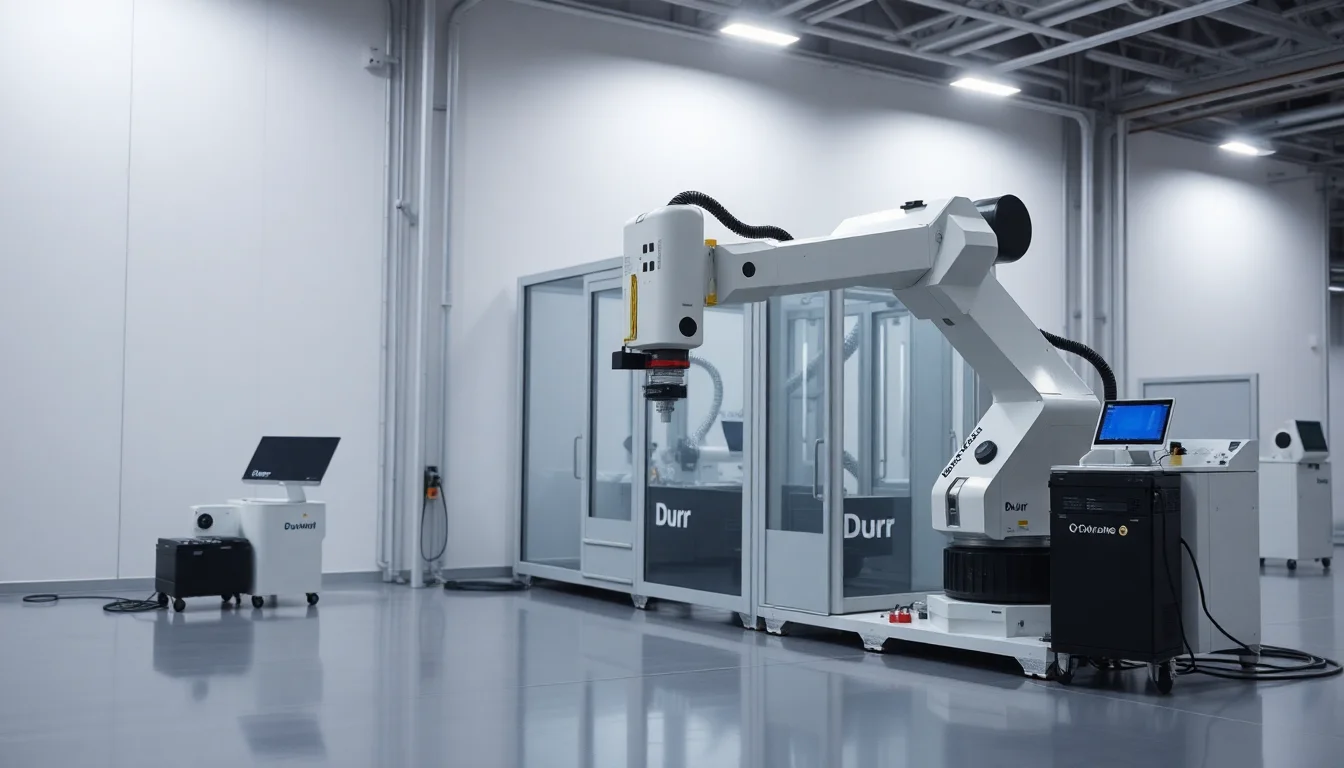
Dürr’s latest paint robot is notable less for a headline-grabbing speed claim than for a structural one: it changes the arm geometry. The company’s EcoRP4 swaps the familiar six-axis symmetry of its predecessor, the EcoRP E/L x33iC, for an asymmetric architecture that is explicitly tuned for high-volume, standardized automotive painting lines.
That may sound like a minor mechanical revision. In a paint shop, it is not. Dürr says the compact robot’s new geometry improves access to the body for the applicator and helps it reach hard-to-access interior areas more reliably. In the narrow world of car-body painting, where coverage, reach and consistency matter as much as cycle time, that kind of reach change can influence both the layout of a line and the maintenance burden that comes with running it.
A geometry rethink: EcoRP4 redefines painting-line economics
The EcoRP4’s central design idea is to rework the arm geometry around the task rather than preserve a generic six-axis form factor. Dürr frames the result as an asymmetric arm arrangement that opens up access to interior areas of the body while also reducing the number of components in the robot itself.
That component reduction matters because paint lines are not simple robot cells. They are dense, uptime-sensitive production systems where every added part is another part that may need inspection, calibration or replacement over a long operating life. By lowering parts count, Dürr is signaling that the robot’s economics are supposed to improve through simpler upkeep, not just through a different motion envelope.
The company positions EcoRP4 as a successor to the six-axis EcoRP E/L x33iC, which makes the design shift more explicit. This is not a new family of robots entering a new application; it is a rethinking of how the robot should be shaped for a very specific industrial job.
Design for deployment: flexible mounting for diverse paint shops
Dürr is also pairing the new geometry with a broader deployment model. The EcoRP4 can be integrated into paint shops as a floor-mounted robot, a tower installation, or on linear rails.
That flexibility is important because automotive paint operations are rarely identical from one plant to the next. Some lines are purpose-built, while others have to fit into older layouts or mixed production environments. A robot that can be mounted in multiple ways gives plant engineers more room to work around space constraints, body variants and line geometry without redesigning the entire cell around the machine.
For technical buyers, the value of that modularity is less about elegance and more about retrofit logic. A robot that can be positioned on the floor, elevated on a tower, or deployed along a rail can be matched more closely to the physical demands of the line. That broadens the addressable use case beyond a single fixed installation pattern.
Economic calculus: parts, maintenance, and the ROI question
Dürr’s economic argument rests on two linked claims: fewer components and improved access. The first should reduce maintenance demands; the second should help the robot do its work in places that are traditionally harder to serve without awkward motion planning or additional mechanical complexity.
The company is careful to tie the design to lower maintenance requirements and operating costs, especially for manufacturers with high production volumes. That is a plausible fit for standardized automotive painting lines, where even small reductions in downtime, service labor, or spare-parts complexity can matter across a large installed base. But the launch material does not supply hard performance figures, so the ROI case remains directional rather than quantified.
That distinction matters. In a process environment like paint application, buyers will want evidence that a simpler arm geometry does not introduce new service constraints, calibration issues or workflow friction elsewhere in the line. The promise of reduced maintenance is meaningful, but it is also the kind of claim that has to survive long-term plant operation before it becomes accepted practice.
AI-ready robotics: what EcoRP4 enables in the control stack
Dürr has not disclosed any new AI features for the EcoRP4, and it would be wrong to infer capabilities the company has not claimed. Still, the hardware choice is relevant to the software stack.
A robot that is easier to deploy across floor, tower and rail configurations and that is designed around a more task-specific geometry can be a cleaner foundation for process control software, simulation and digital-twin work. In paint operations, those layers often depend on stable mechanical assumptions: reachable surfaces, repeatable motion envelopes and predictable maintenance windows.
If the EcoRP4 delivers what Dürr says it is built for, the most immediate software implication is not autonomous painting intelligence but better control of a standardized process. That could support tighter process tuning, more consistent line behavior and, over time, more useful predictive-maintenance models because the machine architecture itself is simplified.
The key point is that this is an enabling architecture, not a fully described AI product. Its relevance to AI lies in how it may reduce mechanical uncertainty in a system that future control software has to manage.
Market timing and risk: 2027 launch amid an AI/robotics rollout
Dürr says the EcoRP4 is slated for a market launch in 2027, which gives the company time to validate the platform and gives buyers time to compare it against existing six-axis solutions and any newer competitors that emerge before then.
That timing also reflects the broader direction of the automotive manufacturing market. Plants are still pushing for high-volume, standardized lines, but they are also looking for automation that is easier to maintain and integrate into increasingly software-defined operations. A robot that promises a lower component count and multiple mounting options fits that direction, even if the business case will still depend on site-specific integration work.
The risks are familiar ones: adoption will hinge on demonstrated reliability, the practical cost of integration, and whether the new geometry actually simplifies life in the field once it is installed in real paint shops. A 2027 launch means those questions are not yet answered. What Dürr has done is to make the mechanical architecture itself the argument.
For an industry that has spent decades standardizing around six-axis robots, that is the more interesting move. EcoRP4 suggests that the next round of improvement in paint automation may come not from adding complexity, but from removing it in the right places.


